How to Develop a Premium Sweatshirt: Fabric, Fit, MOQ and Sampling
Written by Aimee Xiang
Founder of Kellogg Fashion
Focused on heavyweight apparel manufacturing, fabric engineering, garment development, quality control, and scalable production.
Introduction
Finding a custom sweatshirt manufacturer is not simply a matter of comparing unit prices.
For established and growing apparel brands, the real objective is to find a manufacturing partner capable of translating an approved product direction into consistent commercial production.
That requires control across four connected areas:
- Fabric development
- Minimum order quantity
- Sample approval
- Bulk production
A premium sweatshirt may look simple, but its finished quality depends on fabric construction, pattern engineering, rib recovery, shrinkage control, sewing, decoration and finishing. If these elements are not defined during development, inconsistencies are likely to appear when the product moves into bulk production.
This guide is intended for fashion brands, private-label businesses and wholesalers that already have a defined product direction, reference garment, technical specification or established market. It explains what to evaluate when selecting a custom sweatshirt manufacturer for a serious production program.
What Does Custom Sweatshirt Development Include?
A custom sweatshirt manufacturer produces garments according to a brand’s own specifications rather than supplying only standard blank products.
Depending on the project, custom development may include:
- Fabric composition and GSM
- French terry or brushed fleece construction
- Custom fabric colour
- Oversized or structured fit
- Garment measurements
- Neckline and rib dimensions
- Embroidery, appliqué or printing
- Garment dyeing or vintage washing
- Custom neck and care labels
- Hangtags and packaging
- Pre-production approval
- Bulk production and quality control
The manufacturer’s role is not only to sew the garment. It is to convert the brand’s creative and technical requirements into a repeatable production specification. Brands ready to move from planning into sampling can explore our custom sweatshirt manufacturing capabilities for fabric selection, fit development and bulk production.
For premium sweatshirts, this is particularly important because small differences in fabric density, shrinkage, neckline construction or rib recovery can noticeably change the appearance and fit of the finished product.
Brands evaluating different suppliers should therefore look beyond basic factory capacity. Our guide to choosing the right clothing manufacturer for a premium fashion brand explains the broader criteria that should be considered before beginning development.
Custom Sweatshirt Manufacturing Starts With a Clear Product Brief
A productive development process normally begins with clear project information.
This may include:
- Tech pack
- Reference garment
- Measurement chart
- Fabric composition
- Target GSM
- Pantone colour
- Artwork files
- Decoration dimensions
- Label specifications
- Planned order quantity
- Size range
- Target delivery date
- Destination market
A physical reference sample can be especially useful when fabric hand feel, fit and garment structure are difficult to communicate through images alone.
For sweatshirts that are already selling, choose a reference from an approved production batch and identify any changes separately. Our guide to transferring existing apparel production explains how to preserve the original fit while reviewing fabric and construction improvements.
A manufacturer can recommend technical solutions, but the brand should still define the commercial direction of the product. For example, “a premium oversized sweatshirt” is not yet a complete production specification.
The manufacturer still needs to understand:
- How oversized should the fit be?
- Should the garment feel soft and relaxed or dense and structured?
- Is the sweatshirt intended for year-round use or a colder season?
- Is the interior French terry or brushed fleece?
- Should the surface be clean and compact or washed and aged?
- What is the target retail positioning?
- What quantity is planned for each colour?
Clear information allows the manufacturer to recommend fabrics and construction methods that match the actual product rather than developing through repeated guesswork.
1. Choosing the Right Fabric for a Custom Sweatshirt
Fabric has the greatest influence on the weight, structure, comfort and perceived quality of a sweatshirt. Similar development principles also apply to other heavyweight products. Learn more about custom heavyweight apparel development from fabric selection through sampling and bulk production.
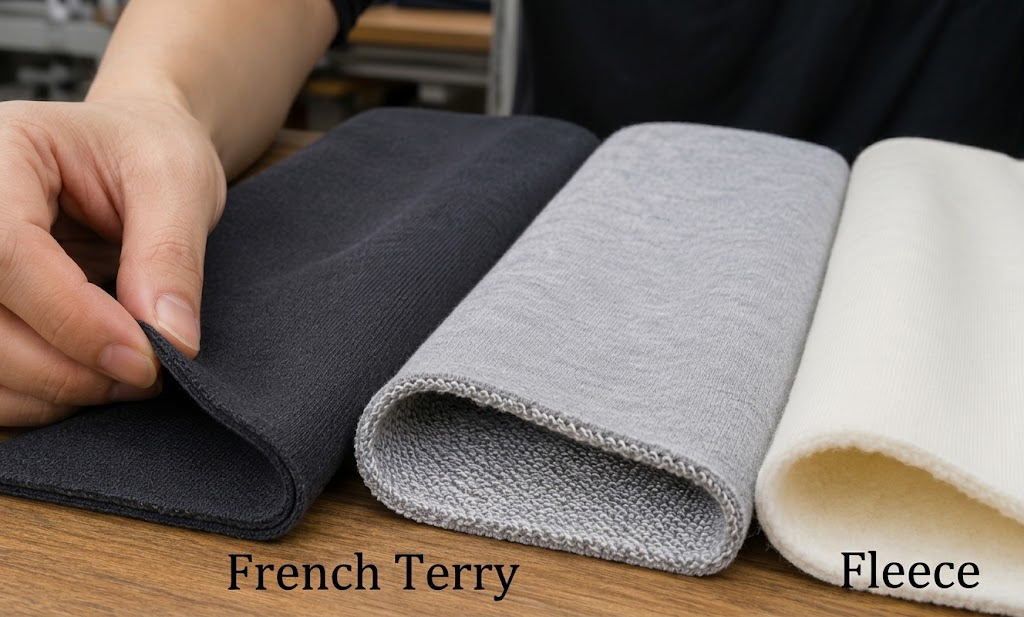
Two fabrics with the same GSM can still produce completely different garments. GSM only describes fabric weight per square metre. It does not fully define:
- Yarn quality
- Knitting density
- Fibre composition
- Surface appearance
- Interior construction
- Stretch and recovery
- Shrinkage
- Pilling performance
- Finishing
- Hand feel
For this reason, an experienced custom sweatshirt manufacturer should discuss fabric construction and performance rather than recommending fabric based on GSM alone.
French Terry vs Brushed Fleece
French terry, also known as loopback fabric, has visible loops on the interior.
It can provide:
- A clean premium interior
- Better breathability
- A substantial but less insulated feel
- Good suitability for transitional or year-round collections
- A fabric that may soften and develop character with wear
Brushed fleece is mechanically brushed on the interior to create a softer and warmer surface.
It can provide:
- A soft interior hand feel
- Greater warmth
- A fuller and more insulated sensation
- Strong suitability for autumn and winter collections
- A familiar premium sweatshirt feel
Neither construction is automatically superior. The correct option depends on the brand’s intended product, climate, customer expectations and desired wearing experience.
Cotton and Cotton-Blend Sweatshirt Fabrics
A high-cotton fabric can provide a natural surface, soft hand feel and premium appearance. However, cotton content alone does not guarantee better performance.
Cotton-polyester blends may be used when the product requires:
- Improved dimensional stability
- Better shape retention
- Additional durability
- More controlled shrinkage
- Greater recovery
The appropriate composition should be selected according to the product objective. A manufacturer should be able to explain why a particular fibre composition is being recommended rather than presenting composition as a marketing number.
What GSM Is Suitable for Premium Sweatshirts?
Premium sweatshirts may use a wide range of fabric weights depending on their intended structure.
As a general product-development reference:
- 320–380 GSM: substantial but relatively versatile
- 400–460 GSM: heavyweight with stronger structure
- 480–600 GSM: very heavyweight and more specialised
Higher GSM does not automatically mean higher quality.
An overly heavy fabric may create unnecessary stiffness, affect drape, increase shrinkage risk or make the finished garment unsuitable for the target climate. Fabric density, yarn, finishing and pattern engineering are as important as weight.
Brands comparing heavyweight fleece options can also review the differences between 400 GSM, 450 GSM and 500 GSM hoodies. Although the article focuses on hoodies, the same fabric principles are relevant to heavyweight sweatshirt development.
2. Fabric Performance Must Be Evaluated Before Bulk Production
A fabric should not be approved only because the first swatch feels good.
For commercial production, relevant fabric characteristics may include:
- Actual GSM
- Composition
- Width
- Colour consistency
- Shrinkage
- Spirality or twisting
- Pilling resistance
- Stretch and recovery
- Surface appearance
- Interior finish
- Hand feel after washing
Shrinkage is particularly important for sweatshirt production.
Changes in body length, sleeve length, chest width or neckline shape can alter the complete fit of the garment. The manufacturer may need to consider expected fabric behaviour when developing patterns and finished measurements.
If a sweatshirt will be garment dyed, enzyme washed or vintage washed, the material should be evaluated together with the intended finishing process. Fabric performance before washing may not represent the final garment result.
Premium heavyweight garments also introduce additional technical requirements. A dense 500 GSM fabric cannot always be handled in the same way as a standard lightweight fleece. More information is available in our guide explaining why heavyweight apparel production requires more than a standard clothing factory.
3. How MOQ Works in Custom Sweatshirt Manufacturing
MOQ means minimum order quantity, but it should not be evaluated as one isolated number.
A custom sweatshirt order may involve minimum quantities at several levels:
- Minimum quantity per style
- Minimum quantity per colour
- Minimum fabric dyeing quantity
- Minimum custom rib quantity
- Minimum label or packaging quantity
- Minimum quantity for specialised washing
- Minimum quantity for custom trims
For a practical quantity and size example, see how to plan a 200-piece custom apparel order by style, color and size.
A manufacturer may technically be able to sew a small number of garments, but that does not mean every fabric, colour, trim or finishing process is commercially practical at that volume.
Why Colour Quantity Affects MOQ
Each additional colour may require separate:
- Fabric sourcing or dyeing
- Cutting
- Thread matching
- Rib matching
- Embroidery or print setup
- Washing batches
- Quality inspection
- Packing
For example, one style produced in one colour is operationally different from the same total quantity divided across five colours.
Brands should therefore ask:
What is the MOQ per style and per colour for this exact specification?
This is more useful than asking only for the factory’s lowest possible MOQ.
MOQ Should Match the Product Complexity
A basic sweatshirt made from an available stock fabric may support a different minimum quantity from a sweatshirt requiring:
- Custom-developed fabric
- Custom-dyed colour
- Special rib construction
- Large appliqué
- Multi-position embroidery
- Garment dyeing
- Vintage washing
- Custom metal trims
- Special packaging
The more specialised the product, the more important it becomes to plan a commercially viable quantity.
For brands developing repeat collections, the objective should not be to force every process into the smallest possible order. It should be to establish a quantity that supports consistent materials, reliable production and a viable landed cost.
4. What Information Is Needed for an Accurate Sweatshirt Quotation?
A serious quotation requires more than a front-view image.
To provide meaningful pricing, a custom sweatshirt manufacturer normally needs to know:
- Garment style
- Fabric composition
- Target GSM
- Fabric construction
- Colour quantity
- Order quantity per colour
- Size breakdown
- Garment measurements
- Construction details
- Printing or embroidery requirements
- Artwork dimensions and placement
- Washing or dyeing process
- Labels and trims
- Packaging requirements
- Delivery destination
Price can change significantly according to the specification.
For example, a 460 GSM brushed fleece sweatshirt with a simple chest embroidery cannot be accurately compared with a 500 GSM garment-dyed sweatshirt featuring large appliqué, custom rib and multiple labels.
If the product has not yet been fully sampled, the first quotation may need to be treated as an estimate based on the available specifications. Final bulk pricing should reflect the approved fabric, construction, decoration and finishing.
This protects both the brand and the manufacturer from building a production agreement around an incomplete product definition.
5. The Custom Sweatshirt Sampling Process
Sampling is the stage where the product specification is tested as a physical garment.
The objective is not simply to produce one attractive piece for photography. A development sample should help confirm whether the intended product can move into repeatable commercial production.
A typical sampling process may include the following stages.
Step 1: Project Review
The manufacturer reviews:
- Tech pack
- Reference sample
- Fabric requirements
- Measurements
- Artwork
- Quantity
- Timeline
- Special construction or finishing
At this stage, unclear or conflicting specifications should be identified before material preparation begins.
Step 2: Fabric and Colour Confirmation
The brand may review:
- Available fabric options
- Custom-developed fabric
- Colour cards
- Lab dips
- Fabric swatches
- Surface and interior finish
Fabric should ideally be confirmed before precise artwork placement and appliqué dimensions are finalised, especially when fabric weight and garment drape affect the finished appearance.
Step 3: Pattern Development
The pattern is developed according to the approved measurements, fit direction and fabric behaviour.
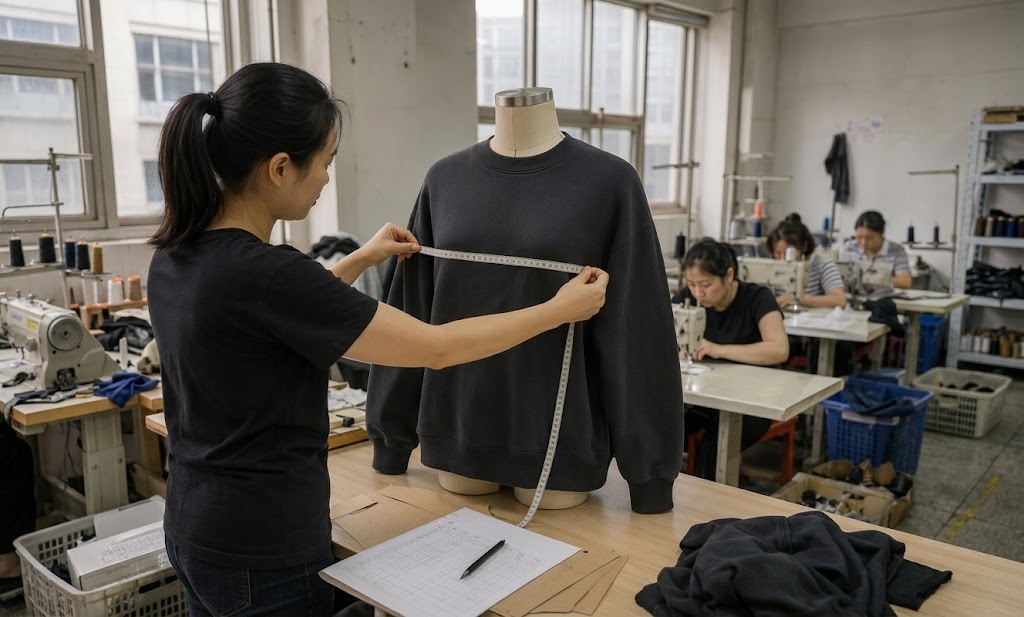
For an oversized sweatshirt, pattern development may involve more than increasing the chest width. The manufacturer may also need to balance:
- Shoulder width
- Armhole depth
- Sleeve volume
- Body length
- Hem width
- Neck opening
- Rib dimensions
- Overall proportion
A well-balanced oversized fit should look intentional rather than simply oversized in every measurement.
Step 4: Sample Construction
The first development sample allows the brand and manufacturer to review:
- Fit
- Measurements
- Fabric
- Construction
- Neckline shape
- Rib recovery
- Decoration
- Labels
- Overall hand feel
If substitute materials are used during an early prototype, that should be clearly identified because the final fabric may change the fit and appearance.
Step 5: Sample Review and Revision
Feedback should be consolidated and measurable.
Instead of saying “make the sweatshirt slightly more premium,” useful comments might include:
- Increase chest width by 2 cm
- Reduce body length by 1.5 cm
- Move embroidery 1 cm toward the centre
- Increase neck rib height to 3 cm
- Use a denser fabric with a cleaner outer surface
- Reduce sleeve opening
- Adjust shoulder slope
Consolidated feedback reduces unnecessary sample rounds and helps maintain a clear development history.
Step 6: Pre-Production Approval
Depending on the project, a pre-production sample may be required after the fabric, measurements, decoration, labels and finishing are finalised.
This sample becomes an important reference for bulk production.
Changes made after final sample approval can affect pricing, lead time and production consistency. Brands should therefore stabilise the specification before authorising bulk manufacturing.
For a practical example of this process across multiple coordinated products, see our premium heavyweight collection development case study, covering T-shirts, hoodies, sweatshirts and sweatpants from sampling and revision through approval and bulk production.
6. How Long Does Custom Sweatshirt Sampling Take?
Sampling time depends on the product specification.
Important variables include:
- Whether the fabric is available
- Whether a custom colour is required
- Pattern complexity
- Artwork approval
- Embroidery or printing
- Custom labels and trims
- Washing or dyeing
- Number of revision rounds
- Speed of brand feedback
A straightforward sample using an available fabric will normally move faster than a garment requiring custom knitting, custom dyeing, specialised appliqué and multiple finishing processes.
Shipping time should also be separated from actual development time.
Brands with a fixed launch date should work backward from:
Required delivery date → Shipping → Bulk production → Pre-production approval → Sample revisions → Fabric and colour development
For a more detailed planning framework, see our guide to clothing manufacturing lead times from sampling to bulk production.
7. Moving From Approved Sample to Bulk Production
Approving one sweatshirt does not automatically guarantee consistent bulk production.
Bulk manufacturing introduces:
- Multiple fabric rolls
- Larger cutting quantities
- Size assortments
- Repeated sewing operations
- Decoration batches
- Washing or finishing batches
- Packing requirements
The manufacturer therefore needs to convert the approved sample into controlled production information.
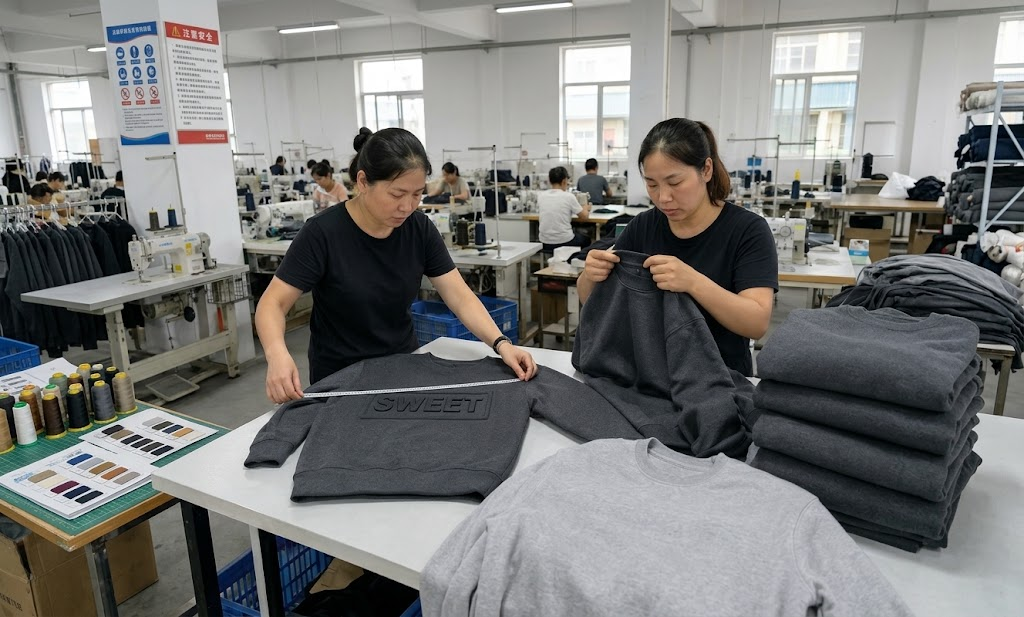
This may include:
- Approved fabric specification
- Approved colour reference
- Final pattern
- Graded size measurements
- Measurement tolerances
- Construction details
- Artwork dimensions
- Decoration placement
- Label positions
- Wash reference
- Packing instructions
Brands can learn more about these variables in our article on why bulk production quality can differ from approved samples.
Our sample-to-bulk apparel production case study also shows how KELLOGG controlled fabric, fit, workmanship and quality checkpoints after sample approval.
8. Quality Control in Sweatshirt Production
Quality control should take place throughout production rather than only after every garment has been completed.
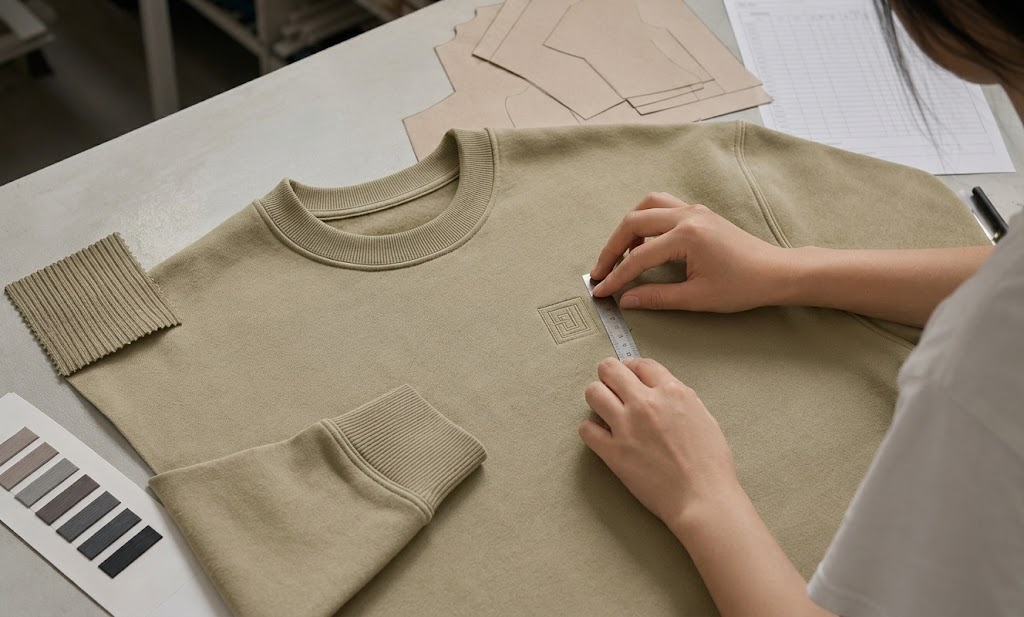
Relevant checkpoints may include:
Fabric Inspection
The manufacturer checks relevant fabric characteristics before cutting, including colour, visible defects, width and specification consistency.
Cutting Control
Fabric relaxation, pattern version, grain direction, panel alignment and size identification can all affect the finished garment.
Sewing Inspection
Important sweatshirt construction points may include:
- Neckline shape
- Shoulder seams
- Sleeve attachment
- Side seams
- Rib alignment
- Seam allowance
- Stitch tension
- Decoration placement
Measurement Inspection
Measurements may be checked during production against the approved size specification and tolerance.
Decoration Inspection
Embroidery, printing and appliqué should be checked for:
- Dimensions
- Colour
- Placement
- Density
- Registration
- Puckering
- Adhesion
- Overall appearance
Finishing and Final Inspection
After washing or finishing, garments may be checked for:
- Final measurements
- Colour consistency
- Hand feel
- Surface appearance
- Workmanship
- Labels
- Stains
- Packing accuracy
Our detailed article on how clothing manufacturers control quality in bulk production explains how these checkpoints work across the manufacturing process.
9. What Premium Brands Should Expect From a Sweatshirt Manufacturer
A suitable manufacturing partner should be able to discuss more than unit price.
For premium custom sweatshirt production, brands should evaluate whether the manufacturer can:
- Recommend fabric according to product positioning
- Explain fabric construction and composition
- Develop structured or oversized fits
- Anticipate shrinkage and finishing behaviour
- Produce clean embroidery, printing or appliqué
- Translate sample approval into bulk specifications
- Maintain communication throughout development
- Control measurements and workmanship during production
- Support repeat orders with consistent references
The best manufacturing relationship is based on clear decisions and documented approvals.
A manufacturer should provide technical guidance where needed, but the brand should also be prepared to confirm its product direction, commercial quantity and production calendar.
10. Red Flags When Comparing Custom Sweatshirt Manufacturers
Brands should be cautious when a supplier:
- Quotes without reviewing the specification
- Treats GSM as the only measure of fabric quality
- Cannot explain the proposed fabric construction
- Avoids discussing shrinkage
- Agrees to every requirement without technical review
- Provides no clear sample approval process
- Cannot explain MOQ per style and colour
- Changes materials without approval
- Has no method for controlling bulk measurements
- Gives an unrealistic production schedule
A very low quotation or extremely short timeline may indicate that important development requirements have not yet been included.
The correct question is not simply:
Which manufacturer offers the lowest price?
A more commercially relevant question is:
Which manufacturer can reproduce the approved sweatshirt consistently at the required quantity, quality level and delivery schedule?
11. Preparing a Custom Sweatshirt Project for KELLOGG
KELLOGG works with fashion brands, private-label businesses and wholesalers developing premium and heavyweight apparel.
Brands ready to begin product development can explore KELLOGG’s custom sweatshirt manufacturing services, from fabric and fit development to sampling and bulk production.
Relevant product categories include:
- Crewneck sweatshirts
- Heavyweight hoodies
- Zip-up hoodies
- Sweatpants
- Tracksuits
- Oversized T-shirts
- Washed and vintage-finished apparel
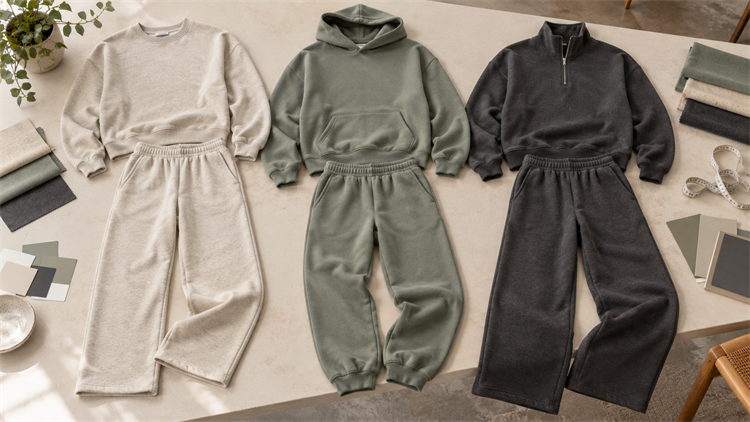
For brands developing a sweatshirt together with matching sweatpants, KELLOGG also provides coordinated sweatset development covering aligned fabrics, custom colors, brand-specific fits, decoration, sampling and bulk production.
One example is our custom heavyweight quarter-zip sweatshirt set, combining a structured zip collar, contrast raglan sleeve panels and relaxed wide-leg sweatpants in coordinated 420 GSM brushed fleece.
To evaluate a custom sweatshirt project efficiently, brands should provide as much of the following information as possible:
- Tech pack or reference garment
- Target fabric composition and GSM
- Preferred French terry or fleece construction
- Pantone colour or colour reference
- Garment measurements
- Artwork files
- Decoration size and placement
- Planned order quantity per colour
- Size range
- Packaging requirements
- Target production schedule
- Delivery country
If some technical details are still being finalised, a clear reference sample and defined commercial direction can provide a practical starting point.
Projects with confirmed specifications, realistic quantities and an organised approval process can move through fabric selection, sampling and production more efficiently.
Final Thoughts
Choosing a custom sweatshirt manufacturer requires more than confirming whether a factory can sew a sweatshirt.
The manufacturer needs to connect:
Fabric → Pattern → Sample → Approval → Bulk production
Fabric determines the garment’s structure and performance. MOQ affects which materials and processes are commercially practical. Sampling converts the product direction into a physical standard. Production control determines whether that standard can be maintained across the full order.
For premium apparel brands, the objective is not to develop the cheapest possible sweatshirt or complete the smallest possible order.
The objective is to build a well-defined product that can be manufactured consistently, delivered reliably and repeated across future collections.
If your brand has a tech pack, reference garment or defined sweatshirt specification, contact KELLOGG with your target fabric, planned quantity, artwork and production schedule. We can review whether the project matches our custom development and manufacturing capabilities.
Frequently Asked Questions
Q1.What information should I send to a custom sweatshirt manufacturer?
A: Provide a tech pack or reference garment, fabric requirements, target GSM, measurements, colour, artwork, planned quantity per colour, size range, packaging requirements and delivery schedule. The more complete the information, the more accurately the manufacturer can assess sampling, MOQ and pricing.
Q2.What is the MOQ for custom sweatshirts?
A: MOQ depends on the style, colour quantity, fabric, decoration, washing, labels and trims. Brands should confirm MOQ per style and per colour for their exact product specification rather than relying on one general number.
Q3.Can a sweatshirt manufacturer develop custom fabric?
A: Custom fabric development may be possible when the planned production quantity supports the required knitting, composition, GSM, colour and finishing. For smaller programs, an appropriate available fabric may be more commercially practical.
Q4.Is French terry or brushed fleece better for premium sweatshirts?
A: French terry provides a clean loopback interior and can be suitable for year-round or transitional products. Brushed fleece offers a softer, warmer interior. The best option depends on the intended season, hand feel, structure and target customer.
Q5.How many samples are required before production?
A: The number of sample rounds depends on the quality of the initial specification and the complexity of the product. Clear tech packs, reference garments and consolidated feedback usually reduce unnecessary revisions.
Q6.Why can bulk sweatshirts differ from the approved sample?
A: Bulk production introduces larger fabric quantities, multiple sizes, cutting, repeated sewing operations, decoration batches and finishing processes. These variables must be controlled through specifications, tolerances and production inspections.
Q7.When should a brand request a quotation?
A: A preliminary estimate can be requested once the main product specification and quantity are known. Final bulk pricing should be based on the approved fabric, construction, decoration, labels and finishing requirements.
Q8.Does a higher GSM always create a better sweatshirt?
A: No. GSM affects weight and structure, but fabric density, yarn, composition, finishing, shrinkage and pattern engineering also determine the quality of the finished garment.
Share this article