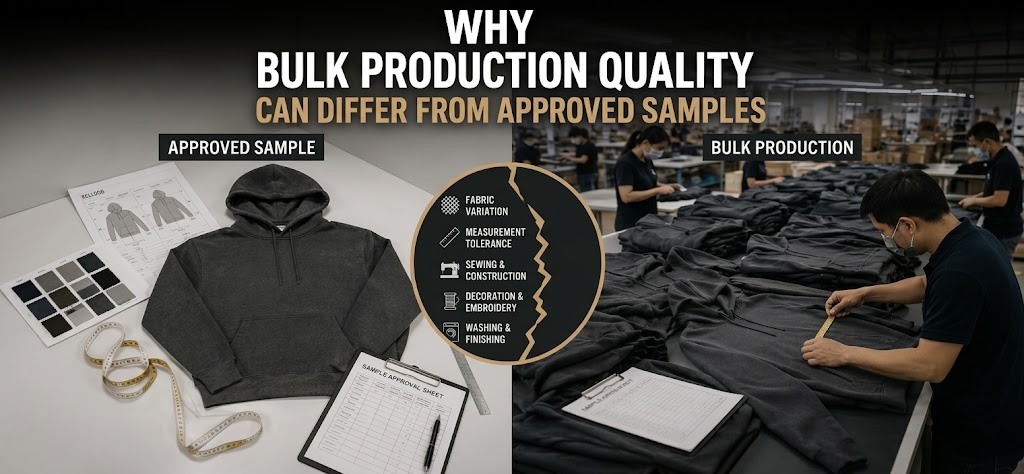
Why Bulk Production Quality Can Differ From Approved Samples
Written by Aimee Xiang
Founder of Kellogg Fashion
Focused on heavyweight apparel manufacturing, fabric engineering, garment development, quality control, and scalable production.
Introduction
A brand approves a sample. The fabric feels right, the measurements are correct, the embroidery looks clean, and the garment has the intended fit.
Then bulk production arrives — and something feels different.
The hoodie may fit slightly differently. The fabric may feel softer or firmer. The wash may show more variation. Embroidery may create more puckering. Measurements may shift after finishing.
This does not necessarily mean that the approved sample was wrong.
The real issue is that producing one approved garment and reproducing that garment consistently across hundreds or thousands of units are two different manufacturing challenges.
Bulk apparel production introduces variables that may not be visible during sampling.
Understanding those variables helps brands establish better production standards, reduce quality risk and evaluate whether a clothing manufacturer can reliably move a product from sample development to commercial production.
Approved Sample vs Bulk Production: What Changes?
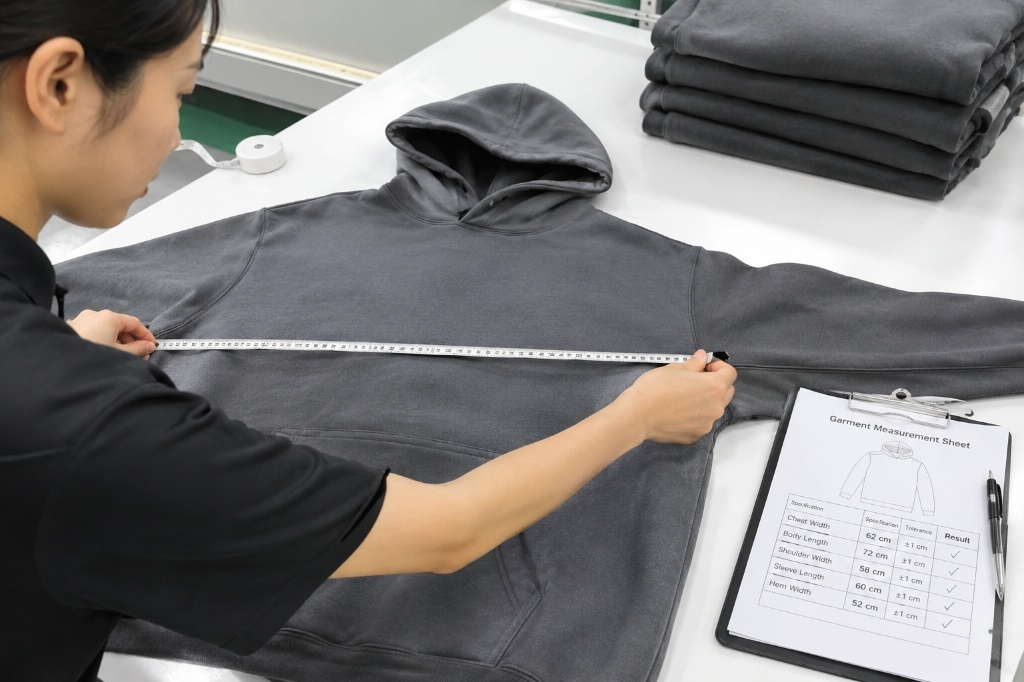
An approved sample establishes the target for bulk production. Our [premium heavyweight lifestyle collection case study]{https://kelloggfashion.com/blog/premium-heavyweight-lifestyle-collection-case-study) shows how this process works in practice, from first-sample fit adjustments and client feedback to an approved production standard and bulk manufacturing.
Depending on the product, the approved reference may define:
- Fabric composition
- Fabric weight (GSM)
- Fabric construction
- Color
- Hand feel
- Garment measurements
- Fit
- Construction
- Stitching
- Embroidery or printing
- Washing and finishing
- Labels and trims
- Packaging
But an approved sample is usually produced in a very small quantity.
Bulk production introduces a much larger manufacturing system.
For example:
Sample Development
1 garment
→ Small fabric quantity → Limited cutting → Limited sewing → Individual inspection
Bulk Production
500 garments
→ Multiple fabric rolls → Bulk cutting → Multiple sewing operations → Decoration batches → Washing or finishing batches → Size assortment → Final inspection
The product specification may remain the same, but the number of production variables increases significantly.
This is why bulk consistency requires more than simply giving the factory an approved sample.
1. Fabric Lot Variation Can Change the Finished Garment
Fabric is one of the first variables that can create differences between an approved sample and bulk production.
A development sample may use a small quantity of fabric, while bulk production may require multiple rolls or production lots.
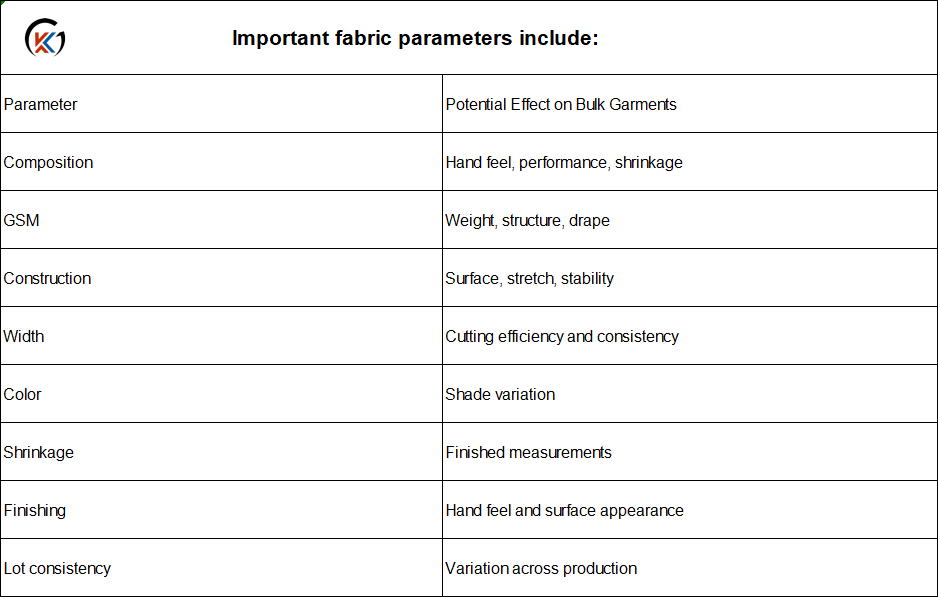
For heavyweight apparel, even relatively small changes in fabric characteristics can affect the finished garment.
A 450 GSM brushed fleece, for example, is not defined only by the number “450 GSM.”
Yarn, knitting structure, cotton/polyester composition, brushing, compacting and finishing can all influence how the fabric behaves.
This is why fabric approval should consider more than color and appearance.
Fabric inspection before cutting is an important part of heavyweight fabric quality control, particularly when brands require consistent GSM, shrinkage, hand feel and surface appearance across bulk production.
These controls are particularly important during custom heavyweight T-shirt development, where fabric density, collar structure, shrinkage and fit must remain consistent from sample to bulk production.
2. Fabric Shrinkage Can Change Garment Measurements
A garment can be cut correctly and still finish outside the intended measurement if fabric shrinkage has not been properly considered.
Knitted fabrics can change dimensions after:
- Relaxation
- Washing
- Garment dyeing
- Heat
- Drying
- Finishing
This becomes especially important for heavyweight hoodies, sweatshirts and sweatpants because fabric structure and finishing can influence dimensional stability. For heavyweight hoodies, sample-to-bulk consistency also depends on controlling the finished fabric, shrinkage, hood shape, measurements, decoration and washing as one connected standard. See the complete heavyweight hoodie sampling and bulk production process.
In premium crewneck production, the neckline and rib structure introduce additional approval points. See the complete heavyweight crewneck sweatshirt fabric, fit and construction guide.
For sweatpants, dimensional changes can affect not only overall length but also the waist, hip, rise, inseam, leg opening and side-seam position. Our guide to heavyweight sweatpants shrinkage, fit and construction explains which product variables should be confirmed before bulk cutting. These variables should be confirmed during custom sweatpants development before bulk fabric is cut.
For example, if the approved sample has already gone through the intended finishing process but bulk measurements are evaluated before finishing, the two garments are not being compared at the same production stage.
The manufacturer therefore needs to understand:
Approved finished measurement
→ Expected fabric behavior → Pattern / cutting allowance → Finishing process → Final garment measurement
Shrinkage should not be treated as an isolated fabric number. It needs to be considered together with pattern dimensions, garment construction and finishing.
3. Cutting at Scale Introduces New Variables
Producing one sample may involve individually cutting garment panels.
Bulk production requires cutting many layers and sizes efficiently.
This introduces additional variables such as:
- Fabric relaxation
- Marker accuracy
- Pattern version
- Grain direction
- Layer alignment
- Cutting precision
- Size identification
- Panel bundling
If a small cutting error is repeated across a large quantity, the result may become a systematic measurement problem.
For example, differences in:
- Chest width
- Body length
- Sleeve length
- Waist
- Hip
- Inseam
may originate before the garment reaches the sewing line.
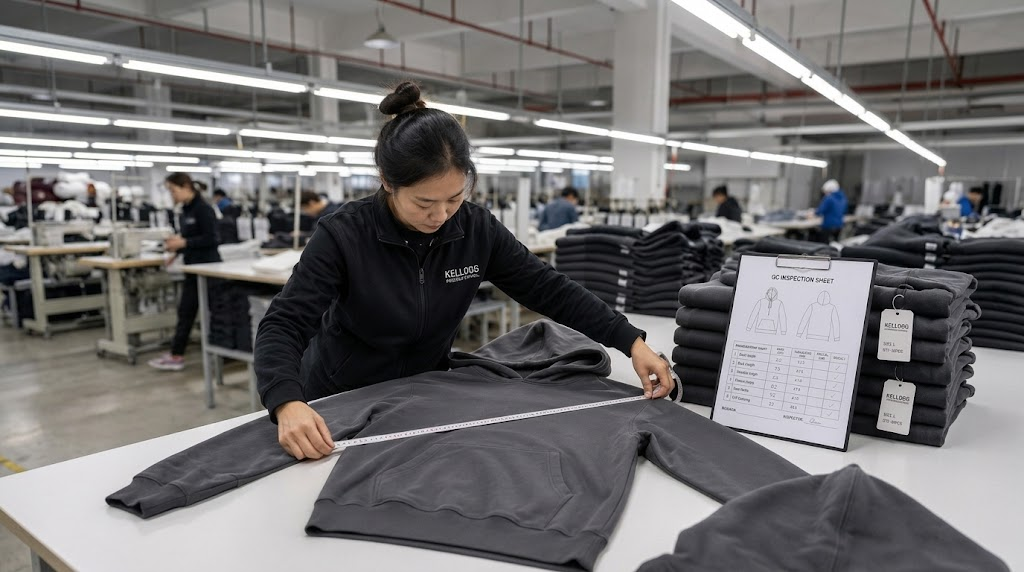
This is why measurement control should begin during production rather than waiting until all garments are completed.
4. Multiple Sewing Operations Can Create Construction Variation
A sample garment may receive highly concentrated attention during development.
Bulk production requires the approved construction to be reproduced consistently through multiple sewing operations.
Potential variables include:
- Seam allowance
- Stitch tension
- Stitch density
- Operator technique
- Panel alignment
- Pocket positioning
- Rib attachment
- Hood attachment
- Zipper installation
- Reinforcement points
For example, a hoodie with incorrectly controlled seam allowance may gradually move away from the approved finished measurement even when the original pattern is correct.
Construction quality therefore needs to be checked while garments are being produced.
Effective quality control during bulk production allows construction and measurement problems to be identified before the same issue is repeated across the entire order.
5. Measurement Tolerance Does Not Mean Every Garment Is Identical
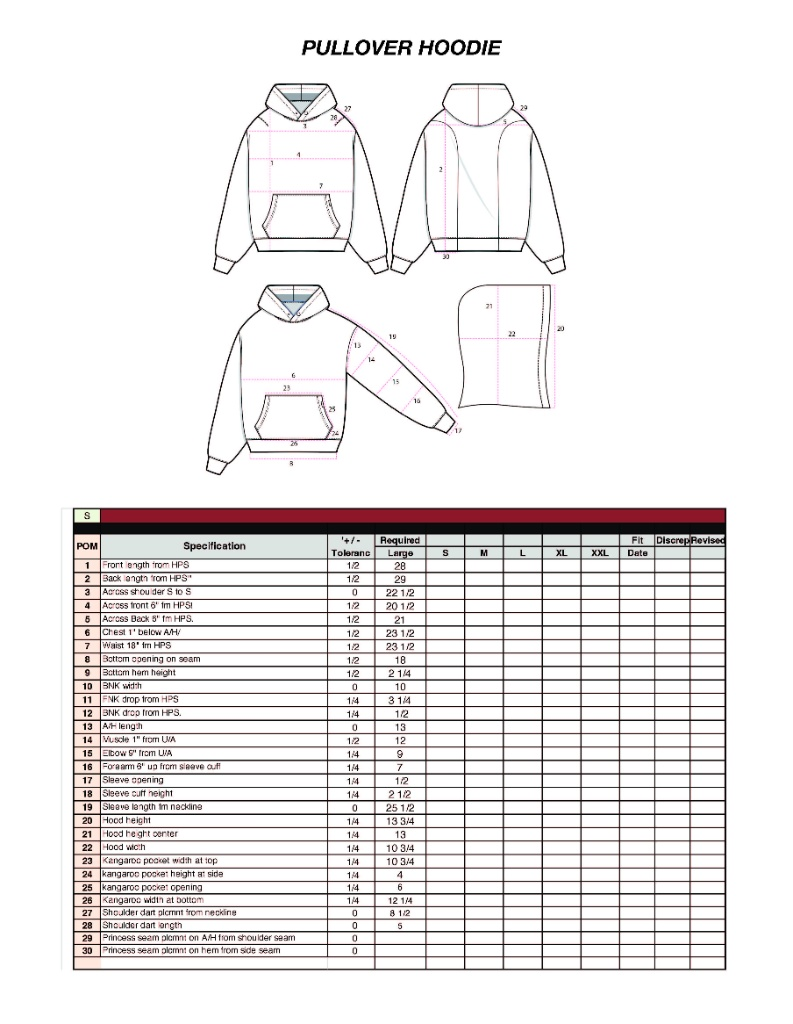
One of the most important concepts for apparel brands to understand is measurement tolerance.
Bulk garments are manufactured products made from flexible textile materials.
It is unrealistic to assume that every finished garment will measure exactly the same to the millimeter.
Instead, brands and manufacturers normally establish:
Target Measurement + Agreed Tolerance
For example, the specification may define a target finished measurement for:
- Chest
- Body length
- Shoulder
- Sleeve
- Waist
- Hip
- Rise
- Inseam
- Leg opening
The acceptable tolerance depends on factors such as:
- Garment type
- Fabric construction
- Measurement point
- Wash treatment
- Product specification
There is no single universal tolerance that should automatically be applied to every garment.
The approved tech pack and agreed production specification should define the relevant tolerance.
This distinction matters because:
Normal variation within an agreed tolerance is not the same as uncontrolled production inconsistency.
6. Embroidery Can Behave Differently in Bulk Production
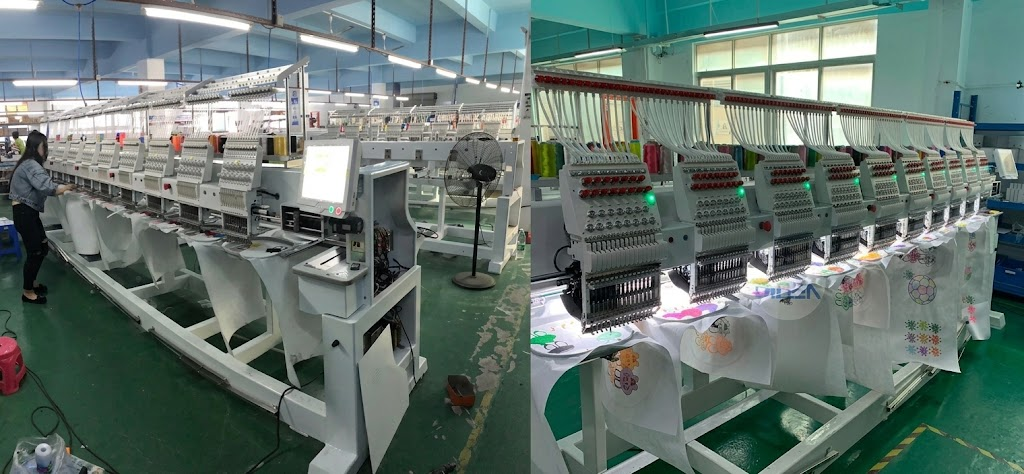
Embroidery that looks perfect on one development sample still needs to be controlled during bulk production.
Important variables include:
- Artwork dimensions
- Stitch count
- Stitch density
- Thread tension
- Thread color
- Backing
- Placement
- Fabric thickness
- Fabric stretch
- Machine settings
Heavyweight fleece can provide a stable embroidery surface, but incorrect settings may still cause:
- Puckering
- Fabric distortion
- Uneven density
- Incorrect placement
- Thread problems
This becomes particularly noticeable when the same embroidery is repeated across hundreds of garments.
A production-ready embroidery specification should therefore establish the approved appearance and placement before bulk decoration begins.
7. Printing Introduces Its Own Bulk Consistency Challenges
Printing also needs to move from sample approval into repeatable production.
Depending on the printing method, bulk variables may include:
- Ink consistency
- Color
- Artwork registration
- Placement
- Coverage
- Curing temperature
- Curing time
- Fabric surface
- Production speed
A print that appears correct immediately after printing may still develop problems if curing or adhesion is inconsistent.
For this reason, print quality should be evaluated according to the approved artwork and relevant performance requirements rather than appearance alone.
8. Garment Washing Can Create Controlled — or Uncontrolled — Variation
Washing is one of the most important variables in premium streetwear production.
Processes such as:
- Garment dyeing
- Enzyme washing
- Acid washing
- Vintage washing
- Fading
- Softening
- Distressing
can affect:
- Color
- Shade
- Hand feel
- Measurements
- Shrinkage
- Surface texture
- Decoration appearance
Some variation may be intentional.
For example, a vintage wash may be designed to produce garments that are not visually identical.
But there is an important distinction:
Controlled variation is part of the design. Uncontrolled inconsistency is a production problem.
Brands should therefore establish an approved wash reference and determine what level of variation is commercially acceptable.
Different garment washing and finishing processes can affect both the appearance and dimensional stability of bulk garments.
9. Garment Dyeing Can Affect Both Color and Measurements
Garment dyeing creates another layer of production complexity because the finished garment is subjected to dyeing and finishing after construction.
Variables may include:
- Dye absorption
- Fabric composition
- Temperature
- Processing time
- Garment load
- Washing
- Drying
- Finishing
These factors can influence final shade, hand feel and garment dimensions.
For brands developing washed or garment-dyed streetwear, approval should therefore consider the garment after the complete dyeing and finishing process.
Understanding garment dyeing for streetwear is particularly important when color variation, shrinkage and vintage finishing are part of the product design.
10. Different Production Batches Can Produce Variation
Bulk orders may sometimes be processed across different:
- Fabric rolls
- Cutting batches
- Sewing lines
- Embroidery runs
- Printing runs
- Washing batches
The larger and more complex the order, the more important batch consistency becomes.
This is one reason manufacturers use production references and inspection checkpoints throughout manufacturing.
Instead of asking:
“Does this garment look good?”
the better production question is:
“Does this garment remain within the approved specification?”
That changes quality control from a subjective opinion into a measurable manufacturing process. As order quantities increase, brands need stronger process controls for maintaining quality as production scales.
11. Changes After Sample Approval Increase Production Risk
Another common reason bulk production differs from the approved sample is that the product specification continues changing after approval.
Examples include:
- Changing fabric
- Changing GSM
- Changing color
- Adjusting measurements
- Moving artwork
- Changing embroidery size
- Changing labels
- Changing wash treatment
- Changing packaging
Individually, these changes may appear small.
But each change can affect another part of the product.
For example:
Fabric change
→ Different shrinkage → Different finished measurements
Embroidery size change
→ Different stitch density → Different fabric distortion risk
Wash change
→ Different hand feel → Different shrinkage → Different color result
This is why production specifications should be stabilized before bulk manufacturing begins.
12. A Pre-Production Sample Can Reduce the Gap
Depending on the product and production process, a pre-production sample can provide an important checkpoint before full bulk manufacturing.
The objective is not simply to make another sample.
It is to verify that the production-ready combination of:
- Fabric
- Pattern
- Measurements
- Construction
- Decoration
- Labels
- Trims
- Wash
- Finishing
still produces the approved result.
This becomes especially valuable when changes were made after earlier development samples.
The closer the approved production reference is to the actual bulk manufacturing conditions, the easier it becomes to identify potential differences before production scales.
In custom sweatshirt development, this process begins earlier with fabric selection, pattern confirmation, MOQ planning and structured sample approval. See the complete custom sweatshirt sampling and production process.
13. In-Line Inspection Helps Stop Problems From Scaling
Final inspection is important, but it happens late in the manufacturing process.
If a repeated problem is discovered only after 1,000 garments are completed, correction becomes significantly more difficult.
In-line inspection is designed to identify issues while production is still running.
For example:
10 garments show incorrect pocket placement
→ Investigate and correct the operation
rather than:
1,000 garments completed
→ Discover incorrect pocket placement during final inspection
This is one of the reasons professional bulk quality control should focus on prevention and process control, not only defect detection.
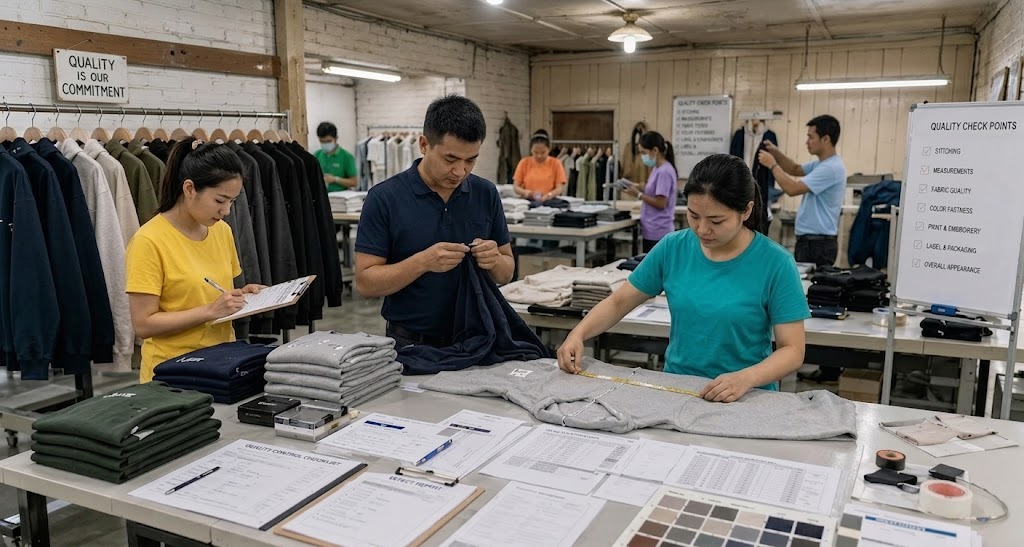
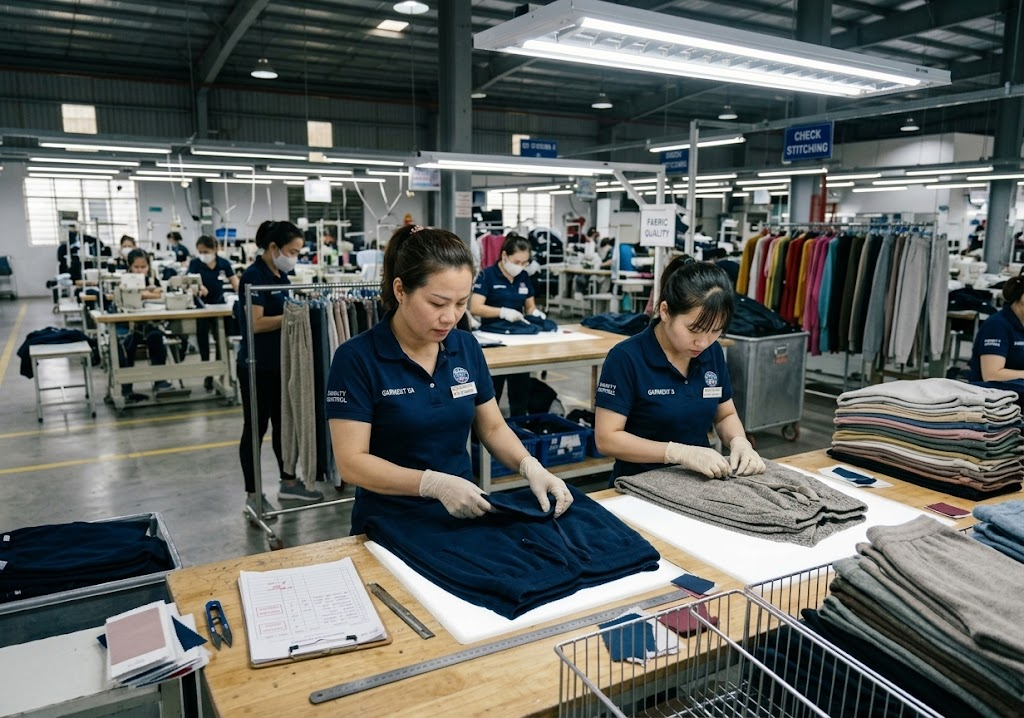
A structured bulk garment quality control process can include checkpoints across fabric inspection, cutting, sewing, decoration, finishing and final inspection.
14. Final Inspection Cannot Fix Every Production Problem
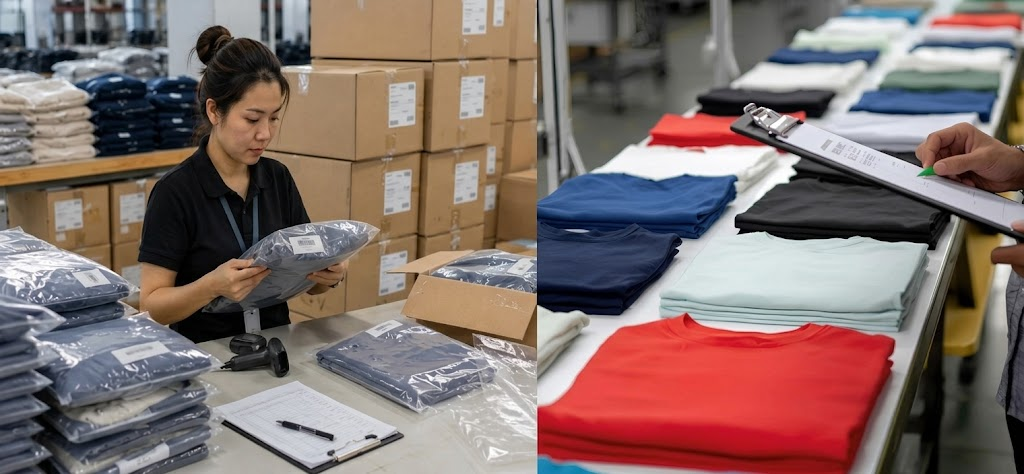
Final inspection is sometimes misunderstood as the stage where garment quality is created.
It is not.
Final inspection can identify problems such as:
- Measurement deviations
- Visible workmanship defects
- Incorrect labels
- Decoration problems
- Stains
- Packing errors
But it cannot efficiently correct every systematic problem created earlier in production.
For example, if an entire production batch has incorrect shrinkage, final inspection can identify the issue — but it cannot reverse the fabric behavior.
The more effective approach is:
Prevent → Monitor → Correct → Verify
rather than:
Produce everything → Inspect → Discover problems
15. Why Scaling Production Makes Consistency More Difficult
The challenge becomes more significant as brands grow.
Moving from:
50 pieces → 200 pieces → 500 pieces → 1,000+ pieces
may involve more:
- Fabric
- Operators
- Machines
- Production batches
- Sizes
- Colors
- Decoration
- Finishing
- Logistics
A manufacturer capable of producing one excellent sample is therefore not automatically capable of reproducing that product consistently at commercial scale.
For growing apparel brands, manufacturing capability should include both:
Product Development Capability
and
Bulk Production Consistency
When scaling hoodie production, brands should evaluate whether their manufacturing partner can maintain fabric, measurement, construction and finishing consistency as quantities increase. When these issues are discovered too late, they can also become a major cause of clothing production delays.
16. How Brands Can Reduce Sample-to-Bulk Differences
Brands and manufacturers can reduce risk by establishing clear production standards before bulk manufacturing.
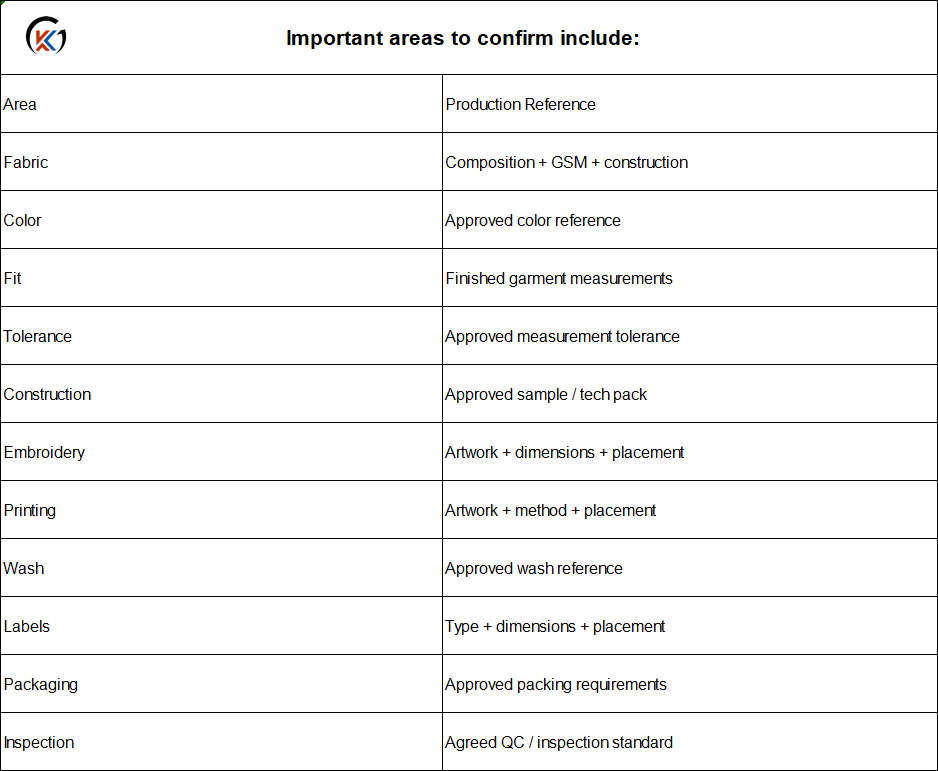
The objective is to reduce ambiguity.
“Same as sample” is useful as a visual reference.
But:
Approved sample + measurable specification + production checkpoints
creates a much stronger foundation for consistent bulk manufacturing.
17. What Brands Should Ask a Manufacturer Before Bulk Production
Before moving from sample approval into production, brands can ask:
- Has the bulk fabric been checked against the approved specification?
- Has shrinkage been considered in the finished measurements?
- Which sample is the final production reference?
- Are measurement tolerances confirmed?
- Are embroidery or print specifications finalized?
- Is the wash or finishing reference approved?
- Will measurements be checked during production?
- How are repeated defects identified and corrected?
- What final inspection method will be used?
- Have labels, trims and packaging been approved?
These questions help reveal whether a manufacturer treats quality as a final inspection activity or as a production management system.
Quality systems should therefore be part of evaluating a clothing manufacturer, particularly for brands moving from development quantities into repeat commercial production.
How KELLOGG Approaches Sample-to-Bulk Consistency
At KELLOGG, custom apparel development is built around converting approved product requirements into production specifications that can be followed during bulk manufacturing.
This controlled approach is applied throughout our custom sweatshirt production, including fabric approval, measurements, construction, decoration and packaging. See how these controls are applied in practice in our sample-to-bulk quality consistency case study, covering fabric approval, production standards, pre-production sampling and in-line quality control.
For heavyweight hoodies, sweatshirts, sweatpants, tracksuits and other custom apparel, relevant production parameters may include:
- Fabric composition
- Fabric GSM
- Fabric construction
- Garment measurements
- Measurement tolerances
- Construction details
- Embroidery or printing
- Washing and finishing
- Labels and trims
- Packaging requirements
The exact control points depend on the product, fabric, decoration, finishing process and order requirements.
The objective is not simply to reproduce the appearance of one sample.
It is to maintain the approved product standard as consistently as possible across commercial production.
Final Thoughts
The difference between an approved sample and bulk production is not simply a question of whether a factory can “copy the sample.”
It is a question of manufacturing control.
As production moves from one garment to hundreds or thousands, more variables enter the process:
Fabric → Cutting → Sewing → Decoration → Washing → Finishing → Inspection
The purpose of a strong manufacturing system is to control those variables against the approved product specification.
For apparel brands, especially those moving into larger or repeat orders, the most important question is therefore not:
“Can this manufacturer make a good sample?”
It is:
“Can this manufacturer reproduce the approved standard consistently at scale?”
That is the difference between successful sample development and reliable bulk apparel manufacturing.
Frequently Asked Questions
Q1. Why can bulk production differ from an approved clothing sample?
A: Bulk production introduces more variables than sample development, including larger fabric quantities, multiple fabric rolls, bulk cutting, multiple sewing operations, decoration batches and finishing processes. These variables need to be controlled against the approved production specification.
Q2. Does an approved sample guarantee identical bulk garments?
A: No. An approved sample establishes the production target, but bulk consistency depends on fabric control, measurements, construction, decoration, finishing and quality checkpoints throughout manufacturing.
Q3. How can brands reduce differences between samples and bulk production?
A: Brands can reduce risk by approving production-ready fabric, measurements, tolerances, artwork, decoration, wash references, labels and packaging before bulk manufacturing begins.
Q4. Why do garment measurements change during bulk production?
A: Measurements may be affected by fabric relaxation, shrinkage, cutting, seam allowance, sewing operations, washing, dyeing and finishing.
Q5. Can every garment in a bulk order have exactly the same measurements?
A: Textile garments naturally have manufacturing variation. Brands and manufacturers should establish target measurements and appropriate tolerances according to the garment, fabric, construction and finishing process.
Q6. Is final inspection enough to control bulk garment quality?
A: No. Final inspection is important, but quality problems are more effectively controlled through checkpoints during fabric preparation, cutting, sewing, decoration and finishing.
Q7. Why does garment washing create variation?
A: Washing can affect color, hand feel, shrinkage, surface appearance and finished garment measurements. Some variation may be intentional, but acceptable results should be established through approved references and production standards.
Q8. What is the difference between a good sample and reliable manufacturing?
A: A good sample demonstrates that a manufacturer can develop the product. Reliable manufacturing requires the ability to reproduce the approved product standard consistently across bulk and repeat production.
Share this article