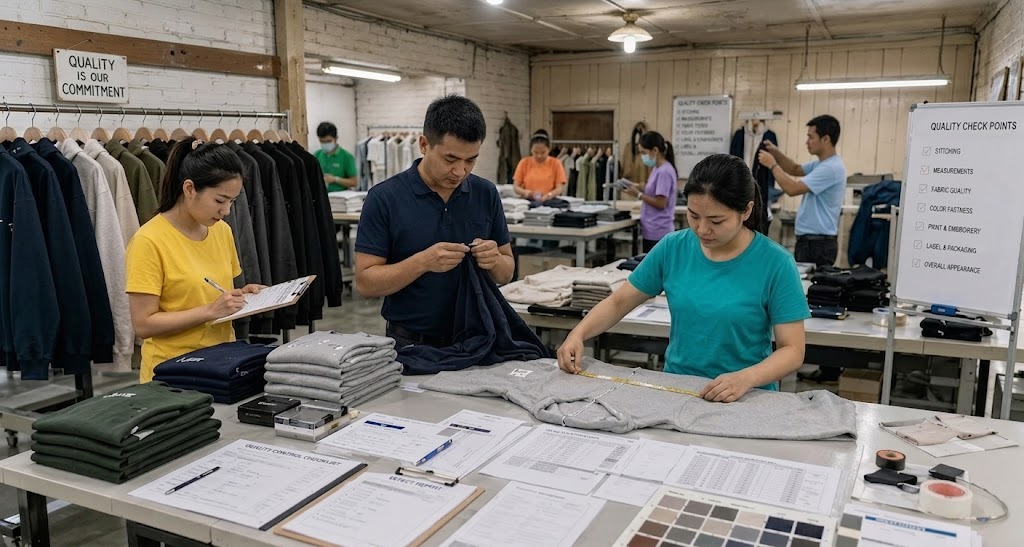
How Premium Apparel Brands Maintain Quality When Scaling Production
Written by Aimee Xiang
Founder of Kellogg Fashion
Focused on heavyweight apparel manufacturing, fabric engineering, garment development, quality control, and scalable production.
Introduction
Producing 50 high-quality garments is one challenge.
Producing 500 or 5,000 garments that still look, fit and feel like the approved sample is a different challenge entirely.
As premium apparel brands scale production, quality problems often do not come from one dramatic manufacturing failure. They appear through small variations that multiply across larger quantities:
- Fabric GSM shifts between batches
- Dye lots produce slightly different shades
- Measurements drift during sewing
- Embroidery density changes
- Wash effects become inconsistent
- Rib tension varies
- Different operators interpret construction differently
- Finishing standards become less consistent
A premium garment does not remain premium simply because production quantity increases.
Maintaining quality at scale requires the manufacturer to convert an approved product into a repeatable production standard.
This guide explains how premium apparel brands can scale clothing production while maintaining consistency in fabric, fit, construction, decoration, finishing and final quality.
1. Why Scaling Apparel Production Changes the Quality Challenge
During sample development, the objective is relatively simple:
Can the manufacturer make the garment correctly?
During bulk production, the question changes:
Can the manufacturer reproduce the same garment consistently hundreds or thousands of times?
That difference matters.
That difference matters.
A sample may be produced by one experienced sample maker using carefully selected fabric and receiving close technical attention.
Bulk production involves:
- Larger fabric quantities
- Multiple fabric rolls
- More sewing operators
- Multiple machines
- Larger cutting quantities
- Repeated embroidery or printing
- Larger washing batches
- Multiple inspection stages
Every additional variable creates an opportunity for variation.
Scaling therefore requires more than increasing production capacity.
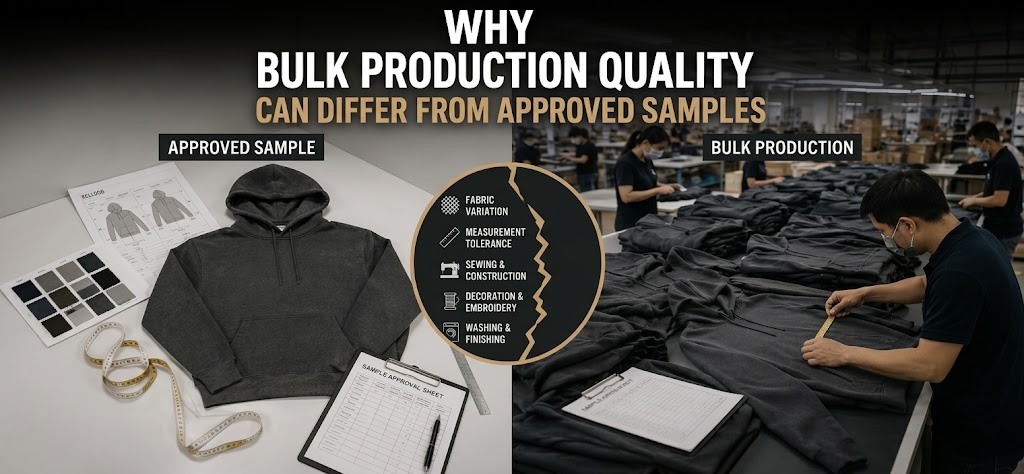
It requires increasing process control.Why bulk production quality can differ from approved samples
2. The Approved Sample Must Become a Production Standard
One of the most important steps before scaling is establishing a clear approved reference.
Depending on the product and production system, this may be referred to as:
- Approved sample
- Pre-production sample
- PP sample
- Sealed sample
- Golden sample
The terminology may vary, but the function is similar.
The approved garment becomes the physical reference for bulk production.
It should represent the confirmed:
- Fabric
- Color
- Measurements
- Fit
- Construction
- Stitching
- Embroidery
- Printing
- Trims
- Labels
- Washing
- Finishing
Production teams should not rely only on photographs or email comments once bulk manufacturing begins.
A physical approved reference gives sewing, QC and finishing teams something concrete to compare against. This becomes especially important when working with a custom T-shirt manufacturer, where fabric weight, fit, neckline construction and finishing must remain consistent from the approved sample through bulk production.
Our apparel quality control case study shows how KELLOGG converted an approved sample into a repeatable standard for fabric, measurements, construction and bulk production.
Why this becomes more important at scale
When only a few garments are being made, verbal instructions may appear sufficient.
When hundreds of garments move through multiple operations, interpretation becomes dangerous.
The production standard needs to become repeatable rather than subjective.
Maintaining quality within one production run is only part of the challenge. Brands replenishing proven styles also need to maintain apparel consistency across repeat orders, especially when new fabric lots, dye batches or trims are introduced.
This becomes particularly important when a heavyweight hoodie moves from technical sampling into repeat commercial orders. A structured heavyweight hoodie development and approval process helps define the fabric, fit, construction and finishing standards that bulk production must reproduce.
3. Lock the Specification Before Increasing Quantity
Scaling an unstable product usually scales its problems.
Before increasing production quantity, brands should confirm that the product specification is sufficiently stable.
That means resolving major questions around:
Fabric → Fit → Construction → Decoration → Trims → Finishing
before large-scale cutting begins.
A production-ready specification should normally include:
- Final measurement chart
- Measurement tolerances
- Approved fabric specification
- Approved color
- Approved construction
- Stitching requirements
- Decoration artwork and placement
- Trim specifications
- Label placement
- Washing or finishing requirements
- Packaging requirements
If these details continue changing after bulk materials have been prepared, quality control becomes much more difficult.
If growth also requires a change of manufacturing partner, prepare your existing collection for a new manufacturer before increasing volume, so the new sample can be assessed against your established product standard.
**A useful scaling principle
Do not scale unresolved decisions.**
Increasing quantity should happen after the product becomes technically stable, not simply after the first sample looks good.Clothing tech pack for production
This principle can be seen in our heavyweight lifestyle collection development case study, where fit and proportion issues were resolved through sample revision before the collection moved into bulk production.
4. Bulk Fabric Must Be Controlled Separately From Sample Fabric
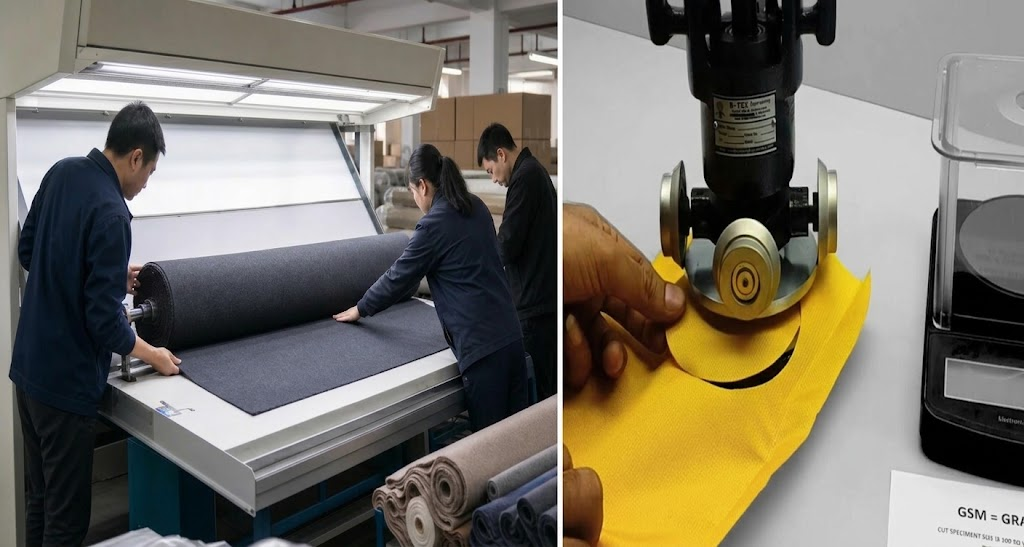
For premium apparel, fabric consistency is one of the biggest scaling risks.
The fabric used for an approved sample may come from a small reference cutting.
Bulk production may require hundreds or thousands of meters.
The manufacturer therefore needs to control characteristics such as:
- Fiber composition
- GSM
- Fabric width
- Color
- Shrinkage
- Surface appearance
- Brushing
- Hand-feel
- Stretch and recovery
- Pilling performance
- Dimensional stability
For heavyweight apparel, relatively small differences can become noticeable.
A 450 GSM hoodie made from dense compact fleece can feel substantially different if the bulk fabric becomes softer, looser, lighter or more heavily brushed.
The specification may still say “heavyweight fleece,” but the finished product no longer communicates the same quality.
5. GSM Alone Is Not Enough to Control Premium Fabric Quality
Premium brands should not define fabric quality using GSM alone.
Two fabrics can have similar weights but behave very differently because of differences in:
- Yarn
- Knitting density
- Fiber composition
- Surface finishing
- Brushing
- Compacting
- Washing
- Fabric structure
For example, two fabrics both measuring approximately 450 GSM may have completely different:
- Hand-feel
- Drape
- Surface appearance
- Recovery
- Shrinkage
- Structural stability
This is particularly important when scaling heavyweight hoodies, sweatpants, tracksuits and premium sweatshirts.For a product-specific example, our premium heavyweight crewneck development guide explains how fabric, collar construction, rib recovery and fit must be approved as one complete system.
The bulk fabric should therefore be evaluated against the approved fabric reference rather than relying on GSM as the only acceptance criterion.Choosing the right GSM for premium hoodies
6. Control Dye Lots Before Garment Production
Color consistency becomes more difficult as fabric volume increases.
Large orders may involve:
- Multiple fabric rolls
- Multiple dyeing batches
- Different production dates
Even when the same color formula is used, variations can occur.
For premium garments—especially black, charcoal, navy, brown, washed colors and muted neutral tones—small differences may become visible when garments are displayed together.
Before cutting, bulk fabric should therefore be checked for:
- Shade consistency
- Roll-to-roll variation
- Lot identification
- Surface appearance
Where necessary, fabric from different shade groups should be managed carefully rather than randomly mixed within garments.
The objective is simple:
A customer buying two garments in the same color should not feel that they came from two different collections.
7. Shrinkage Must Be Understood Before Bulk Cutting
Shrinkage becomes particularly important for cotton-rich and heavyweight garments.
Imagine a hoodie specification requires a finished chest measurement of 64 cm.
If the fabric changes dimension significantly after washing or finishing, cutting the pattern exactly to 64 cm does not guarantee a 64 cm finished garment.
Production may need to account for expected shrinkage.
This is why manufacturers may test:
- Length shrinkage
- Width shrinkage
- Rib shrinkage
- Washing response
- Dimensional recovery
before finalizing bulk cutting.
The objective is not necessarily zero shrinkage.
The objective is predictable and controlled shrinkage.Controlling shrinkage in heavyweight apparel production
8. Fabric Inspection Should Happen Before Cutting
Once fabric has been cut, material problems become much more expensive to correct.
Bulk fabric inspection should therefore identify potential issues before large quantities enter production.
Typical checks may include:
- Fabric defects
- Holes
- Stains
- Knitting faults
- Width variation
- Shade variation
- Surface inconsistencies
- GSM deviation
This creates an important quality gate:
Bulk Fabric Arrives
↓
Fabric Inspection
↓
Testing / Approval
↓
Cutting
rather than:
Bulk Fabric Arrives → Cut Immediately
The second approach may appear faster, but it increases risk.Fabric quality control in heavyweight hoodie manufacturing
9. Size Sets Help Validate Grading Before Full Production
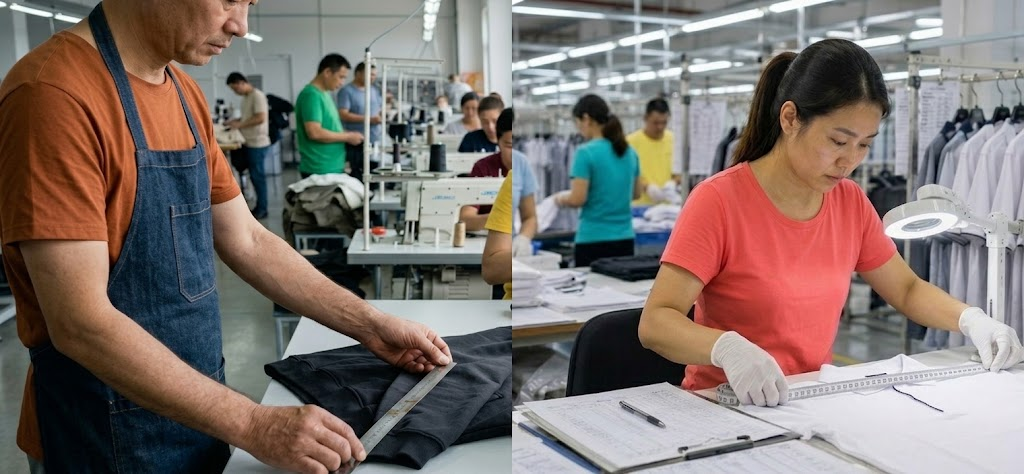
An approved medium-size sample does not automatically prove that XS, S, L, XL and XXL will fit correctly.
This becomes particularly important when scaling products with:
- Oversized silhouettes
- Drop shoulders
- Wide-leg trousers
- Cropped proportions
- Complex panel construction
A size set allows the manufacturer and brand to evaluate how the approved base pattern behaves across multiple sizes.
This can identify grading problems before hundreds of units are produced. This is especially important when scaling custom jogger and wide-leg sweatpants across multiple sizes.
For example:
A medium hoodie may have the correct body width.
But after grading, the XL sleeve length may become excessive.
Or the XS hood may become disproportionately small.
These problems may not be visible when only one development size is evaluated.
10. A Small Pilot Run Can Reduce Scaling Risk
For technically demanding products, moving directly from one approved sample to a very large production quantity may not always be the safest route.
A pilot or controlled initial production run can help validate:
- Sewing sequence
- Construction consistency
- Measurement control
- Decoration
- Washing
- Finishing
- Production efficiency
This is particularly useful when the product contains several interacting variables.
Examples include:
- Heavyweight fabrics
- Complex embroidery
- Custom hardware
- Garment washing
- Multiple panels
- Difficult seam construction
- Tight measurement tolerances
The purpose of a pilot run is not simply to produce more samples.
It is to test whether the manufacturing process itself is stable enough to scale.
11. Measurement Tolerances Must Be Defined
Bulk garments will not measure identically to the tenth of a millimeter.
Textile materials are flexible, sewing involves physical operations, and garment measurements naturally contain some variation.
The goal is therefore not absolute mathematical identity.
The goal is to establish acceptable tolerances.
For example, a specification might define:
- Chest: 64 cm
- Tolerance: ±1 cm
The exact tolerance depends on the garment, measurement point, fabric and construction.
Critical measurements may require tighter control than less important measurements.
Premium brands should identify which measurements directly affect:
- Fit
- Silhouette
- Comfort
- Visual balance
and prioritize those during bulk inspection.
12. Cutting Accuracy Becomes More Important as Volume Increases
A small cutting error repeated once creates one defective garment.
The same error repeated across 1,000 cut panels becomes a production problem.
Before bulk cutting, manufacturers should verify:
- Final patterns
- Grading
- Fabric direction
- Shrinkage allowance
- Marker accuracy
- Size ratios
- Cutting quantities
This is why scaling quality depends heavily on controlling processes before sewing begins.
Quality cannot be inspected into a garment after every panel has already been cut incorrectly.
13. Sewing Quality Must Be Standardized Across Operators
Bulk garment production involves multiple sewing operations.
A premium hoodie, for example, may require separate operations for:
- Shoulder joining
- Sleeve attachment
- Hood construction
- Pocket attachment
- Side seams
- Rib attachment
- Zipper installation
- Topstitching
- Label attachment
Different operators may perform different operations.
Without clear production standards, small differences can accumulate.
Premium production therefore requires consistency in:
- Seam allowance
- Stitch density
- Tension
- Alignment
- Reinforcement
- Topstitching
- Seam appearance
The objective is not simply:
“The seam is strong.”
For premium apparel, it also needs to be:
clean, consistent and visually aligned with the approved product.
14. In-Line Quality Control Matters More as Production Scales
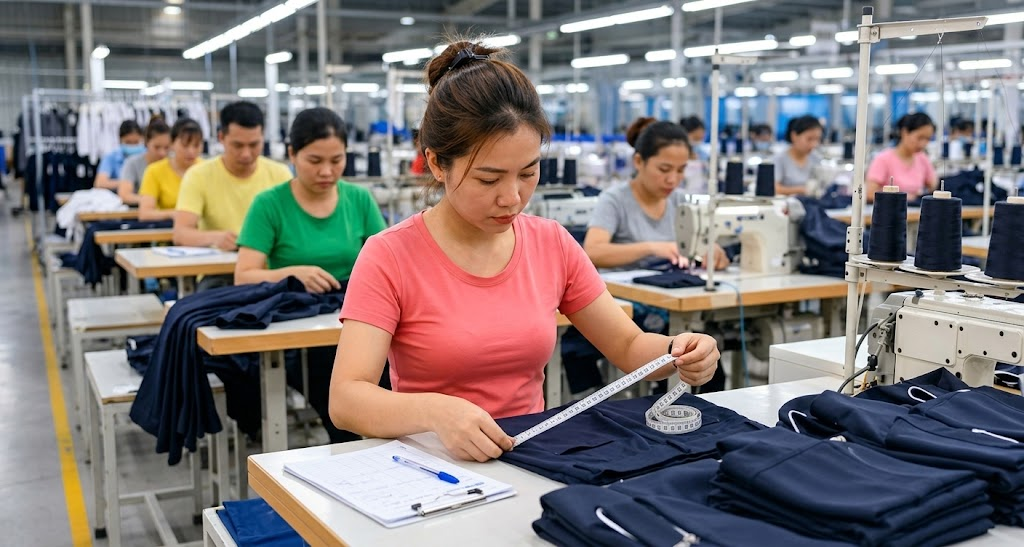
Waiting until all garments are finished before checking quality is risky.
If one construction error is repeated across 800 garments, final inspection can identify the problem—but it cannot prevent the 800 repetitions that already occurred.
In-line quality control changes the timing of detection.
Instead of:
Produce 800 → Inspect → Discover Problem
the system becomes:
Produce → Inspect During Production → Correct → Continue
Typical in-line checks may focus on:
- Measurements
- Sewing construction
- Seam quality
- Stitching
- Placement
- Workmanship
This does not eliminate final inspection.
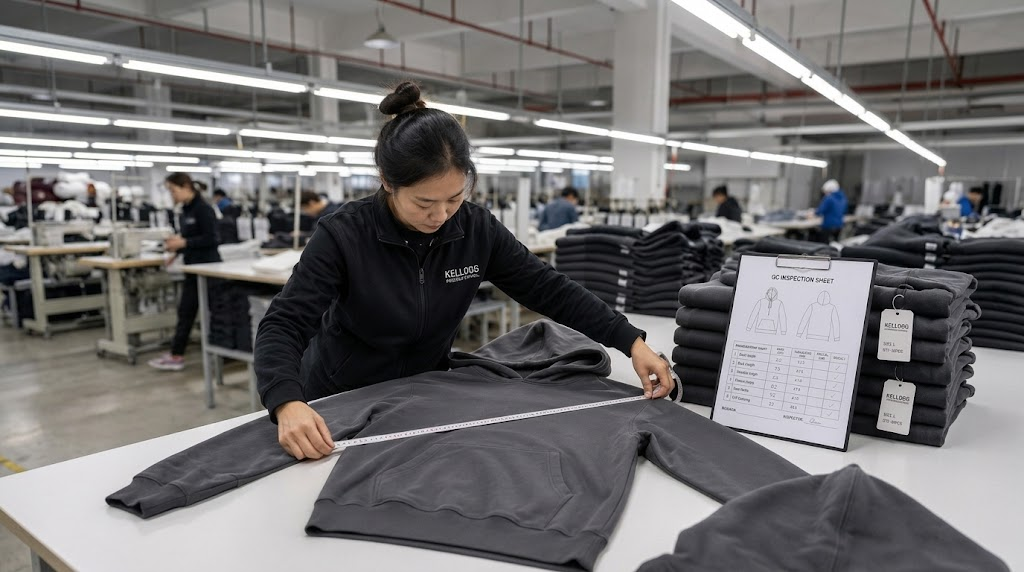
It reduces the probability that a repeated defect reaches final inspection at scale.How clothing manufacturers control quality in bulk production
15. Embroidery Must Be Controlled as a Production Process
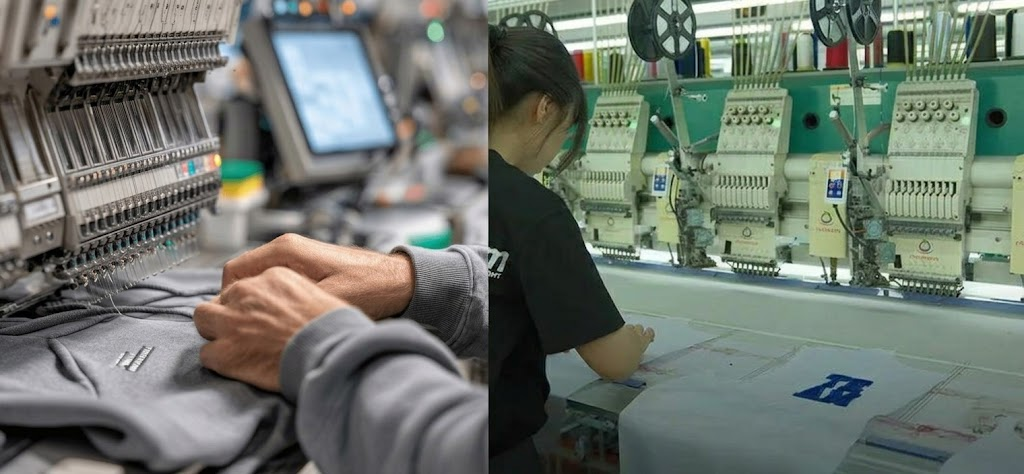
Premium embroidery is not controlled simply by approving an artwork file.
Bulk consistency can be affected by:
- Stitch density
- Thread tension
- Stabilizer
- Fabric thickness
- Hoop positioning
- Machine settings
- Thread color
- Artwork size
Heavyweight fabrics create their own challenges because the substrate behaves differently from lightweight jersey.
A premium brand should evaluate:
Approved Embroidery Sample
against:
Bulk Embroidery Output
not merely compare the bulk garment with a digital artwork file.
Important checks include:
- Size
- Placement
- Thread color
- Edge definition
- Distortion
- Fabric puckering
- Overall appearance
16. Printing Quality Also Needs Bulk Controls
The same principle applies to printing.
Screen printing, puff printing, high-density printing and other decoration techniques can vary because of:
- Ink viscosity
- Screen setup
- Pressure
- Curing
- Fabric surface
- Operator technique
A visually acceptable first print does not automatically guarantee identical results across hundreds of garments.
Bulk production therefore needs an approved print standard and periodic checks during production.
The earlier deviation is identified, the smaller the affected quantity.
17. Garment Washing Is One of the Hardest Processes to Scale Consistently
Garment washing creates some of the most attractive effects in premium streetwear.
It also creates additional production variables.
Processes such as:
- Acid wash
- Enzyme wash
- Vintage wash
- Garment dye
- Snow wash
- Silicone wash
can affect:
- Color
- Hand-feel
- Shrinkage
- Surface texture
- Measurements
- Decoration
A wash result approved on one sample needs to be translated into a repeatable bulk process.
That requires control over variables such as:
- Washing time
- Chemical concentration
- Temperature
- Load size
- Drying
- Garment composition
This is why washed garments may show more natural variation than standard piece-dyed garments.
The objective is not always perfect visual identity.
For some wash effects, controlled variation is part of the design.
The important point is defining what level of variation is acceptable.Garment washing and finishing techniques
18. Custom Trims Must Scale With the Garment
Premium quality is not limited to fabric and sewing.
Customers also interact with:
- Zippers
- Snaps
- Drawcords
- Metal hardware
- Woven labels
- Silicone patches
- Ribbing
- Packaging
A premium garment can lose perceived value if the main body is excellent but the zipper feels weak or the label construction is inconsistent.
Before scaling, brands should confirm that custom trims can be produced reliably at the required quantity.
This becomes particularly important for components requiring:
- Custom molds
- Plating
- Color matching
- Engraving
- Special materials
The trim supplier therefore becomes part of the apparel quality system.
19. Quality Control Should Be Layered, Not Concentrated at the End
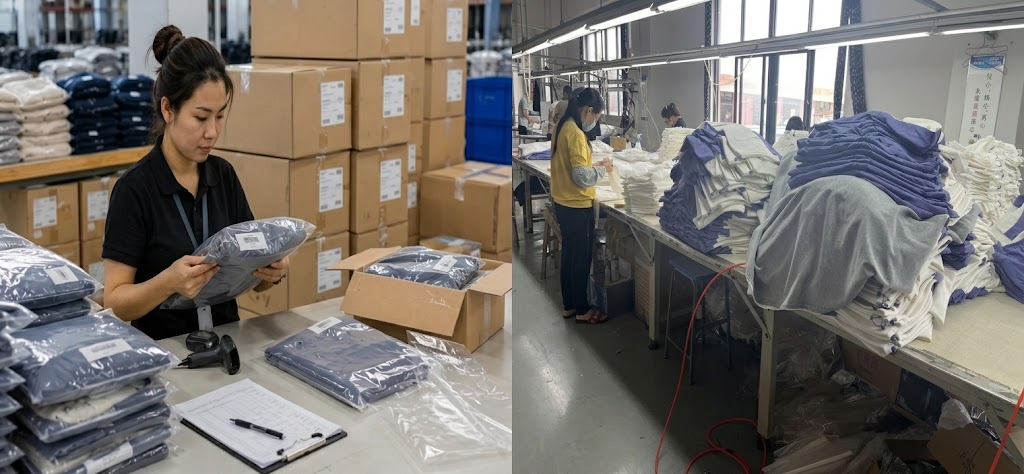
A scalable quality system uses multiple checkpoints.
A practical structure can look like:
Stage 1 — Incoming Material Control
Check fabric, trims, colors and material specifications.
Stage 2 — Pre-Production Control
Confirm approved sample, patterns, grading and production instructions.
Stage 3 — Cutting Control
Check cutting accuracy, fabric direction and panel quality.
Stage 4 — In-Line Production Control
Monitor construction, measurements and workmanship while garments are being produced.
Stage 5 — Decoration / Finishing Control
Check embroidery, printing, washing and finishing against approved standards.
Stage 6 — Final Inspection
Evaluate finished goods before packing and shipment.
This approach moves quality control upstream.
Instead of asking:
“How many defects did we find at the end?”
the better question becomes:
“How early did we prevent defects from spreading?”
20. Final Inspection Is a Verification Stage, Not the Entire Quality System
Final inspection remains important.
Finished garments can be checked for:
- Workmanship
- Measurements
- Appearance
- Color
- Decoration
- Labels
- Packaging
- Quantity
Depending on buyer requirements, order size and inspection protocol, sampling-based inspection methods such as AQL may also be used.
But final inspection should verify the effectiveness of the production system.
It should not be the first time anyone checks whether the garments were produced correctly.
A defect discovered after 10 garments is a manageable production issue.
The same defect discovered after 5,000 garments is a scaling failure.
21. Quality Data Becomes More Valuable as Orders Grow
Scaling brands should gradually move from subjective quality comments toward measurable production information.
Instead of:
“The hood looks slightly wrong.”
record:
“Hood opening exceeds approved measurement by 1.5 cm.”
Instead of:
“The fabric feels lighter.”
check:
GSM, construction, finish and approved bulk fabric reference.
Instead of:
“There are many defects.”
record:
- Defect type
- Frequency
- Production stage
- Affected quantity
- Corrective action
This allows repeated problems to be identified and corrected systematically.
As production volume increases, quality management should become more measurable, not more subjective.
22. Scaling Too Quickly Can Create Quality Problems
One of the most common mistakes growing apparel brands make is increasing complexity at the same time as quantity.
For example:
First Order
- 100 hoodies
- 1 color
- 1 embroidery
Then immediately:
Second Order
- 2,000 garments
- 5 styles
- 6 colors
- Multiple washes
- Multiple embroidery positions
- Custom hardware
- New packaging
This does not simply increase volume.
It multiplies production variables.
A safer scaling strategy may be:
Increase quantity first
↓
Confirm production consistency
↓
Then increase product complexity
rather than increasing quantity, SKU count and technical complexity simultaneously.
23. Scaling Production Can Also Affect Lead Time
More volume requires more than additional sewing time.
It can also increase requirements for:
- Fabric production
- Dyeing
- Cutting
- Decoration
- Washing
- QC
- Packing
Production capacity therefore needs to be considered before increasing order quantity.
A manufacturer capable of producing an excellent 100-piece order may not necessarily have the systems required to manage 10,000 pieces at the same quality level.
Brands should evaluate both:
Technical capability
and
Production management capability.
Clothing manufacturing lead times from sampling to bulk production
24. Rushing Scale Can Create Production Delays
Quality problems and production delays are often connected.
For example:
Bulk Fabric Problem
↓
Replacement / Correction
↓
Production Rescheduling
Or:
Repeated Sewing Defect
↓
Rework
↓
QC Reinspection
↓
Shipment Delay
This is why scaling decisions should consider quality and delivery together.
The fastest theoretical production schedule is not always the fastest route to sellable finished goods.Common causes of clothing production delays
25. The Manufacturer Must Scale Its Management System Too
Scaling is not simply about adding more machines.
As order volume increases, manufacturers need stronger coordination between:
- Merchandising
- Fabric sourcing
- Pattern making
- Cutting
- Sewing
- Embroidery / printing
- Washing
- QC
- Packing
- Shipping
A small production issue that can be corrected informally on a 50-piece order becomes much harder to manage across thousands of units.
The manufacturer's internal communication system therefore becomes increasingly important as production grows.
Premium brands should evaluate whether a supplier can manage complexity—not simply whether the factory has enough sewing machines.
26. What Premium Brands Should Ask Before Scaling an Order
Before increasing production volume, brands should ask their manufacturer:
Product Stability
Is the final specification fully approved?
Fabric
Can the same fabric specification be reproduced consistently at bulk quantity?
Color
How will dye-lot variation be controlled?
Fit
Have grading and size sets been checked?
Production
What changes when the order increases from 100 pieces to 1,000 pieces?
Decoration
How will embroidery or printing consistency be monitored?
Finishing
How will washing or special finishing be controlled?
QC
At which stages will inspection occur?
Capacity
Can the manufacturer realistically handle the quantity within the required schedule?
Corrective Action
What happens if a repeated defect is discovered during production?
The answers reveal much more than simply asking:
“Can you produce 1,000 pieces?”
27. A Practical Quality-Control Framework for Scaling Apparel Production
For premium brands, a scalable production process can be summarized as:
1. Finalize Product Specification
↓
2. Approve Production Sample
↓
3. Approve Bulk Fabric & Trims
↓
4. Verify Grading / Size Set
↓
5. Confirm Production Instructions
↓
6. Start Controlled Bulk Production
↓
7. Conduct In-Line QC
↓
8. Control Decoration & Finishing
↓
9. Conduct Final Inspection
↓
10. Pack & Release for Shipment
The most important principle is that each stage reduces uncertainty before the next stage begins.
This is what allows production volume to increase without allowing quality variation to increase at the same rate.
28. Scaling Quality Is Really About Controlling Variation
The fundamental challenge of apparel manufacturing at scale is variation.
Variation can come from:
Materials
Fabric, dye lots, trims.
Machines
Sewing, embroidery, printing.
People
Operators, inspectors, finishing teams.
Processes
Cutting, sewing, washing, pressing.
Environment
Temperature, humidity, storage and production conditions.
A scalable manufacturing system does not assume variation will disappear.
It identifies which variations matter, establishes acceptable tolerances, monitors them and corrects problems before they spread.
That is the difference between simply producing more garments and scaling premium apparel production.
29. Final Thoughts
Premium apparel quality does not scale automatically.
As production quantity increases, the number of materials, operators, processes and production variables also increases.
Brands that maintain quality at scale usually do several things well:
They lock the specification before bulk production.
They establish an approved physical production standard.
They control bulk fabric rather than assuming it matches sample fabric.
They validate grading and measurements.
They inspect production while garments are being made.
They control embroidery, printing and washing as repeatable processes.
They use final inspection as verification—not as the entire quality system.
Most importantly, they understand that scaling is not simply:
100 pieces → 1,000 pieces
It is:
A controlled product → a controlled manufacturing system → repeatable quality at higher volume.
For premium fashion and streetwear brands, the right manufacturing partner is therefore not simply the factory capable of producing the largest quantity.
It is the manufacturer capable of maintaining the intended fabric, fit, construction, finishing and overall product standard as quantity increases. Brands scaling premium crewneck programs can work with an experienced sweatshirt manufacturing partner to maintain approved standards across repeat and higher-volume orders.
Frequently Asked Questions
Q1.How do clothing brands maintain quality when increasing production volume?
A:Brands maintain quality by locking product specifications, approving bulk materials, controlling measurements and tolerances, using approved production references, conducting in-line inspections and verifying finished garments before shipment.
Q2.Why can quality change when apparel production scales?
A:Larger orders involve more fabric, operators, machines and production processes. Each introduces potential variation, making process control increasingly important.
Q3.What is a golden sample in clothing manufacturing?
A:A golden sample is an approved physical garment used as a reference for bulk production. It represents the agreed fabric, fit, construction, decoration, trims and finishing standard.
Q4.Should bulk fabric be checked even if the sample fabric was approved?
A:Yes. Bulk fabric can come from different rolls or production batches and should be checked for characteristics such as color, GSM, width, shrinkage and surface consistency.
Q5.Why is in-line quality control important for large apparel orders?
A:In-line QC can identify repeated problems while production is still running, reducing the number of garments affected before corrective action is taken.
Q6.Does a larger clothing order automatically mean lower quality?
A:No. Larger quantities do not inherently reduce quality. Quality depends on whether the manufacturer has appropriate material controls, production standards, inspection systems and capacity to manage the increased volume.
Q7.What should brands check before increasing an apparel order?
A:Brands should confirm product specifications, bulk fabric, colors, grading, size sets, trims, decoration, finishing standards, QC procedures and realistic production capacity.
Q8.Is final inspection enough for premium apparel production?
A:No. Final inspection is important, but premium apparel quality should be controlled throughout material preparation, cutting, sewing, decoration and finishing rather than inspected only after production is complete.
Share this article