How Fabric, Rib and Shrinkage Affect Heavyweight Crewneck Sweatshirts
Written by Aimee Xiang
Founder of Kellogg Fashion
Focused on heavyweight apparel manufacturing, fabric engineering, garment development, quality control, and scalable production.
Introduction
For established fashion labels, premium streetwear brands and private-label businesses, developing a heavyweight crewneck sweatshirt is not simply a matter of removing the hood from an existing hoodie pattern.
A crewneck exposes the quality of the fabric, neckline, shoulder balance and silhouette more directly. Without a hood or front pocket to add visual weight, small problems become easier to see: a weak collar, excessive shoulder collapse, an unstable hem, surface puckering or a body shape that feels wide without looking intentional.
The strongest heavyweight crewnecks are developed as a complete system. Fabric weight, knit density, composition, pattern proportions, rib performance, decoration and finishing must work together—and remain consistent beyond the approved sample.
This guide explains the decisions experienced product teams should evaluate when developing a premium heavyweight crewneck sweatshirt for sampling and bulk production.
AI Overview: What Defines a Premium Heavyweight Crewneck Sweatshirt?
A premium heavyweight crewneck sweatshirt normally combines a dense, stable fabric with a deliberately engineered silhouette and a resilient neckline. Depending on the intended season and fit, approximately 380–500 GSM can provide a substantial hand-feel without automatically making the garment excessively stiff or bulky.
However, GSM alone does not determine quality. Fabric construction, yarn quality, surface density, composition, compacting, shrinkage control and recovery all affect how the finished sweatshirt looks and performs.
For a category-wide reference, our guide to heavyweight fabrics, GSM and garment construction explains how these variables affect different heavyweight garment types.
For a production-ready result, brands should approve the finished fabric—not only a nominal GSM—and evaluate the garment after washing for neckline recovery, body length, shoulder position, twisting and overall silhouette retention.
A Crewneck Must Be Developed Differently From a Hoodie
Although hoodies and crewneck sweatshirts may use the same fabric family, the visual and structural requirements are not identical. The same principle applies when a crewneck is developed with matching bottoms. Sweatpants may use the same fabric family, but waistband recovery, rise, pocket stability and leg shape require a separate construction standard. See our heavyweight sweatpants fabric, GSM, fit and construction guide for the complete development framework.
When a crewneck is developed with matching bottoms, the two garments should be engineered as one coordinated product. Brands building matching sets can explore our custom sweatset manufacturing service for fabric alignment, balanced fits, color control, sampling and bulk production.
A hoodie gains shape from several additional components:
- The hood adds weight and volume around the neckline.
- The front pocket changes the drape and stiffness of the lower body.
- Drawcords, eyelets and hood seams introduce more construction detail.
- A double-layer hood can help communicate heavyweight value.
A crewneck has fewer components, so the fabric and pattern carry more responsibility. The neckline becomes a focal point. Shoulder width and sleeve pitch are more visible. The front body must sit cleanly without a kangaroo pocket stabilizing or interrupting the surface.
This is why converting a hoodie into a crewneck by simply replacing the hood with ribbing often produces an unbalanced result. The neckline opening, shoulder slope, front and back neck drop, sleeve shape, body length and rib tension may all require adjustment. Premium heavyweight hoodie construction
Choosing the Right GSM for a Heavyweight Crewneck
For premium crewneck sweatshirts, the practical heavyweight range often begins around 380 GSM and can extend beyond 500 GSM. The correct weight depends on the desired silhouette, climate, decoration and wearing experience.
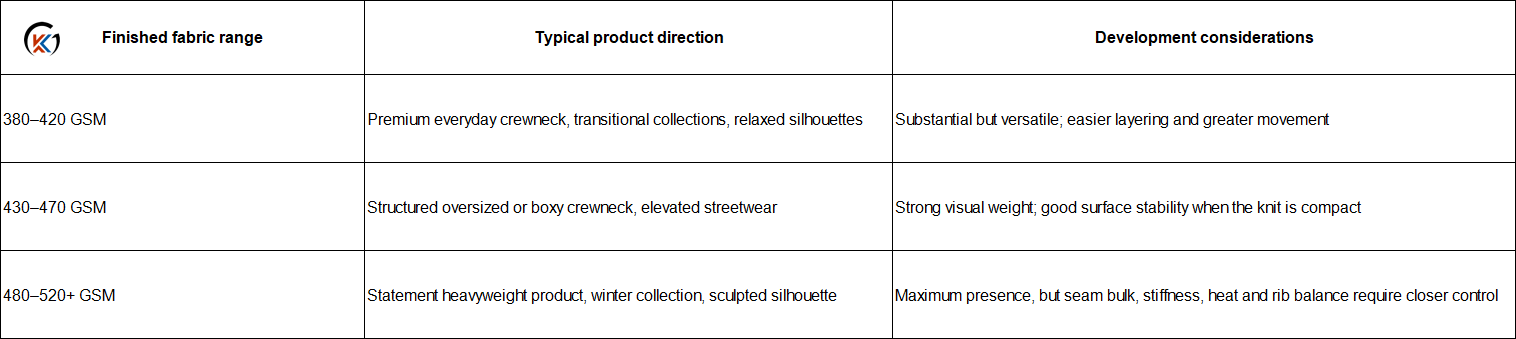
These ranges are directional rather than universal specifications. A dense 420 GSM fabric may look cleaner and more premium than a loosely knitted 500 GSM fabric. Likewise, a fabric that measures 460 GSM before compacting may reach a different finished weight after stabilization.
Brands should therefore confirm:
- Whether GSM is measured before or after compacting and finishing
- Acceptable GSM tolerance for bulk production
- Whether the quoted fabric is stock-supported or custom developed
- Whether the approved colour affects weight or hand-feel
- How the fabric performs after the intended garment wash
Whether the sample and bulk fabric will use the same construction and finishing route
GSM should define a performance and positioning range—not replace a complete fabric specification. 400 vs 450 vs 500 GSM hoodies
French Terry or Brushed Fleece?
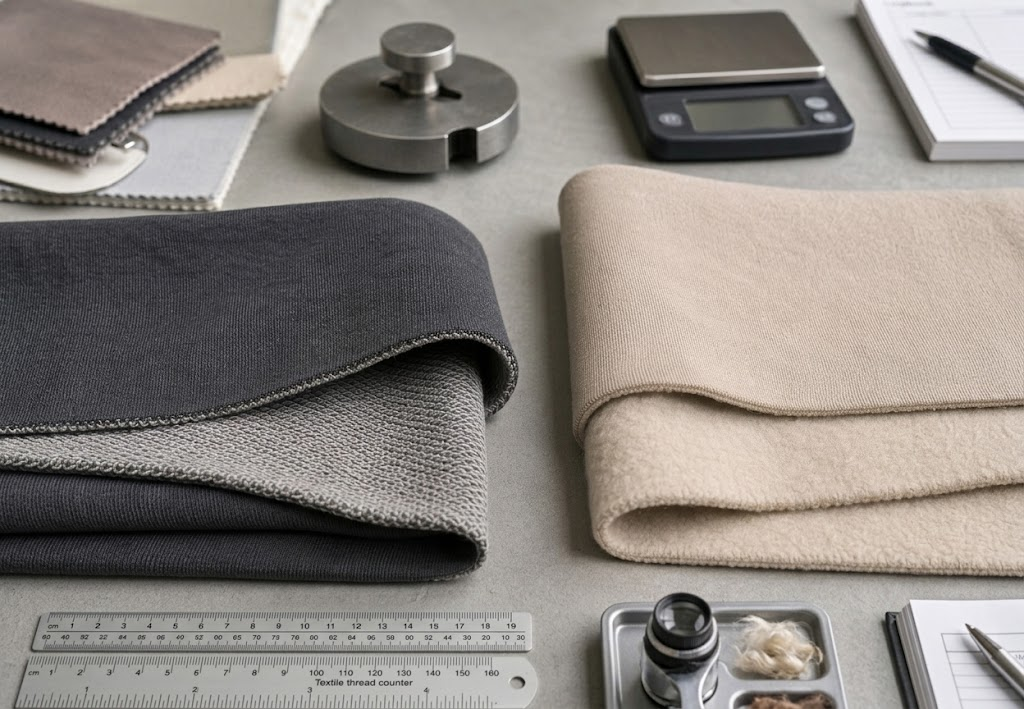
Both French Terry and brushed fleece can be used for premium heavyweight crewnecks, but they create different results.
Heavyweight French Terry
French Terry has loops on the reverse side rather than a brushed interior. Depending on yarn, density and finishing, it can provide:
- A cleaner internal construction
- More breathability
- A structured but less insulated wearing experience
- Strong suitability for transitional collections
- A controlled, substantial drape
- Compatibility with garment dye and selected vintage finishes
French Terry is not automatically firm or premium. A loose loop construction can grow, twist or feel less compact than expected. Heavyweight French Terry also requires careful relaxation and shrinkage control before cutting.
Brushed Fleece
Brushed fleece has a raised, soft reverse surface. It can provide:
- Greater warmth
- A fuller and softer internal hand-feel
- Strong cold-season positioning
- A more cushioned product experience
Good visual structure when the outer face is dense and smooth
The brushing process must be controlled. Excessive brushing may create fibre shedding, internal pilling or an overly fluffy fabric that feels bulky without appearing refined.
The decision should be based on season, retail positioning, target hand-feel and silhouette. A brand developing a compact, matte, boxy crewneck may need a very different fleece construction from a brand developing a soft, relaxed comfort product—even at the same GSM. French Terry vs fleece for streetwear
Fabric Composition: Natural Hand-Feel vs Dimensional Stability
Common heavyweight sweatshirt compositions include 100% cotton and cotton-rich blends such as 85% cotton/15% polyester or 80% cotton/20% polyester.
100% Cotton
When properly knitted and finished, 100% cotton can deliver:
- A natural cotton hand-feel
- Strong premium fibre positioning
- Good suitability for garment dye
- A characterful surface after selected wash treatments
However, cotton-rich heavyweight fabrics may be more sensitive to shrinkage, growth, twisting and permanent deformation. The result depends on yarn quality, knit structure, compacting and garment finishing—not composition alone.
Cotton-Polyester Blends
A carefully engineered cotton-polyester fleece can improve:
- Shape retention
- Recovery
- Dimensional stability
- Durability
- Resistance to repeated deformation
The construction matters. Some fabrics are developed with a cotton-dominant outer face and polyester strategically incorporated to support the internal structure. This can maintain a premium cotton surface while improving production and wear performance.
For a crewneck, composition should be selected alongside the target neckline, hem and silhouette. A soft 100% cotton fabric may suit a deliberately relaxed product, while a cotton-rich blend may better support a cleaner, structured form that must recover consistently after wear.
Fabric Density Matters More Than Thickness Alone
Premium heavyweight sweatshirts usually benefit from a smooth, compact outer face. Density influences:
- How cleanly the body panels hang
- Whether seams appear flat or wavy
- The stability of embroidery and appliqué
- Print definition
- Surface pilling and fuzziness
- How strongly the garment holds a boxy silhouette
A fabric can be heavy because it is dense, or because it is bulky and loosely constructed. These are not equivalent.
When reviewing swatches, product teams should compare more than hand weight. Hold the fabric vertically to assess drape. Stretch it across and along the grain to evaluate recovery. Inspect the outer face under directional light. Compare the surface before and after washing. Check whether the edge rolls excessively after cutting.
These observations often reveal more about production suitability than the GSM certificate alone.
Fit Development: Oversized Does Not Mean Uniformly Larger
A premium oversized crewneck should appear intentional from every angle. Simply adding width to a standard sweatshirt block often creates an uncontrolled body, low armholes and sleeves that lack proportion.
The main fit variables include:
Shoulder Width and Shoulder Drop
The shoulder position defines much of the garment's visual identity. A moderate drop can create a relaxed premium silhouette. A more exaggerated drop can support a directional streetwear look, but it changes sleeve balance and may increase fabric accumulation around the upper arm.
Body Width and Length
Boxy does not necessarily mean short, and oversized does not necessarily mean long. Width and length must be developed as a ratio. The intended customer, size range and styling direction should be clear before grading begins.
Armhole and Sleeve Volume
A lowered armhole creates ease, but excessive depth can restrict movement or make the garment collapse beneath the arm. Sleeve width should support the body volume without appearing disconnected from it.
Sleeve Pitch and Sleeve Stacking
Heavy fabric does not move like standard sweatshirt fleece. Sleeve pitch, elbow volume and cuff position affect whether the sleeve hangs cleanly or creates controlled stacking. This should be judged on-body, not only from flat measurements.
Hem Behaviour
The hem may sit close to the body, fall straight or pull the silhouette inward. Rib tension, rib height and body-to-rib ratio determine the result. If the rib retracts too strongly, the sweatshirt may balloon above the hem. If it is too weak, the lower body can lose definition after wear.
An approved reference garment can communicate volume and proportion efficiently, but it should be supported by a complete measurement specification and construction notes. Reference garments do not replace a controlled tech pack.
Neckline Engineering Is the Critical Difference
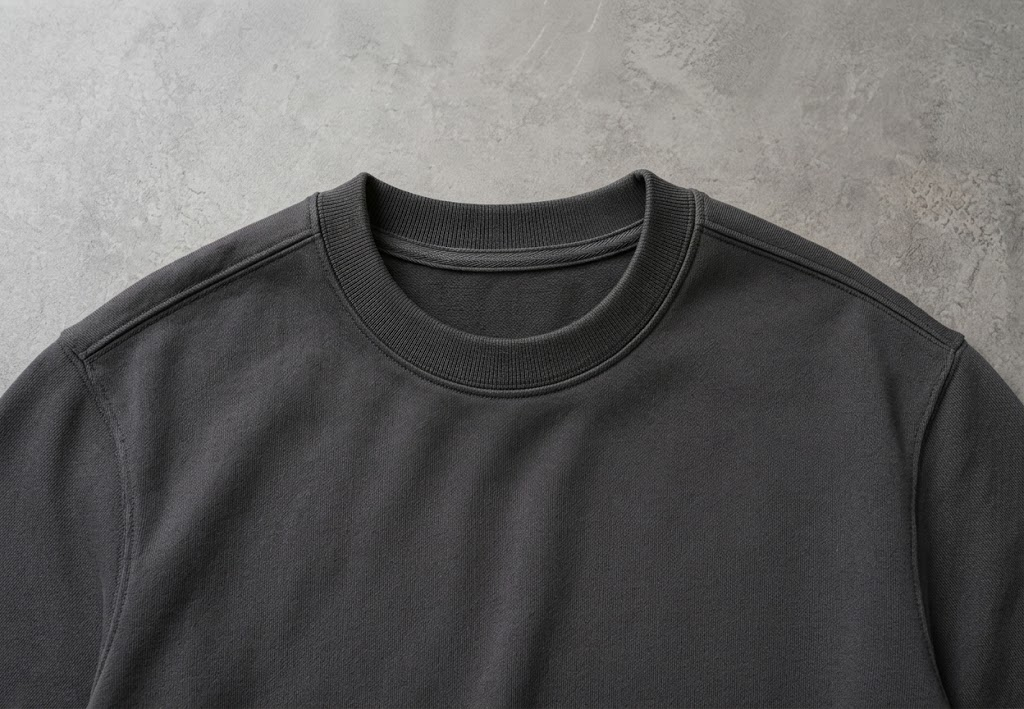
The collar is one of the first areas experienced buyers inspect on a crewneck sweatshirt. It should sit evenly, recover after stretching and remain proportionate to the garment weight.
Important variables include:
- Neck opening width and depth
- Front-to-back neck drop
- Rib composition and recovery
- Rib weight and thickness
- Rib height
- Rib-to-neckline sewing ratio
- Seam allowance and attachment method
- Neck tape or internal reinforcement
- Topstitching or coverstitch specification
A heavy body fabric paired with weak ribbing can cause the collar to flare, wave or stretch out. An overly tight rib may pull the neckline inward and create puckering around the upper chest.
For very heavyweight constructions, reducing the neck opening is not always the correct solution. The collar pattern, rib tension and attachment process should be tested together. Neckline appearance should be checked after washing and after repeated controlled stretching—not only immediately after sewing.
Construction Details That Affect Perceived Quality
Heavyweight fabric places more pressure on seams and machinery. Construction must accommodate bulk without making the garment look industrial or overbuilt.
Key areas include:
Shoulder and Neck Stabilisation
Shoulder tape, back-neck tape or another appropriate stabilisation method can reduce stretching. The choice should remain compatible with the intended inside finish.
Seam Type and Stitch Density
Overlock, coverstitch and flatlock options create different appearances and levels of bulk. Stitch density, needle size and thread must be suitable for the fabric. Incorrect settings can cause skipped stitches, seam tunnelling, puckering or visible needle damage.
Underarm and Side-Seam Intersection
Thick seam intersections should be planned before production. Poorly controlled bulk can create hard points, uneven feeding and inconsistent stitching.
Rib Attachment
Collar, cuff and hem rib must be attached with consistent tension. Small variation between operators can create visible differences across bulk units.
Internal Finish
Premium quality is also judged from inside the garment. Thread trimming, seam cleanliness, label attachment, taped areas and bulky intersections should be included in the approval standard.
Embroidery, Printing and Appliqué on Heavyweight Crewnecks
The uninterrupted chest area makes a crewneck particularly suitable for embroidery, screen printing, appliqué and mixed decoration. It also makes execution defects more visible.
Embroidery
Embroidery approval should consider:
- Stitch count and artwork scale
- Backing selection
- Fabric compression
- Puckering around the artwork
- Distortion after washing
- Placement tolerance across sizes
A dense fabric can provide a stable embroidery base, but heavy stitch coverage still requires testing. The embroidery sample should use the actual production fabric and finished garment wash wherever possible.
Screen Printing and Specialty Printing
The outer surface must suit the intended print system. A fuzzy or uneven face may reduce edge definition. Puff, high-density, distressed and multi-colour prints each create different curing and registration requirements.
Appliqué
Appliqué adds material and seam load to the front body. Fabric compatibility, edge finishing, backing and wash behaviour must be tested as a complete construction.
Decoration should be approved on a garment or production-representative panel—not only through a digital artwork file.
Shrinkage, Twisting and Wash Stability
Heavyweight fabric can change significantly during washing and finishing. Pre-shrinking and compacting reduce risk, but they do not remove the need for garment testing.
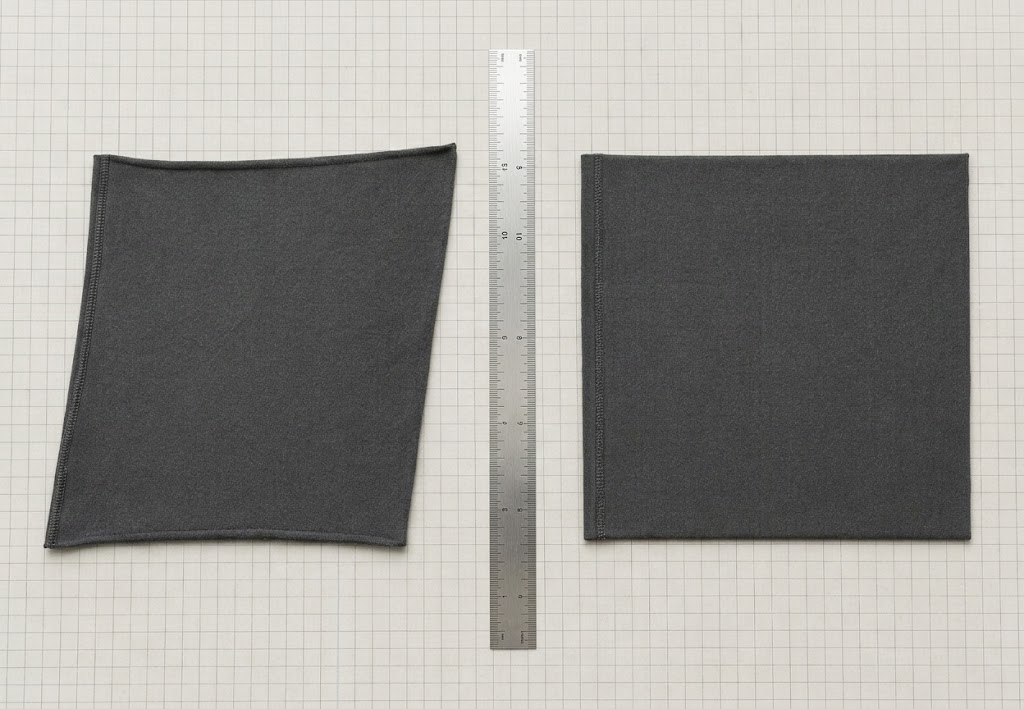
Brands should define:
- The wash method used for testing
- Measurement points and tolerances
- Acceptable length and width shrinkage
- Collar, cuff and hem recovery expectations
- Allowable twisting or spirality
- Surface pilling standard
- Colourfastness requirements
- Whether measurements are taken before or after conditioning
The crewneck should be evaluated as a full garment because components may react differently. Body fabric and rib can shrink at different rates. Embroidery can restrict one area while surrounding fabric contracts. Garment dye or vintage washing can further change dimensions and surface appearance. Shrinkage control in heavyweight French Terry production
What Should Be Approved Before Bulk Production?
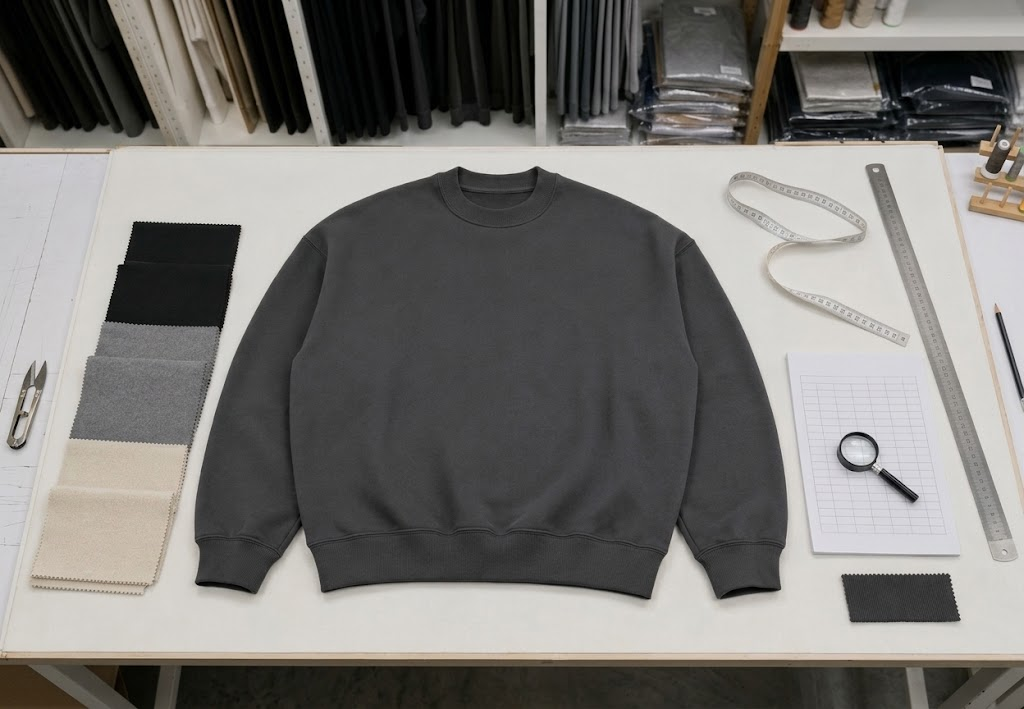
An experienced brand team should move into bulk only after the critical product variables are documented and approved.
Fabric Approval
- Finished composition and GSM range
- Fabric construction and usable width
- Approved colour standard
- Outer-face appearance and reverse texture
- Hand-feel and drape
- Shrinkage and wash results
- Pilling, colourfastness and recovery requirements where applicable
Fit Approval
- Approved sample size and measurement chart
- Shoulder position and body proportions
- Sleeve volume and cuff position
- Neck opening and collar appearance
- Hem behaviour
- Grading rules across the size range
Construction Approval
- Stitch and seam specifications
- Rib quality and attachment ratio
- Stabilisation and neck-tape details
- Label locations
- Decoration method, size and placement
- Internal finishing standard
Production Approval
- Pre-production sample using confirmed bulk materials
- Measurement tolerances
- Colour and shade approval process
- Inline and final inspection points
- Packing method
- Approved reference sample retained for comparison
The approved sample should not function as the only specification. It should be supported by an updated tech pack, measurement chart, artwork files, colour references and written approval comments.
When the crewneck is paired with matching sweatpants, evaluate both garments under the same agreed wash conditions and review their proportions together afterward. Our coordinated sweatset fabric and wash-performance guide explains what to confirm before approving the complete set.
Why the Approved Sample Can Still Differ From Bulk
Bulk production introduces variables that are not always visible in a single development sample: fabric lot differences, cutting relaxation, operator handling, rib tension, machine settings, washing load and finishing conditions.
The goal is not to assume that sample approval eliminates variation. The goal is to define which variables matter, establish tolerances and control them throughout production.
For heavyweight crewnecks, neckline shape, body length, shoulder position, rib recovery, embroidery appearance and wash performance deserve particular attention during inline inspection. Why bulk production can differ from approved samples
Developing a Premium Heavyweight Crewneck With KELLOGG
KELLOGG works with fashion brands, private-label businesses and wholesalers developing premium heavyweight apparel for international markets.
For an efficient crewneck development review, brands should provide as much of the following as available:
- Current tech pack and measurement chart
- Reference garment or approved fit block
- Target finished GSM and composition
- Intended French Terry or brushed fleece direction
- Required colours and estimated quantities
- Artwork files and decoration specifications
- Target wash or surface finish
- Existing test standards or performance requirements
- Required launch or delivery window
Based on the intended silhouette, hand-feel, season and construction, suitable fabric and development routes can then be evaluated before sampling.
Final Assessment
A premium heavyweight crewneck sweatshirt is defined by control rather than weight alone.
The fabric must provide the required surface, structure and wearing experience. The pattern must balance shoulder width, body volume, sleeve shape and length. The collar, cuff and hem rib must recover consistently. Decoration must remain stable after washing. Finally, the approved result must be reproducible across bulk production.
For brands with an established design direction, the most productive starting point is not simply asking for the heaviest available fabric. It is defining the intended finished product: silhouette, hand-feel, performance, construction and approval standards.
Frequently Asked Questions
Q1.What GSM is best for a premium heavyweight crewneck sweatshirt?
A: Approximately 380–500 GSM is a useful development range for many premium heavyweight crewnecks. Around 430–470 GSM can provide strong structure and substantial hand-feel, while lighter or heavier options may be appropriate depending on season, fit and product positioning. Fabric density and finishing remain as important as GSM.
Q2.Is 500 GSM too heavy for a crewneck sweatshirt?
A: Not necessarily. A 500 GSM crewneck can work for winter collections and statement heavyweight products. However, the pattern, rib weight, seam construction and intended wearing experience must accommodate the extra bulk and stiffness.
Q3.Is French Terry or brushed fleece better for a heavyweight crewneck?
A: Neither is universally better. French Terry offers a looped interior, greater breathability and a cleaner transitional product direction. Brushed fleece provides more warmth and a softer inner hand-feel. Selection should follow the intended season, silhouette and customer experience.
Q4.Should a crewneck use the same pattern as a hoodie?
A: No. A hoodie block may provide an initial reference, but removing the hood changes neckline balance and the garment's visual weight. Neck opening, shoulder slope, body proportions, sleeve shape and rib tension should be reassessed for the crewneck.
Q5.How can brands prevent a heavyweight crewneck collar from stretching?
A: Use rib with suitable weight, composition and recovery; engineer the correct collar-to-neckline ratio; stabilise the relevant seams; and approve the neckline after washing and repeated stretch testing. A smaller neck opening alone does not guarantee recovery.
Q6.Can heavyweight crewnecks support dense embroidery?
A: Yes, particularly when the fabric has a compact and stable outer face. The artwork, stitch count, backing, needle settings and wash process should still be tested on the actual production fabric to prevent puckering and distortion.
Q7.What should a brand send before requesting a crewneck sample?
A: A current tech pack, measurement chart, target composition and finished GSM, colour requirements, artwork files, decoration details and reference garment are the most useful starting materials. Existing performance or wash standards should also be included.
Q8.What should be checked after washing the approved sample?
A: Check body and sleeve measurements, shoulder position, twisting, collar shape, cuff and hem recovery, surface pilling, colour change and decoration stability. Results should be recorded against the approved measurement and performance tolerances.
Share this article