How to Choose a Custom Sweatpants Manufacturer: Fabric, Fit and MOQ
Written by Aimee Xiang
Founder of Kellogg Fashion
Focused on heavyweight apparel manufacturing, fabric engineering, garment development, quality control, and scalable production.
Intrdocution
For premium apparel brands, heavyweight sweatpants are not simply a secondary item added to match a hoodie. They are a technically demanding product in their own right.
The fabric must provide weight without excessive stiffness. The pattern must create the intended silhouette while maintaining movement and recovery. The waistband, rise, pockets, seams and leg shape must remain stable through wear, washing and bulk production.
A pair of sweatpants may look simple on a specification sheet, but small decisions can change the finished product significantly. Two styles made from the same nominal 450 GSM fabric can feel completely different because of yarn quality, knit density, interior finish, pattern balance and garment construction.
This guide explains the principal factors established apparel brands, private-label businesses and wholesalers should evaluate when developing premium heavyweight sweatpants for commercial production. Premium heavyweight hoodie GSM and fabric selection
Brands ready to move from product research into sampling can explore our custom sweatpants manufacturing services for fabric selection, fit development and bulk production.
What Defines Premium Heavyweight Sweatpants?
Premium heavyweight sweatpants are defined by a combination of material, fit, construction and production consistency—not by GSM alone.
A commercially developed product should balance:
- Fabric weight and density
- Surface appearance and hand feel
- Drape and structural support
- Stretch and recovery
- Shrinkage and dimensional stability
- Waistband performance
- Rise and crotch balance
- Pocket stability
- Leg shape and hem construction
- Repeatability across sizes, colours and production batches
For an established brand, the objective is rarely to make the heaviest possible sweatpant. The objective is to select a fabric and construction that express the brand's intended silhouette, price position and customer experience.
A relaxed straight-leg sweatpant may require controlled drape and enough density to keep the leg from collapsing. A structured oversized jogger may need stronger recovery at the waistband and cuffs. A washed vintage style may require pattern allowances and construction decisions that account for garment-dye or wash shrinkage.
These products may sit within the same heavyweight category, but they should not be developed from the same assumptions.
Choosing the Right GSM for Heavyweight Sweatpants
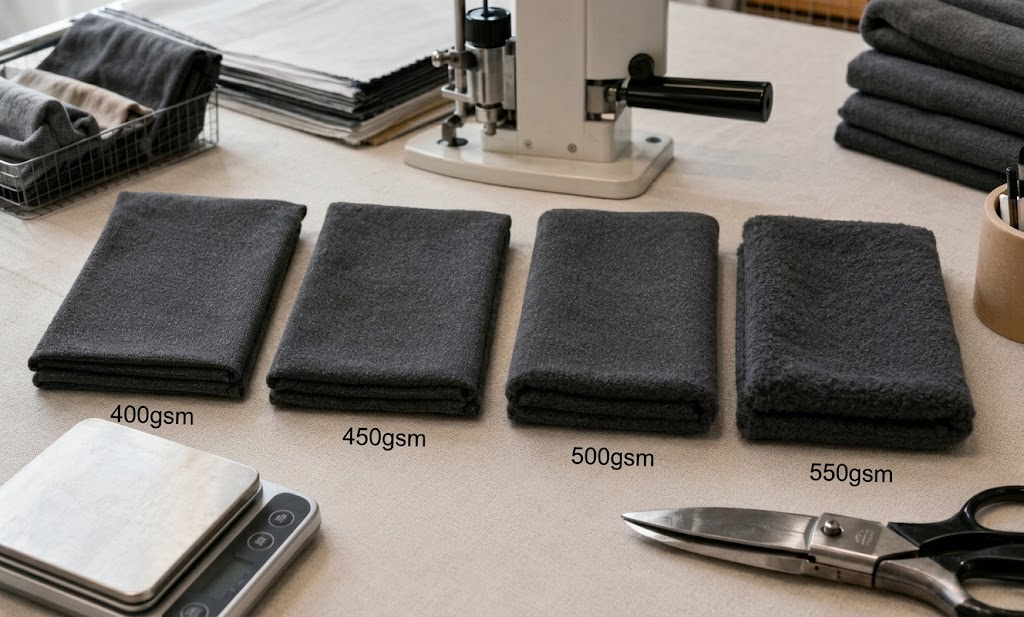
GSM measures fabric weight in grams per square metre. It is an important specification, but it does not independently determine quality, thickness, softness or performance.
350–400 GSM: Substantial but More Versatile
This range can work well for premium year-round sweatpants, especially when the fabric has a compact knit structure and high-quality yarn.
Typical characteristics include:
- Noticeably heavier hand feel than standard fleece
- Easier movement and layering
- More natural drape
- Greater suitability for transitional seasons
- Lower overall garment weight than 450–500 GSM options
A dense 380 or 400 GSM fabric may perform better than a loosely knitted 450 GSM fabric. Finished quality still depends on construction, recovery and finishing.
420–460 GSM: Strong Premium Heavyweight Balance
For many premium brands, this range provides a practical balance between substance, structure and wearability.
It is particularly suitable for:
- Oversized sweatpants
- Relaxed straight-leg silhouettes
- Premium joggers
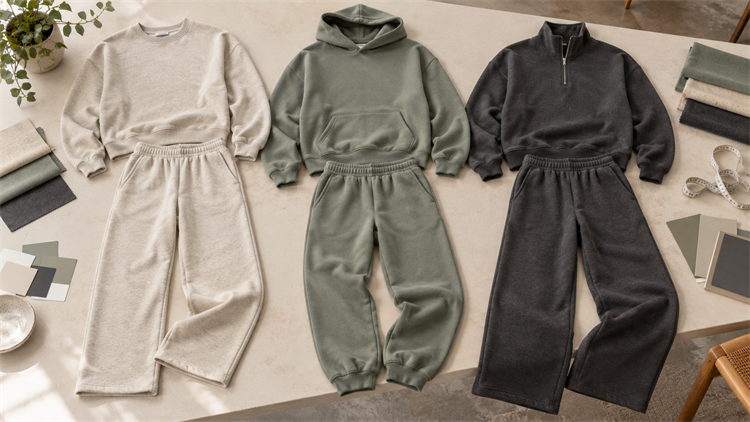
- Coordinated hoodie and sweatpant sets
- Structured brushed-fleece programs
For a finished product reference in this weight range, view our 420 GSM wide-leg sweatpants and quarter-zip sweatshirt set, developed with a structured drape, open-leg silhouette and coordinated contrast side panels.
At this weight, fabric behaviour becomes more important. If the fabric is too rigid, the crotch and knees may feel bulky. If it lacks recovery, the garment may bag at the knees or lose shape at the seat.
480–520+ GSM: Maximum Weight and Structure
Very heavy fabrics can create a strong luxury streetwear statement, but they require deliberate product engineering.
Potential advantages include:
- Strong visual structure
- Substantial premium hand feel
- Defined oversized silhouette
- High perceived material value
Potential challenges include:
- Excessive bulk at the waistband and pocket openings
- Reduced mobility if the pattern is too tight
- Greater sewing and seam-management difficulty
- Higher garment weight and freight cost
- Longer drying time
- More noticeable shrinkage impact
- Increased stress on elastic and waistband construction
For this reason, a 500 GSM sweatpant is not automatically superior to a well-developed 420 or 450 GSM product. The correct weight should support the intended silhouette and end use.
Fabric Construction Matters More Than the GSM Number Alone
When evaluating fabric, brands should confirm more than the supplier's stated weight.
Important parameters include:
- Fibre composition
- Yarn count and yarn quality
- Knit construction
- Fabric density
- Finished rather than greige GSM
- Face smoothness and compactness
- Interior finish
- Stretch and recovery
- Shrinkage in width and length
- Pilling performance
- Colourfastness
- Lot-to-lot consistency
The same GSM can produce different results depending on how the fabric is knitted and finished. A tightly knitted surface usually supports cleaner embroidery, printing and a more refined appearance. A softer and more open construction may provide greater drape but less structural stability.
For premium sweatpants, fabric approval should therefore be based on a physical swatch or development sample whenever possible—not only a composition and GSM description.
100% Cotton vs Cotton/Polyester Blends
Both 100% cotton and cotton/polyester blends can be appropriate for premium heavyweight sweatpants. The right choice depends on the required hand feel, appearance and performance.
100% Cotton
Potential advantages:
- Natural cotton-rich hand feel
- Matte surface appearance
- Strong compatibility with garment dye and vintage wash effects
- Premium perception for cotton-focused collections
Development considerations:
- Greater risk of shrinkage and dimensional movement
- Recovery may be lower than a well-developed blend
- Knees and seat can relax more during wear
- Heavy cotton fabric may require longer relaxation before cutting
Cotton/Polyester Blends
Compositions such as 80/20 or 85/15 cotton/polyester are frequently used when brands require a cotton-dominant exterior with improved stability.
Potential advantages:
- Improved recovery
- Better dimensional stability
- Reduced bagging at the knees and seat
- Greater durability in repeat wear
- More stable performance for coordinated tracksuits
Polyester should not automatically make a fabric feel synthetic. Fibre placement, yarn selection, knitting and finishing determine the final surface and hand feel. In some fleece constructions, polyester can be concentrated within the internal structure while the outer face remains cotton-rich and matte.
Brands should define the desired product experience first, then approve the composition that delivers it.
French Terry vs Brushed Fleece for Sweatpants
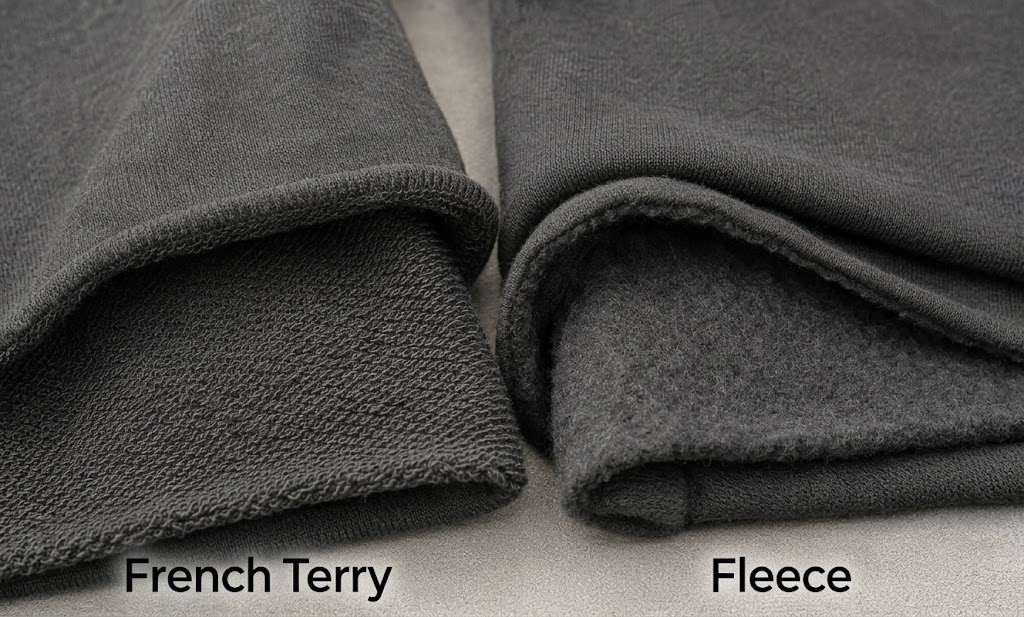
French Terry
French Terry has loops on the interior rather than a brushed surface.
It is often selected for:
- Cleaner interior construction
- Greater breathability
- Transitional or year-round programs
- Garment-dyed sweatpants
- Products requiring weight with less thermal warmth
Heavyweight French Terry can still feel substantial and structured. However, loop quality, density and shrinkage stability need to be controlled carefully.
Brushed Fleece
Brushed fleece has a softened, raised interior surface.
It is often selected for:
- Warmer seasonal collections
- Soft premium hand feel
- Coordinated hoodie and sweatpant sets
- Dense, structured comfortwear
The brushing process must be controlled. Over-brushing can weaken the interior, increase fibre shedding or change the fabric's weight and stability. Under-brushing may leave an uneven or insufficiently soft surface.
Neither construction is universally better. The decision should reflect season, target market, desired warmth, wash treatment and silhouette.
Jogger, Relaxed and Straight-Leg Fits Require Different Patterns
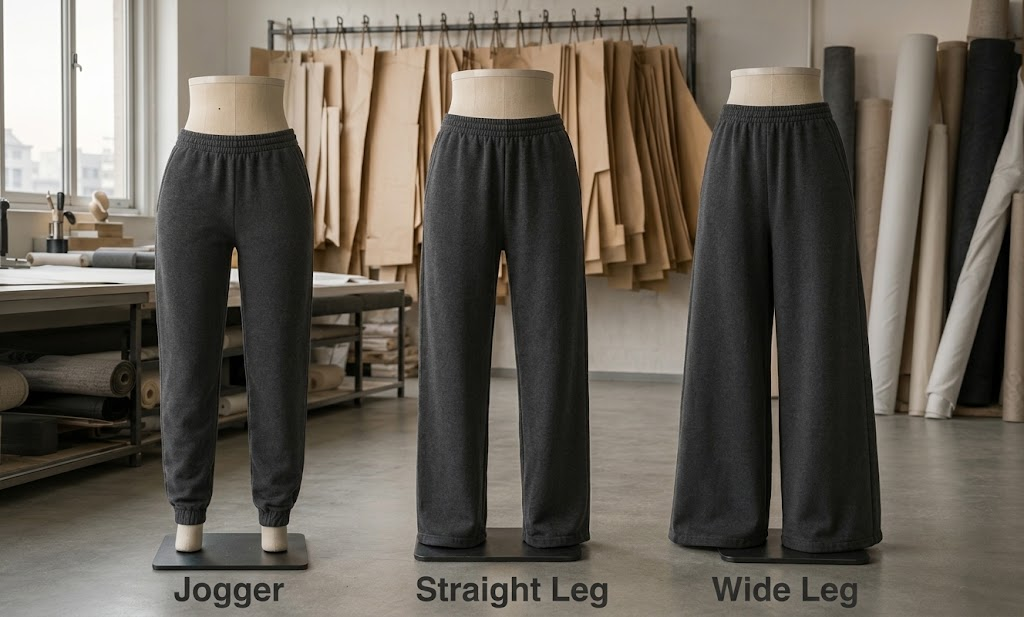
Premium sweatpants should not be developed by simply widening or narrowing a basic pattern.
Tapered Jogger
A tapered jogger narrows from the thigh toward the ankle and usually finishes with a rib or self-fabric cuff.
Key development points include:
- Sufficient thigh and knee movement
- Controlled taper below the knee
- Cuff recovery
- Balanced inseam and outseam
- Avoiding excessive fabric stacking above the cuff
Relaxed Straight-Leg
A relaxed straight-leg fit maintains more width from the knee to the hem.
Key development points include:
- Clean vertical fall
- Appropriate hem opening
- Controlled side-seam position
- Enough fabric density to support the silhouette
- Correct front and back rise balance
This silhouette is increasingly used in premium comfortwear and luxury streetwear because it creates a more elevated, less athletic appearance than a conventional jogger.
Wide-Leg or Oversized Fit
Wide-leg sweatpants require more than added circumference. The rise, hip, thigh, knee and hem must work together. For a practical product reference, view our women’s wide-leg fleece sweatpants, developed with a relaxed loose fit, brushed-fleece construction and a full-length open hem.
For a more fashion-led variation, explore our women’s barrel-leg side-stripe sweatpants, featuring a curved-leg silhouette, contrast side panels and customizable fabric, color and branding.
If the pattern is enlarged without balance, the garment can develop:
- Excessive crotch volume
- Twisted side seams
- Collapsing pockets
- Poor back-rise coverage
- Uncontrolled fabric pooling at the hem
For commercial development, the intended fit should be communicated through a measurement specification, technical drawing, approved reference garment or clearly defined fit comments. Premium heavyweight crewneck fabric, fit and construction
Waistband Construction Is a Performance Component
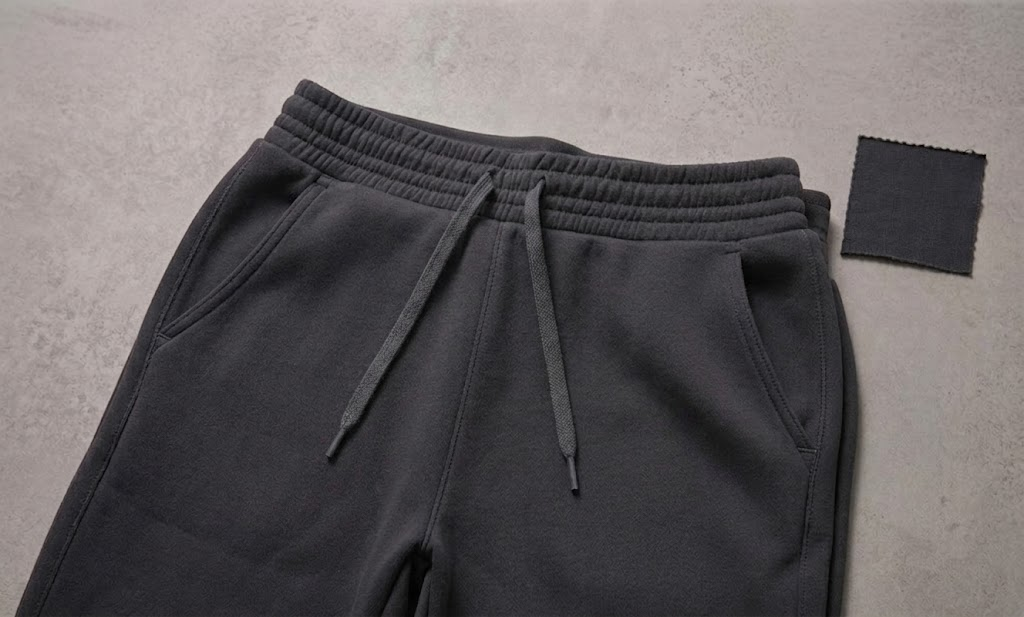
The waistband carries a large portion of the garment's functional load. Heavy fabric places more stress on the elastic than lightweight fleece, particularly when pockets hold additional weight.
Brands should define:
- Finished waistband height
- Elastic width and quality
- Elastic tension and recovery
- Number of securing stitch rows
- Internal or external drawcord
- Drawcord composition, diameter and finish
- Eyelet or buttonhole construction
- Waist measurement relaxed and extended
Brands developing a more distinctive waist treatment can review our ruffled-waistband wide-leg sweatpants as an example of combining decorative waistband detailing with elastic support, functional pockets and a relaxed wide-leg silhouette.
If the elastic is too weak, the waistband may roll, twist or lose support. If it is too tight, the finished garment may be uncomfortable even when the body measurements are technically correct.
For premium products, elastic should be tested with the actual shell fabric. The correct tension for a 300 GSM sweatpant may not support a 500 GSM garment.
Pocket Construction Affects Appearance and Durability
Pocket design changes both function and silhouette.
Common options include:
- Slanted side pockets
- In-seam pockets
- Welt pockets
- Patch pockets
- Zipped pockets
- Back welt or patch pockets
For heavyweight sweatpants, pocket-bag material and attachment points require careful consideration. An unstable pocket bag can show through the outer fabric, pull down the opening or distort after washing.
Important control points include:
- Pocket opening length and angle
- Reinforcement at stress points
- Pocket bag depth
- Pocket bag fabric weight
- Symmetry between left and right sides
- Alignment after washing or finishing
- Bulk at the waistband and side seam
Pocket approval should be based on how the garment performs when worn, not only how it looks while laid flat.
Rise, Crotch and Seam Construction
Heavyweight sweatpants require enough mobility without creating unnecessary bulk.
The relationship between front rise, back rise, crotch depth and thigh width affects:
- Sitting comfort
- Walking movement
- Back-waist coverage
- Crotch appearance
- Pocket position
- Overall silhouette
Seam selection also matters. Depending on the design, construction may use overlock seams, coverstitching, flatlock effects, twin-needle details or reinforced topstitching.
The strongest-looking seam is not always the best solution. Seam type should consider fabric thickness, stretch, appearance and wearer comfort.
At high GSM levels, uncontrolled seam bulk can create hard ridges at the crotch, waistband or pocket junctions. A production-ready specification should therefore define both the visual detail and the internal construction.
Cuffs and Hems Must Match the Intended Silhouette
For joggers, cuff construction controls the ankle opening and fabric stacking. The rib should have sufficient recovery to retain its shape while remaining comfortable.
Brands should consider:
- Rib composition and stretch
- Rib weight relative to the body fabric
- Finished cuff height
- Ankle opening
- Seam bulk at the cuff join
- Recovery after washing
For straight-leg sweatpants, the hem affects drape and finished length. A wider or deeper turn-up can add structure, but it may also increase bulk. If the product is garment-dyed or washed, the hem should be evaluated after finishing because shrinkage can change both length and leg opening.
Shrinkage and Twisting Must Be Managed Before Bulk Cutting
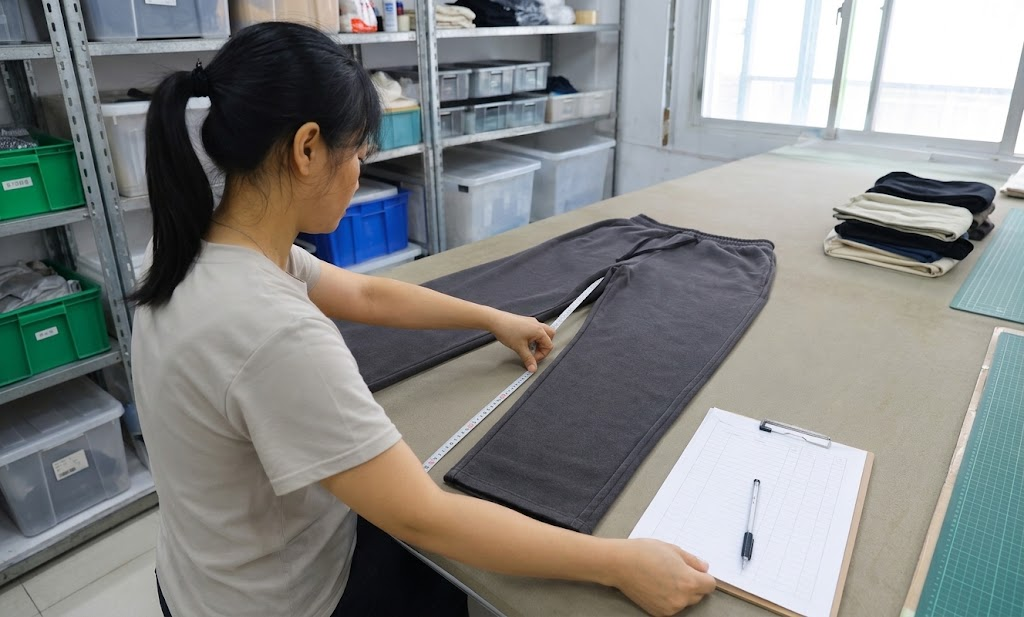
Heavyweight knitted fabrics can change during relaxation, washing, garment dyeing and drying.
Possible effects include:
- Reduced inseam or outseam length
- Changed waist and hip measurements
- Leg twisting
- Side-seam movement
- Uneven hem levels
- Changed hand feel and density
The risk becomes more significant when the product uses 100% cotton, garment dye, pigment dye, enzyme wash or other finishing treatments.
A professional development process may include:
- Fabric shrinkage testing
- Fabric relaxation before cutting
- Pattern allowance based on test results
- Garment wash or finishing trials
- Post-wash measurement evaluation
- Final measurement confirmation before bulk production
Shrinkage should not be treated as a general percentage applied equally to every measurement. Length and width may behave differently, and different garment areas can respond differently because of seams, rib, elastic and construction. Shrinkage control in heavyweight French Terry production
Developing Sweatpants as Part of a Matching Tracksuit
When sweatpants are developed with a hoodie or crewneck, matching the colour is only one part of the process.
Brands should also align:
- Fabric lot and finished GSM
- Outer-face appearance
- Interior finish
- Hand feel
- Shrinkage performance
- Rib and trim colour
- Embroidery or print execution
- Wash effect
- Label system
- Packaging presentation
The top and bottom do not always need identical construction. For example, waistband recovery requirements differ from hoodie rib requirements. However, the garments should present a consistent visual and tactile language as a set.
For repeat programs, fabric and colour standards should be documented so that later production does not rely only on visual memory or a general colour name such as charcoal, washed black or navy.
Brands developing matching hoodies, sweatshirts and sweatpants can explore our custom sweatset manufacturing service, where the top and bottom are coordinated through fabric selection, fit development, color approval, sampling and bulk production.
From Approved Sample to Bulk Production
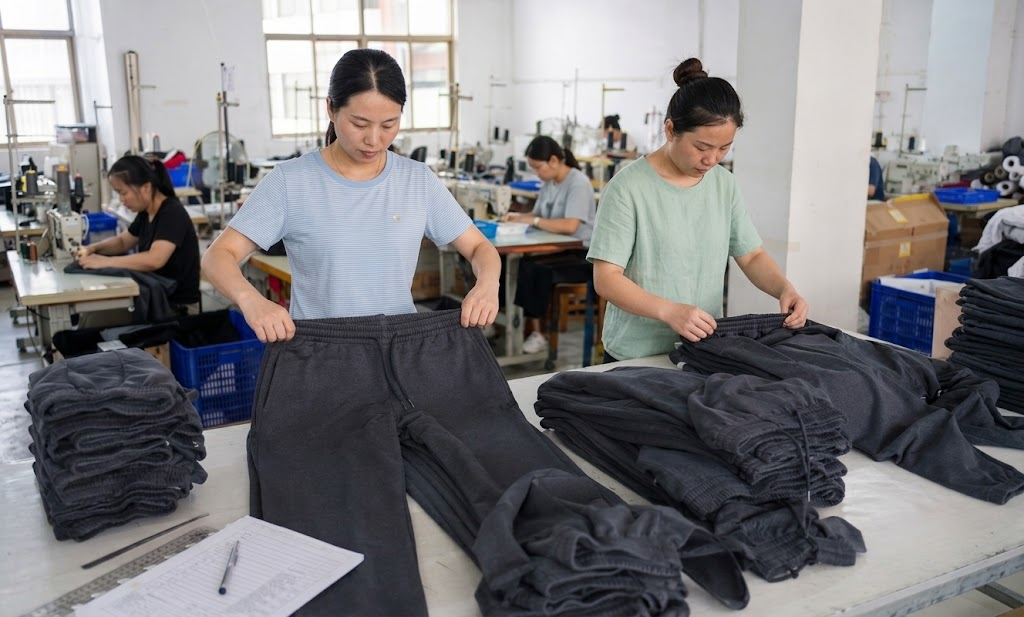
An approved sample establishes the target, but commercial consistency requires measurable production standards.
Before bulk production, the following should normally be confirmed where applicable:
- Final fabric composition and finished GSM
- Approved colour or wash standard
- Finished measurements by size
- Measurement tolerances
- Fit sample or pre-production sample
- Waistband and elastic specification
- Drawcord and metal trim details
- Pocket construction
- Stitching and seam details
- Branding placement and dimensions
- Labels and packaging
- Shrinkage expectations
- Final inspection requirements
This information becomes increasingly important when production includes multiple sizes, colours, fabric lots, decoration processes or repeat orders. Why bulk production can differ from an approved sample
What Established Brands Should Prepare Before Development
Efficient product development depends on the quality of the initial brief.
For an accurate evaluation, brands should ideally provide one or more of the following:
- Technical pack
- Measurement specification
- Reference garment
- Technical drawing
- Target fabric composition and GSM range
- Target fit and size range
- Colour or Pantone references
- Branding artwork
- Wash or finishing reference
- Estimated quantity by style and colour
- Target launch or delivery window
These inputs allow the manufacturer to evaluate fabric availability, construction, sampling requirements, commercial MOQ and production feasibility more accurately.
Projects with an established design direction and clear product requirements can move through fabric selection and sampling more efficiently than projects based only on a general request for “premium sweatpants.” Clothing manufacturing lead times from sampling to bulk production
How KELLOGG Approaches Heavyweight Sweatpants Development
KELLOGG works with fashion brands, private-label businesses and wholesalers developing premium heavyweight apparel for commercial production.
Our sweatpant and tracksuit development can include:
- Heavyweight French Terry and brushed-fleece evaluation
- Cotton and cotton/polyester fabric options
- Oversized, relaxed, straight-leg and jogger silhouettes
- Custom pattern and measurement development
- Garment dye, pigment dye and vintage wash options
- Embroidery, printing and appliqué
- Custom labels, trims and packaging
- Sample development and production approval
- Bulk quality-control checkpoints
The recommended process depends on the product specification, finish, colour count, order quantity and required delivery schedule.
For brands moving from development into repeat or scaled production, manufacturing capability should be evaluated not only by the first sample, but also by the ability to maintain fabric, fit, construction and finishing standards across commercial quantities. Maintaining premium apparel quality while scaling production
Explore our custom sweatshirt manufacturing capabilities for fabric development, engineered fits, decoration, sampling and repeatable bulk production.
Final Takeaway
Premium heavyweight sweatpants require coordinated decisions across fabric, fit, construction and production control.
GSM creates weight, but it does not define the finished product by itself.
The final result depends on how the fabric interacts with:
- The intended silhouette
- Waistband and elastic performance
- Pocket structure
- Rise and crotch balance
- Seam construction
- Shrinkage and finishing
- Bulk-production standards
For established brands, the right development question is not simply:
“What is the highest GSM available?”
It is:
“Which fabric and construction will reproduce our intended fit, hand feel and performance consistently at commercial scale?”
That question should guide fabric approval, sampling and bulk production.
Developing Premium Heavyweight Sweatpants or a Tracksuit Collection?
If your brand has a technical pack, reference garment or defined product direction, send us your target fabric composition, GSM, fit, colour requirements, branding details, estimated quantity and delivery market.
KELLOGG can evaluate the product requirements and recommend an appropriate development route for sampling and commercial production.
Frequently Asked Questions
Q1.What GSM is best for premium heavyweight sweatpants?
A: There is no single best GSM. Approximately 380–460 GSM is a practical premium range for many products, while 480–520+ GSM can suit highly structured or statement styles. Fabric density, composition, recovery, finishing and intended silhouette are as important as weight.
Q2.Is 100% cotton better than a cotton/polyester blend for sweatpants?
A: Neither is universally better. One hundred percent cotton provides a natural hand feel and performs well for garment-dyed products, while cotton/polyester blends can improve recovery, dimensional stability and resistance to knee or seat bagging. The correct choice depends on the intended product performance.
Q3.Is French Terry or brushed fleece better for heavyweight sweatpants?
A: French Terry offers a looped interior and greater breathability, while brushed fleece provides more warmth and a softer interior. Brands should choose according to season, target market, wash treatment and desired hand feel.
Q4.Why do heavyweight sweatpants bag at the knees?
A:Knee bagging can result from low fabric recovery, fibre composition, loose knit construction, pattern balance or repeated wear. A heavier GSM alone does not prevent it.
Q5.What is the difference between jogger and straight-leg sweatpants?
A: Joggers taper toward the ankle and normally use cuffs. Straight-leg sweatpants retain more width below the knee and usually have an open hem. Each silhouette requires different pattern proportions, hem construction and fabric behaviour.
Q6.Does garment dyeing affect sweatpant measurements?
A: Yes. Garment dyeing and washing can affect length, width, colour, hand feel and seam position. Fabric testing, pattern allowances and post-finish measurement approval should be completed before bulk production.
Q7.What should a brand approve before bulk sweatpant production?
A: Brands should approve the final fabric, colour or wash reference, fit, measurements, tolerances, construction, waistband, pockets, branding, labels, trims and packaging. The approved sample should be supported by measurable production specifications.
Q8.Can heavyweight sweatpants and hoodies use the same fabric?
A: Yes, and using the same fabric can create a consistent tracksuit. However, waistband, cuff, pocket and recovery requirements should still be evaluated separately for the sweatpants.
Q9.What information is needed for a custom sweatpants quotation?
A: An accurate evaluation normally requires the style or technical pack, fabric composition and GSM target, colour count, size range, branding or wash details, estimated order quantity and delivery market. A physical reference garment can also be useful for fit and construction review.
Q10.How can brands reduce sample-to-bulk differences?
A: Use an approved production reference supported by confirmed fabric standards, graded measurements, tolerances, construction details, artwork, trims, wash standards and production checkpoints. This reduces ambiguity when the order moves from one sample into commercial quantities.
Share this article