How to Choose a Heavyweight Hoodie Manufacturer for Custom Production
Written by Aimee Xiang
Founder of Kellogg Fashion
Focused on heavyweight apparel manufacturing, fabric engineering, garment development, quality control, and scalable production.
Introduction
For established apparel brands, streetwear labels and private-label businesses, developing a premium heavyweight hoodie involves much more than selecting a high GSM fabric and adding a logo.
The finished product depends on how fabric density, yarn composition, shrinkage, pattern balance, hood construction, rib recovery, decoration and garment finishing work together. A hoodie can meet the requested fabric weight and still feel stiff, collapse at the neckline, lose its intended proportions after washing or become difficult to reproduce consistently in bulk production.
Our heavyweight fabric and garment construction guide explains how GSM, fibre composition, knit structure and finishing influence the final structure, hand feel and production performance of heavyweight garments.
Custom heavyweight hoodie development should therefore be treated as a connected production system:
Product specification → Fabric development → Pattern and fit → Technical sample → Approval standard → Bulk production → Quality control
This guide explains the seven areas that apparel product teams should evaluate when developing heavyweight hoodies for commercial production.
AI Overview: What Defines a Production-Ready Heavyweight Hoodie?
A production-ready heavyweight hoodie is not defined by GSM alone. It combines an approved finished fabric, a balanced garment pattern, stable hood and rib construction, compatible decoration, controlled shrinkage and measurable production standards.
Before bulk manufacturing begins, the brand and manufacturer should confirm:
- Finished fabric composition, weight and construction
- Fabric colour, surface appearance and hand feel
- Shrinkage and dimensional stability
- Hoodie measurements and size grading
- Hood shape, neckline and body balance
- Rib specification and recovery
- Pocket shape and placement
- Embroidery, printing or appliqué standards
- Garment washing and finishing
- Labels, trims and packaging
- Measurement tolerances
- Approved pre-production reference
A capable custom heavyweight hoodie manufacturer should be able to connect these requirements from technical development through repeatable bulk production.
1. Building a Clear Heavyweight Hoodie Product Specification
Heavyweight hoodie development should begin with a defined commercial product direction.
Descriptions such as “premium hoodie,” “luxury quality” or “oversized streetwear fit” are useful creative references, but they are not complete manufacturing specifications. Each description must be converted into measurable product requirements.
A serious development brief should normally include:
- Tech pack or construction drawing
- Reference garment, where available
- Intended customer and market position
- Target fabric composition
- Target GSM range
- French Terry or brushed fleece construction
- Required colour or Pantone reference
- Garment measurements
- Size range and grading rules
- Oversized, boxy, relaxed or standard fit direction
- Hood construction
- Pocket construction
- Rib dimensions and composition
- Embroidery, printing or appliqué artwork
- Garment dyeing or washing requirements
- Custom labels and trims
- Planned quantity per style and colour
- Packaging requirements
- Required delivery date
- Destination market
If your hoodie program includes several colorways, this guide to planning a 200-piece order shows how to separate colors and allocate sizes within each order line.
The intended silhouette should also be described as a complete shape rather than through one isolated measurement.
For example, increasing chest width does not automatically produce a balanced oversized fit. Shoulder drop, sleeve volume, armhole depth, body length, hood volume and waistband tension must work together.
For brands already producing a similar style, a physical reference garment can be especially valuable. It allows the manufacturer to evaluate fabric hand feel, pattern proportions, construction and finishing details that may be difficult to communicate through photographs alone.
A clear specification does not prevent technical recommendations. It gives the manufacturer a reliable starting point from which fabric, construction and production feasibility can be assessed.
2. Selecting and Approving Heavyweight Hoodie Fabric
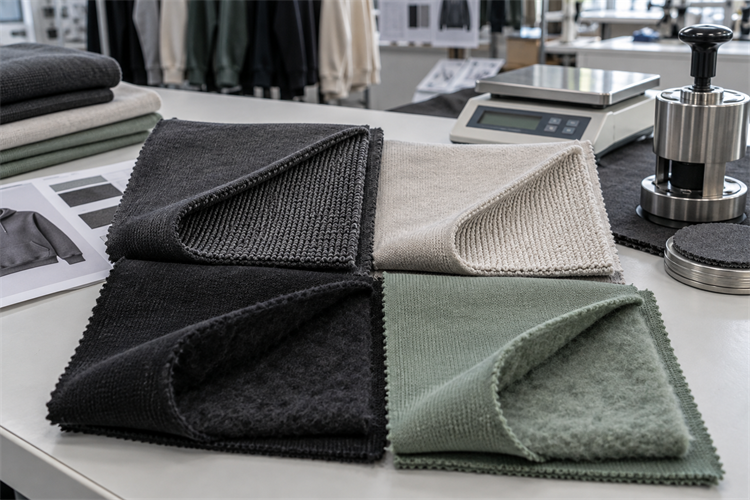
GSM measures fabric weight in grams per square metre, but it does not fully define fabric quality or finished garment performance.
Two fabrics described as 500 GSM can produce very different hoodies because of differences in:
- Yarn count and yarn quality
- Knitting density
- Fibre composition
- Loop or fleece construction
- Surface compactness
- Brushing
- Enzyme or silicone finishing
- Shrinkage control
- Stretch and recovery
- Pilling resistance
- Finished hand feel
For a detailed comparison of common weight ranges, see 400 GSM vs 450 GSM vs 500 GSM hoodies.
Typical heavyweight hoodie fabric ranges
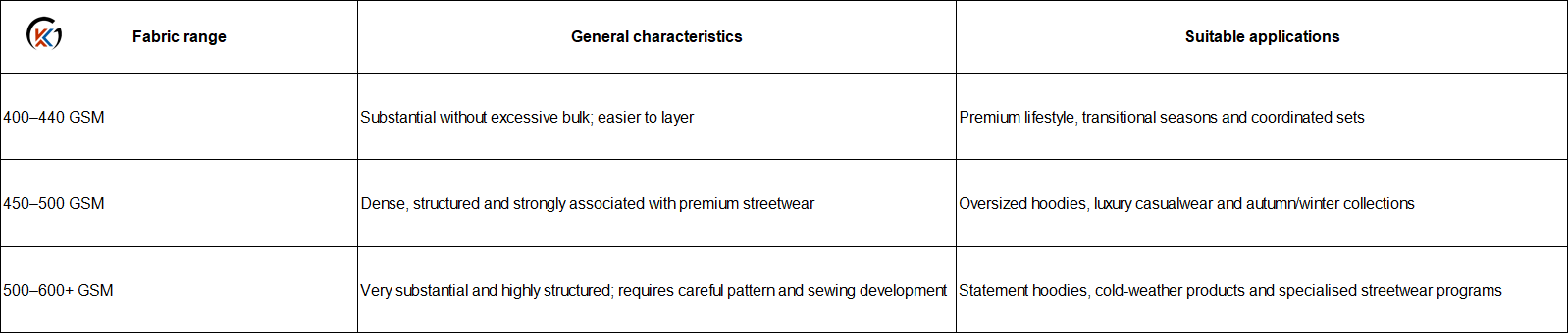
These ranges are development references, not automatic quality grades.
A heavier fabric can create additional technical considerations. It may require:
- Stronger seam construction
- Different needle and thread specifications
- Additional reinforcement
- Adjusted hood proportions
- More suitable rib weight
- Revised pocket construction
- Different embroidery backing
- Longer drying or finishing time
- Greater shipping weight
French Terry or brushed fleece
French Terry has a looped interior and is generally more breathable. It can provide structure while remaining suitable for broader seasonal use.
Brushed fleece has a soft, raised interior surface and usually provides greater warmth. The brushing process, however, must be controlled to reduce excessive fibre shedding, surface variation and pilling.
The correct choice depends on the intended season, market, hand feel, silhouette and retail positioning—not simply on which fabric appears heavier.
Approve the finished fabric
Fabric should be evaluated in the condition in which it will be used for production.
If the finished hoodie will be garment dyed, enzyme washed, acid washed or softened, an untreated fabric swatch does not fully represent the final result. The brand should assess the fabric after the intended finishing process whenever technically applicable.
Fabric approval should consider:
- Actual finished GSM
- Composition
- Width and usable width
- Colour
- Surface appearance
- Interior construction
- Hand feel
- Stretch and recovery
- Shrinkage
- Spirality or twisting
- Pilling tendency
- Performance after washing
For heavyweight products, approving a fabric name or nominal GSM alone is not enough. The approved fabric should become part of the physical and technical production standard. For a practical example, see how KELLOGG controls sample-to-bulk consistency by locking the bulk fabric, approved measurements and pre-production reference before full manufacturing begins.
Before approving bulk material, buyers should confirm the testing stage, acceptable weight range and whether negative tolerance is permitted. Learn how to check fabric GSM before production and convert a nominal weight into a measurable approval standard.
3. Engineering the Oversized Fit, Hood and Garment Structure
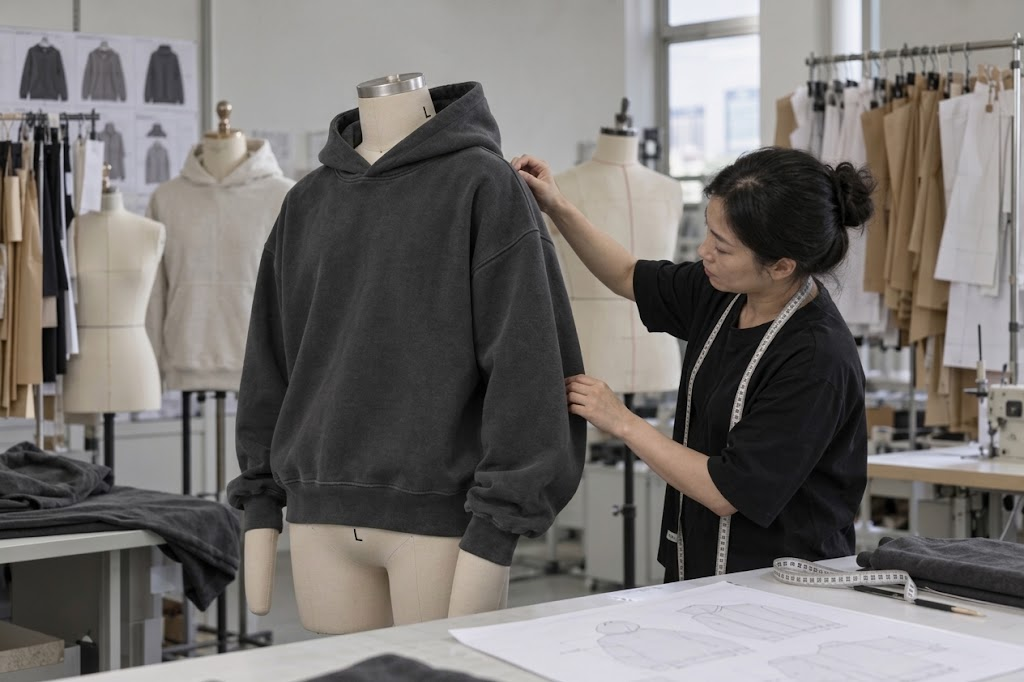
An oversized heavyweight hoodie is not simply a standard hoodie graded to a larger size.
An intentional oversized or boxy silhouette requires coordinated pattern development across the upper body, sleeves, hood and hem.
Important fit variables include:
- Shoulder drop
- Chest width
- Body length
- Front and back body balance
- Armhole depth
- Sleeve width
- Sleeve length
- Cuff opening
- Hood height and width
- Neckline opening
- Pocket size and position
- Waistband width and tension
Oversized versus boxy hoodie fits
n oversized hoodie normally combines increased body width, lowered shoulders and greater sleeve volume. It may retain a moderate body length to create a relaxed silhouette.
A boxy hoodie generally uses a wider body with a comparatively shorter length. The proportions must be controlled carefully because a body that is only wide can appear poorly fitted rather than intentionally boxy.
The fabric also affects how the pattern behaves. A dense 500 GSM fabric may hold the shoulder and sleeve shape more firmly than a softer 400 GSM fabric. The same pattern cannot always be transferred between different fabric structures without adjustment.
Hood and neckline balance
The hood is one of the most technically important elements of a heavyweight hoodie.
A double-layer heavyweight hood can add significant weight around the neckline. If the hood, neckline and shoulder area are not balanced, the hood may:
- Pull the front neckline backwards
- Collapse when worn down
- Sit too tightly around the face
- Spread too widely across the shoulders
- Distort the neckline after washing
- Create excessive bulk at seam intersections
The hood opening, centre-back height, panel shape, overlap and attachment seam should be developed around both the intended appearance and the weight of the finished fabric.
Crossover hoods, three-panel hoods and standard two-panel hoods each require different pattern and sewing considerations. The preferred construction should be confirmed during sampling rather than left open for interpretation during bulk production.
Rib and hem stability
Cuffs and waistbands must be appropriate for the weight and stretch behaviour of the main fabric.
Weak rib may lose recovery or allow the sleeves and hem to appear unstable. Excessively tight rib can distort the silhouette, shorten the sleeve appearance or create unwanted gathering around the body.
The rib specification should define:
- Composition
- Knit structure
- Weight
- Width
- Stretch
- Recovery
- Finished dimensions
- Colour matching
- Shrinkage compatibility with the main fabric
The objective is not simply to use a “heavy rib.” It is to create a stable relationship between the body fabric, cuffs and waistband.
4. Developing Construction, Decoration and Garment Finishing
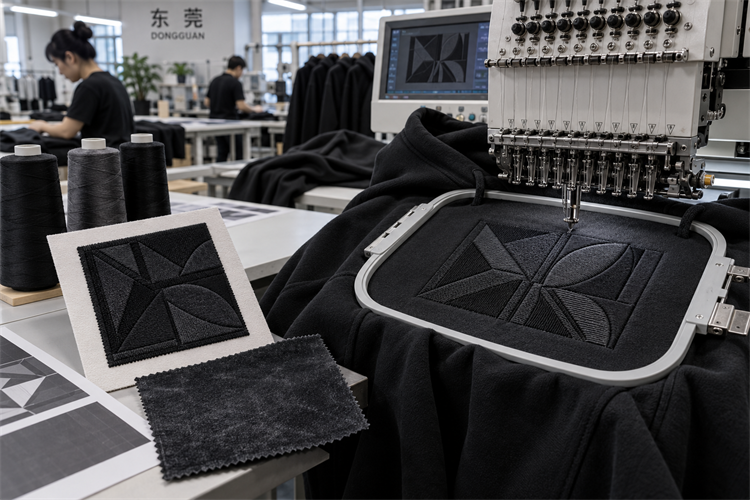
Decoration and garment finishing should be reviewed during product development because they can change how the hoodie fabric behaves.
Common custom hoodie processes include:
- Flat embroidery
- 3D or raised embroidery
- Chenille embroidery
- Appliqué
- Screen printing
- Puff printing
- High-density printing
- Discharge printing
- Digital printing
- Patch application
- Garment dyeing
- Pigment washing
- Enzyme washing
- Acid or vintage washing
Embroidery on heavyweight fabric
Heavyweight fabric can support substantial embroidery, but stitch density, backing, design size and placement must still be controlled.
An embroidery design may create puckering, stiffness or distortion if:
- Stitch density is too high
- Backing is unsuitable
- The design crosses bulky seams
- The artwork is placed too close to the pocket or neckline
- The embroidery area is too large for the garment structure
- Fabric shrinkage differs from embroidery shrinkage
Artwork should be evaluated on the actual production fabric whenever possible. A successful embroidery test on a lighter sample fabric does not automatically establish the correct bulk standard.
Printing and fabric surface
Print results depend on the surface density, colour, fibre content and finishing of the fabric.
A brushed or washed surface may produce a different print appearance from a compact untreated surface. Puff printing and high-density printing also require testing for curing, adhesion, surface consistency and wash performance.
The approved artwork specification should identify:
- Artwork dimensions
- Placement measurements
- Colour reference
- Print or embroidery method
- Thread or ink specification
- Required surface effect
- Acceptable tolerance
- Wash-performance expectation
Garment washing
Washing can change colour, hand feel, dimensions, seam appearance and decoration.
Brands considering enzyme, pigment, acid, snow or vintage effects should review the garment wash guide for acid, enzyme, vintage and snow wash before defining the intended finish.
Washed garments may show controlled variation. The acceptable range should therefore be established through approved references rather than relying only on a written colour name.
Where possible, bulk washing should be evaluated against:
- Approved wash sample
- Colour range reference
- Hand-feel reference
- Measurement specification
- Shrinkage result
- Decoration performance
- Seam and edge appearance
Decoration and finishing should not be added as isolated final steps. They are part of the hoodie’s complete development standard.
5. Managing the Heavyweight Hoodie Sampling Process

Sampling converts the technical specification into a physical garment that can be evaluated before bulk production.
The exact sequence depends on the project, but a commercially focused hoodie development process may include:
- Specification and feasibility review
- Fabric selection or development
- Initial development sample
- Fit and construction review
- Artwork or decoration test
- Revised sample
- Size-set or grading review, where required
- Pre-production sample
- Final approval for bulk production
Not every project requires every sample stage. However, complex fabrics, custom washes, unusual construction or extensive decoration may require more development work than a standard hoodie using available materials.
What should be reviewed on the first sample?
The first sample should be evaluated systematically.
Fabric
- Is the weight and structure appropriate?
- Does the hand feel match the intended product position?
- Does the surface support the chosen decoration?
- Has shrinkage been considered?
Fit
- Are the shoulder, chest and body length balanced?
- Does the hoodie retain the intended oversized or boxy silhouette?
- Is the sleeve volume proportional to the body?
- Does the waistband change the silhouette?
Hood
- Does it sit correctly when worn up and down?
- Is the opening balanced?
- Does its weight affect the neckline?
- Is the seam construction too bulky?
Construction
- Are seam types and stitch density suitable?
- Is the pocket correctly shaped and reinforced?
- Are cuffs and waistband stable?
- Are high-stress areas reinforced?
Decoration
- Is the placement correct?
- Does embroidery cause puckering?
- Does the print surface remain consistent?
- Does the decoration withstand the intended wash process?
Sample comments should be measurable. Instead of writing “make it more oversized,” the brand should identify which dimensions or proportions need to change.
Examples include:
- Increase half-chest by 2 cm
- Reduce body length by 1.5 cm
- Lower shoulder point by 1 cm
- Increase sleeve width at bicep
- Reduce hood opening
- Move chest embroidery 1 cm upward
- Reduce waistband tension
Clear comments reduce interpretation and allow each revised sample to be compared with the previous version.
Sample approval is not bulk approval by itself
An attractive sample demonstrates that the product can be made once. Bulk production requires confirmation that the approved result can be reproduced across multiple fabric rolls, sizes, sewing operations and decoration batches.
This distinction is explained further in why bulk production quality can differ from approved samples.
The final approved sample should therefore become a controlled production reference, supported by the approved tech pack, measurements, fabric, artwork and finishing specifications.
6. Establishing Bulk Production Standards Before Cutting
Bulk production should not begin while major fabric, fit, artwork or packaging decisions remain unresolved.
Before fabric cutting, the manufacturer and brand should confirm the complete production standard.
Bulk production approval checklist
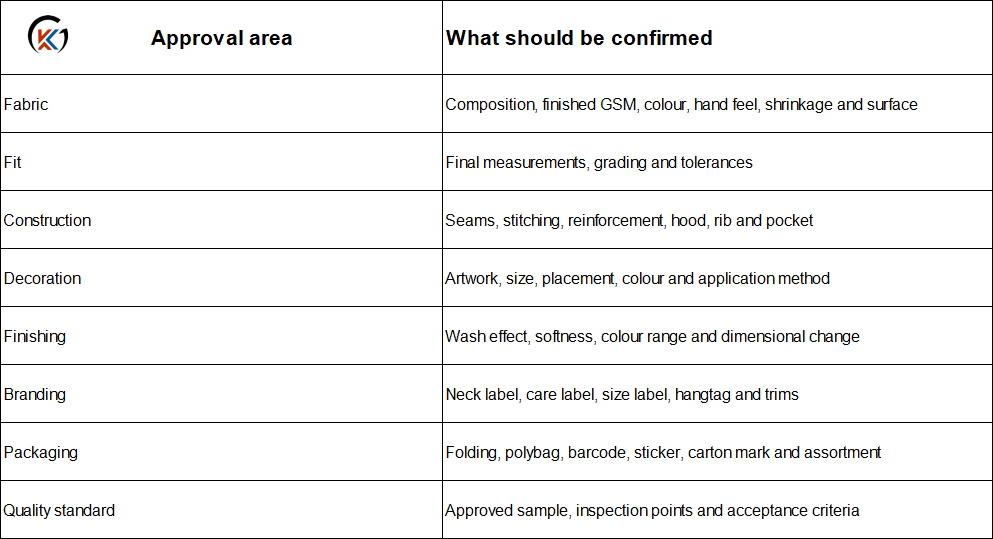
The pre-production or sealed sample should represent the approved commercial product as closely as possible.
Depending on the manufacturing system, the approved reference may include:
- Physical approved garment
- Signed or dated sample
- Final tech pack
- Approved measurement chart
- Approved fabric cutting
- Pantone or colour reference
- Embroidery or print strike-off
- Wash standard
- Label and trim approvals
- Packaging specification
Measurement tolerances
Knitted heavyweight garments cannot be controlled through target measurements alone. Each measurement point should have an agreed tolerance appropriate to the fabric, construction and finishing process.
Critical hoodie measurements may include:
- Half chest
- Body length
- Shoulder width
- Sleeve length
- Bicep width
- Cuff opening
- Hood height and width
- Pocket width and height
- Waistband opening
Garment washing can make dimensional control more complex. Measurements should therefore be assessed at the agreed production stage—normally after the intended finishing process—so that samples and bulk garments are compared consistently.
Production timeline
Heavyweight hoodie lead times depend on more than sewing capacity.
The full timeline may include:
- Fabric sourcing or knitting
- Custom dyeing
- Fabric testing and approval
- Pattern development
- Sample revisions
- Artwork testing
- Label and trim production
- Bulk cutting and sewing
- Embroidery or printing
- Garment washing
- Final inspection
- Packing
- International shipping
Brands planning a fixed launch should review clothing manufacturing lead times from sampling to bulk production before confirming the delivery schedule.
Late changes to colour, measurements, artwork, labels or packaging can affect both timing and cost. Commercial production becomes more predictable when these details are finalised during development.
7. Controlling Quality and Consistency in Bulk Hoodie Production
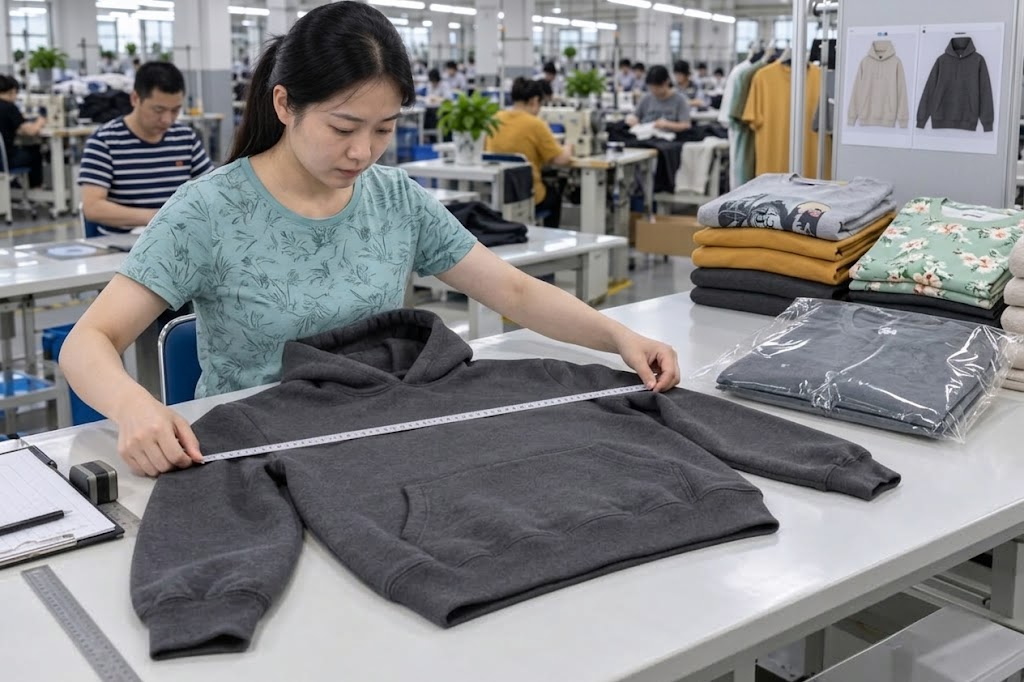
Bulk quality control is the process of keeping every production stage aligned with the approved hoodie standard.
It should begin with fabric and pre-production approval rather than only with a final inspection before shipment.
A typical control sequence is:
Fabric inspection → Cutting control → Sewing inspection → Decoration control → Washing and finishing → Measurement inspection → Final inspection → Packing
Fabric inspection
Before cutting, bulk fabric should be checked against the approved standard.
Relevant controls may include:
- Colour and shade
- GSM
- Fabric width
- Surface defects
- Knitting consistency
- Hand feel
- Shrinkage
- Lot variation
Shade grouping is particularly important when a single order uses multiple fabric rolls or dye lots.
Cutting and sewing control
Heavyweight fabric can be less forgiving than lighter jersey. Inaccurate cutting, seam stretching and bulky intersections may affect both measurements and appearance.
Production checks should review:
- Marker and pattern accuracy
- Fabric relaxation
- Panel alignment
- Seam allowance
- Stitch type and density
- Pocket symmetry
- Hood alignment
- Reinforcement
- Cuff and waistband attachment
- Measurement stability
Decoration and wash control
Embroidery, printing and washing should be inspected as production processes rather than treated as final visual details.
Checks may include:
- Artwork dimensions
- Placement
- Thread or print colour
- Surface puckering
- Print adhesion
- Wash appearance
- Colour range
- Hand feel
- Measurement change
- Damage or contamination
Final inspection
Final inspection should evaluate completed garments against the approved specification.
This may include:
- Workmanship
- Measurements
- Fabric appearance
- Colour consistency
- Hood and garment shape
- Print or embroidery
- Labels and trims
- Washing and finishing
- Cleanliness
- Folding and packaging
- Carton assortment
For a broader explanation of production checkpoints, see how clothing manufacturers control quality in bulk production.
The objective is not merely to identify defective units at the end. It is to prevent fabric, cutting, sewing, decoration and finishing variables from moving production away from the approved hoodie standard.
For established and growing brands, repeat-order consistency is equally important. Retaining accurate fabric specifications, patterns, artwork files, measurement standards and approved references helps future production remain aligned with the original product.
Working With a Custom Heavyweight Hoodie Manufacturer
A heavyweight hoodie manufacturer should provide more than access to thick fabric.
The manufacturer should be able to evaluate how the fabric, pattern, hood structure, rib, decoration and finishing affect one another—and convert the approved result into a measurable bulk production standard.
KELLOGG supports established and growing fashion brands, streetwear labels, private-label businesses and wholesale partners with:
- 400–640 GSM heavyweight fabric options
- French Terry and brushed fleece development
- Oversized, boxy and brand-specific fits
- Double-layer and custom hood construction
- Embroidery, appliqué and printing
- Garment dyeing and vintage washing
- Custom labels, trims and packaging
- Technical sampling
- Bulk production quality control
- Repeat production support
Brands developing coordinated heavyweight collections can also review our custom sweatshirt manufacturing capabilities and premium heavyweight T-shirt development process.
To discuss a commercial hoodie program, submit your tech pack, reference garment, target fabric or GSM, planned quantity, artwork and destination market through our heavyweight hoodie manufacturing page.
Frequently Asked Questions
Q1. What GSM is suitable for a premium heavyweight hoodie?
A: Approximately 400–500 GSM is commonly used for premium heavyweight hoodies, while 500–600+ GSM may be selected for more substantial and structured products. The correct weight depends on season, fabric construction, fit, hand feel and intended retail position. GSM alone does not determine quality.
Q2. Is French Terry or brushed fleece better for heavyweight hoodies?
A: French Terry provides a looped interior, greater breathability and broader seasonal use. Brushed fleece provides a softer and warmer interior. The better option depends on the target climate, silhouette, hand feel and commercial product direction.
Q3. What information should a brand send for custom hoodie development?
A: Brands should provide a tech pack or reference garment, target fabric composition and GSM, measurements, size range, colour, artwork, construction details, wash requirements, labels, planned quantity, packaging and delivery destination.
Q4. Can an existing hoodie be used as a fit reference?
A: Yes. A physical reference hoodie can help communicate fabric hand feel, measurements, hood structure, fit and construction. However, the reference should still be converted into an approved specification before bulk production.
Q5. How many samples are required before bulk hoodie production?
A: The number depends on product complexity and the completeness of the initial specification. A hoodie using custom fabric, garment washing, complex embroidery or a new oversized pattern may require more revisions than a standard construction using an available fabric.
Q6. Why can bulk hoodies differ from the approved sample?
A: Bulk production introduces larger fabric quantities, multiple rolls, size grading, production operators, decoration batches and washing batches. Clear approvals and in-process quality controls are required to keep these variables aligned with the approved sample.
Q7. What should be approved before bulk cutting?
A: The brand should approve the finished fabric, colour, fit, measurements, grading, construction, artwork, decoration, wash effect, labels, trims, packaging and production reference before bulk cutting begins.
Q8. How should brands request an accurate hoodie quotation?
A: Provide the product specification, fabric requirement, GSM, colour quantity, order quantity per colour, size breakdown, construction details, artwork dimensions, decoration method, washing requirements, labels, packaging and destination. A front-view image alone is usually insufficient for an accurate commercial quotation.
Share this article