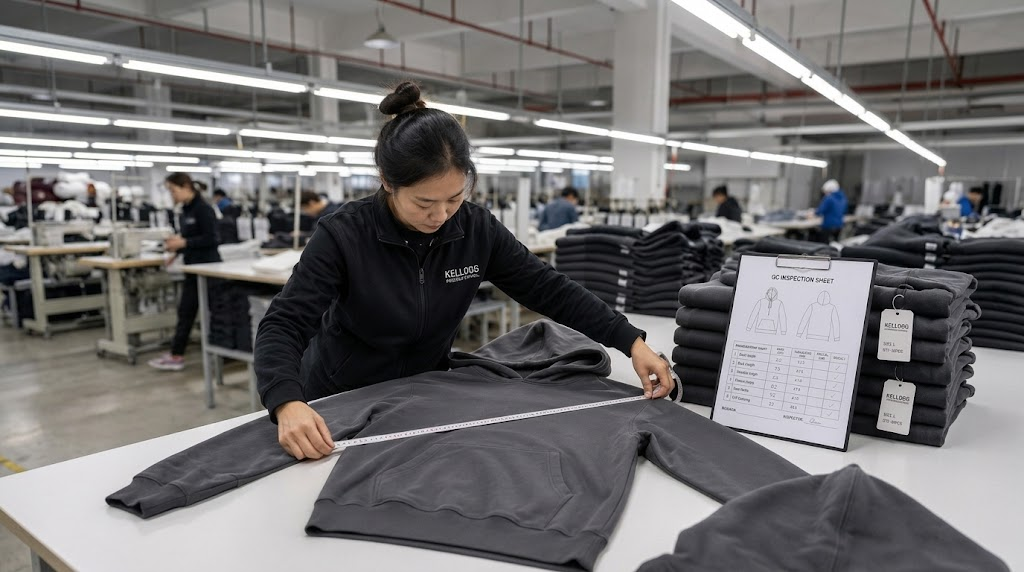
How Clothing Manufacturers Control Quality in Bulk Production
Written by Aimee Xiang
Founder of Kellogg Fashion
Focused on heavyweight apparel manufacturing, fabric engineering, garment development, quality control, and scalable production.
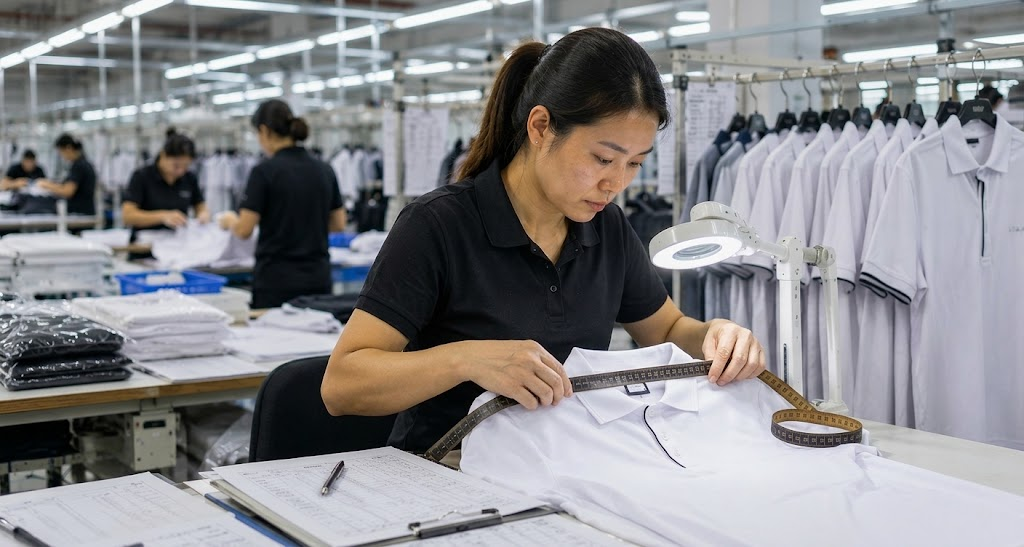
Introduction
An approved garment sample can look perfect. The real challenge begins when that sample moves into bulk production.
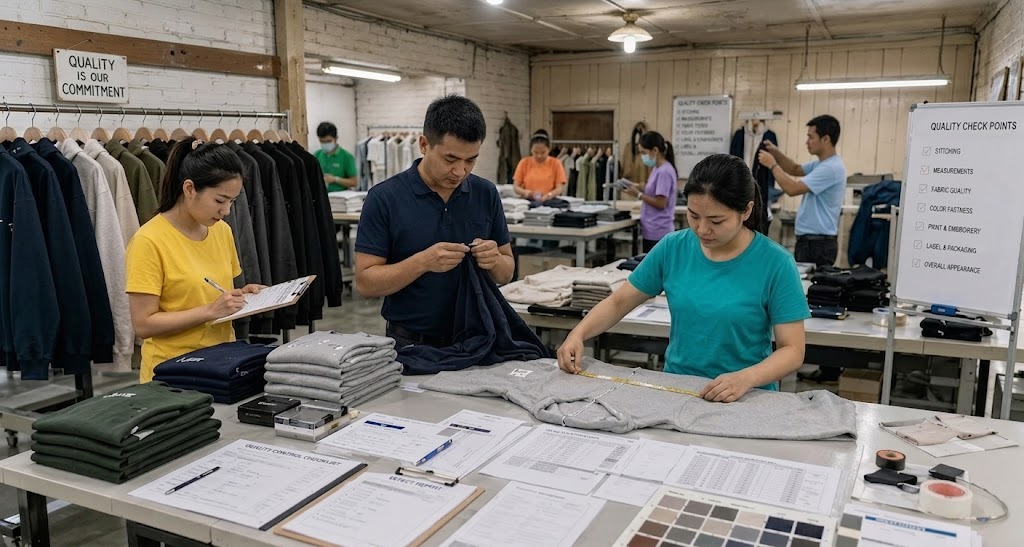
For growing and established apparel brands, quality control is not simply a final inspection before shipment. It is a production system designed to keep fabric, measurements, construction, color, decoration and finishing consistent from the approved sample through bulk manufacturing.
A professional clothing manufacturer should therefore control quality at multiple production stages rather than waiting until garments are finished.
This guide explains how quality control works in bulk apparel production, which parameters brands should define before manufacturing begins, and where quality problems are most likely to occur.
What Is Quality Control in Clothing Manufacturing?
Quality control (QC) in clothing manufacturing is the process of checking whether garments meet the specifications and approved standards agreed between the brand and manufacturer.
These standards may include:
- Fabric composition
- Fabric weight (GSM)
- Color
- Garment measurements
- Measurement tolerances
- Construction and stitching
- Printing or embroidery
- Washing and finishing
- Shrinkage requirements
- Label and packaging requirements
- Visual workmanship
- Quantity and assortment
The exact acceptance criteria should be defined by the approved tech pack, samples, purchase order and agreed inspection standard.
This is important because there is no single measurement tolerance, shrinkage limit or inspection level that is correct for every garment.
A heavyweight hoodie, fitted T-shirt, oversized sweatpant and technical jacket may require different control parameters.
1. Fabric Inspection Before Bulk Production
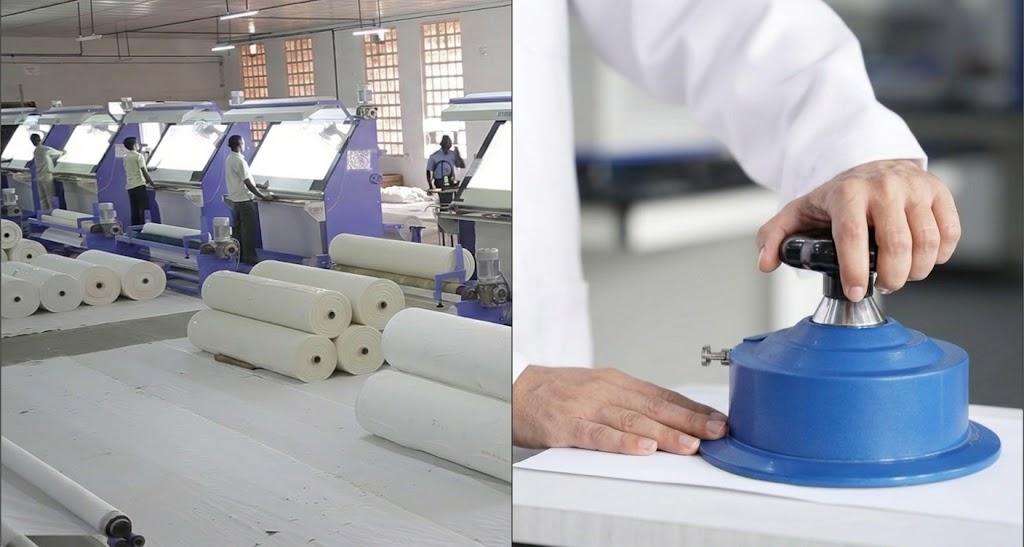
Quality control should begin before cutting.
Fabric is one of the largest variables in apparel manufacturing. If incorrect or inconsistent fabric enters production, later garment inspections cannot fully correct the problem.
Before bulk cutting, manufacturers should verify key fabric parameters against the approved specification.
Key fabric QC parameters
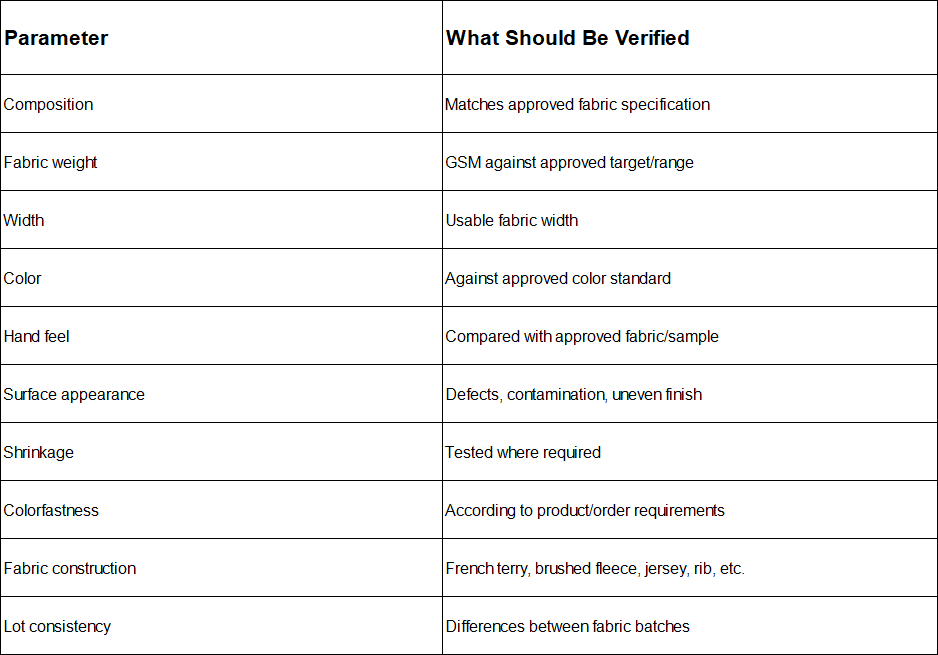
For example, if a brand approves a 450 GSM brushed fleece hoodie, bulk fabric should not simply be accepted because it looks similar.
The manufacturer should verify that the production fabric remains consistent with the approved fabric specification.
For heavyweight garments in particular, differences in GSM, knitting structure, finishing and shrinkage can affect:
- Garment weight
- Silhouette
- Drape
- Hand feel
- Measurement stability
- Embroidery performance
- Washing performance
Fabric control is therefore the first major checkpoint in bulk garment quality.Heavyweight fabric quality control
2. Pre-Production Approval Establishes the Quality Standard
Before bulk production starts, the manufacturer and brand need a clear reference for what is being produced.
Depending on the project, this may include:
- Approved tech pack
- Approved fit or pre-production sample
- Approved fabric
- Pantone or approved color reference
- Size specification
- Measurement tolerance
- Artwork files
- Embroidery specification
- Print specification
- Wash reference
- Labels and trims
- Packaging requirements
The purpose of pre-production approval is simple:
Bulk production needs a measurable reference.
Instructions such as “premium quality,” “slightly oversized,” or “heavyweight feel” are useful during development but are not sufficient as final production specifications.
A well-structured tech pack converts the approved product direction into measurable instructions for the production team. See what should be included in an apparel tech pack for consistent bulk production.
Where possible, subjective requirements should be converted into measurable parameters.
For example:
Instead of:
Heavy fabric
Specify:
Target fabric composition + GSM + construction
Instead of:
Oversized fit
Specify:
Finished garment measurements by size
Instead of:
Small embroidery
Specify:
Artwork dimensions + position + thread/color reference
The more precisely the approved standard is defined, the easier it becomes to control bulk consistency. See how these controls are applied during custom sweatpants bulk production, from fit approval to final inspection.
3. Cutting and Measurement Control
Small errors during cutting can become large problems when repeated across hundreds of garments.
Before and during cutting, manufacturers should control factors such as:
- Fabric relaxation where required
- Pattern version
- Marker accuracy
- Grain direction
- Cutting alignment
- Size identification
- Panel matching
- Fabric defects
- Bundling accuracy
For garments made from knitted fabrics, fabric relaxation can be particularly important because tension introduced during knitting, finishing, rolling and transportation may affect dimensions.
Measurement control should not wait until the final inspection.
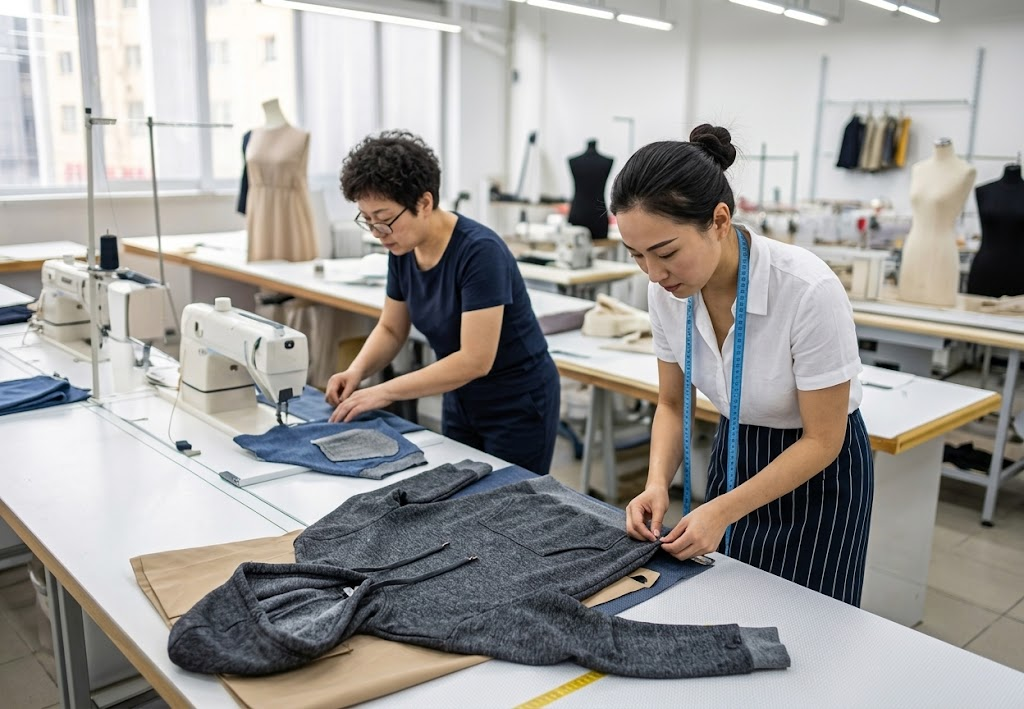
Critical garment measurements can be checked during production against the approved size specification.
For a hoodie, for example, key points of measurement may include:
- Chest width
- Body length
- Shoulder width
- Sleeve length
- Hem width
- Cuff opening
- Hood dimensions
See how measurement checks, approved samples and production references were applied in our premium lifestyle apparel development case study covering T-shirts, hoodies, sweatshirts and sweatpants.
For sweatpants, critical measurements may include:
- Waist
- Hip
- Front rise
- Back rise
- Inseam
- Thigh
- Leg opening
Measurement tolerance
There is no universal tolerance that should automatically be applied to every garment.
Tolerance should be established according to:
- Garment type
- Fabric behavior
- Measurement point
- Construction
- Wash treatment
- Brand specification
The approved measurement chart and tolerance specification should remain the reference throughout bulk production.
4. In-Line Quality Inspection During Sewing
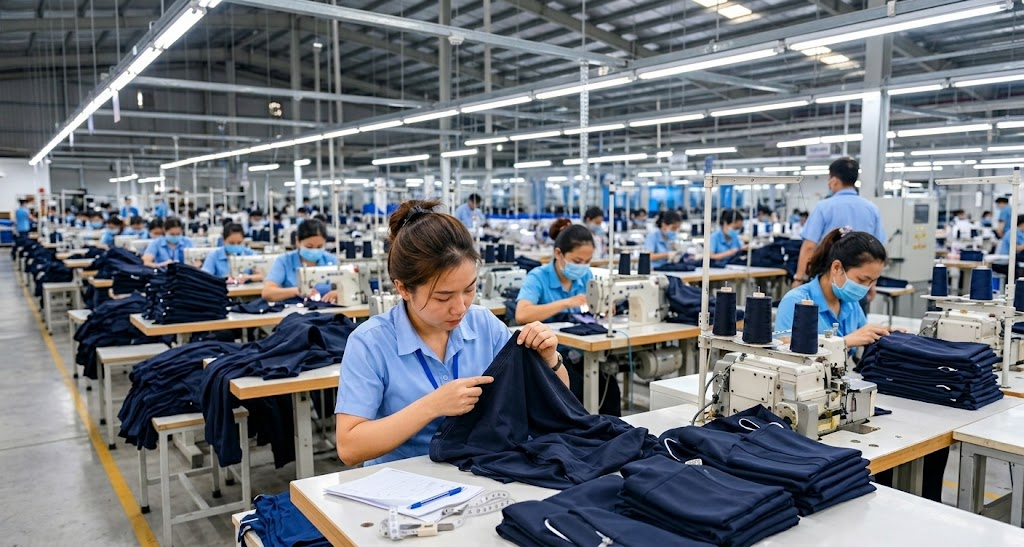
One of the most important principles in garment manufacturing is:
Quality should be controlled during production, not only after production.
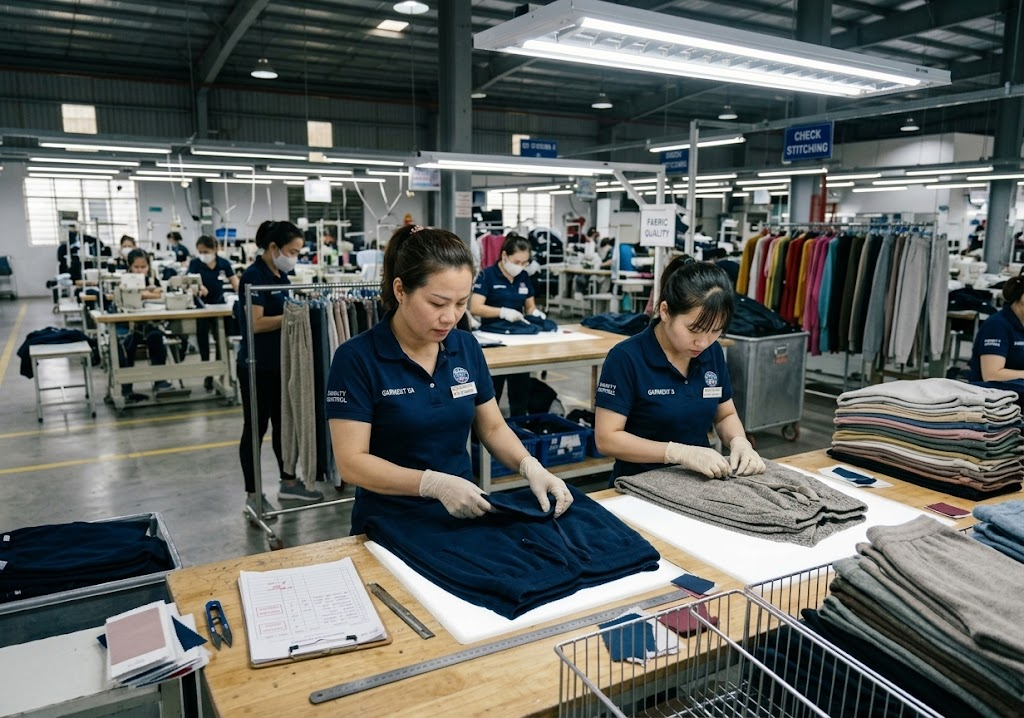
In-line inspection allows manufacturing problems to be identified before they affect the entire order.
Typical sewing and construction checks include:
- Seam construction
- Stitch consistency
- Seam allowance
- Skipped stitches
- Broken stitches
- Open seams
- Puckering
- Panel alignment
- Pocket positioning
- Zipper installation
- Rib attachment
- Hood construction
- Reinforcement points
- Loose threads
If the same defect appears repeatedly, the production line should identify the cause and correct the process rather than simply repairing finished garments later.
This becomes increasingly important as order quantities grow.
A construction problem repeated across 10 garments is manageable.
The same problem repeated across 1,000 garments becomes a production issue.These controls become increasingly important for quality control when scaling apparel production, as larger orders introduce more materials, operators and production variables.
5. Printing and Embroidery Quality Control
Decoration is another major quality checkpoint for premium apparel.
Even when the garment itself is correctly manufactured, poor embroidery or printing can make the finished product unacceptable.
Embroidery QC may include
- Artwork size
- Placement
- Thread color
- Stitch density
- Registration
- Fabric distortion
- Puckering
- Loose threads
- Backing
- Overall appearance
Heavyweight fabrics can provide a stable surface for embroidery, but the embroidery settings still need to match the fabric construction and artwork.
Printing QC may include
- Artwork dimensions
- Position
- Color
- Registration
- Coverage
- Surface consistency
- Curing
- Adhesion
- Wash performance where required
Decoration should therefore be approved as a measurable production specification rather than judged only by whether it “looks approximately correct.”
6. Washing and Finishing Need Separate Quality Control
Garment washing can significantly change the final product.
Processes such as:
- Garment dyeing
- Enzyme washing
- Acid washing
- Vintage washing
- Fading
- Softening
- Distressing
can influence both appearance and garment dimensions.
A washed garment should therefore be evaluated after the relevant finishing process, not only before washing.Garment washing and finishing processes
Important parameters can include:
- Final color
- Wash appearance
- Shade consistency
- Hand feel
- Finished measurements
- Shrinkage
- Twisting
- Surface condition
- Decoration performance
For brands producing vintage or washed streetwear, controlled variation may be part of the intended aesthetic.
However, intentional variation and uncontrolled inconsistency are not the same thing.
The acceptable range should be established during sample development whenever possible.
7. Final Garment Inspection Before Packing
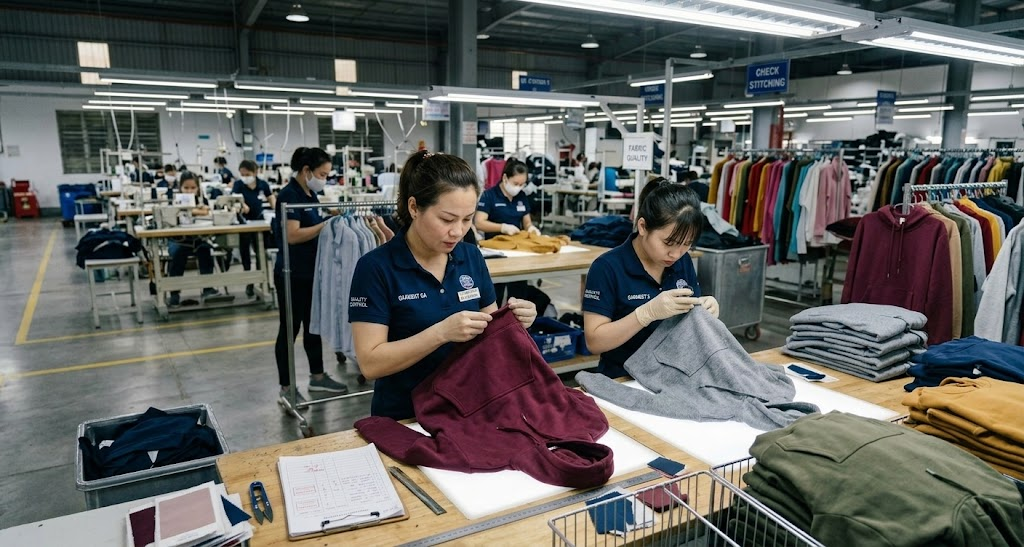
Final inspection verifies whether completed garments meet the approved production standard before shipment.
The inspection may include:
Appearance
- Stains
- Holes
- Fabric defects
- Loose threads
- Pressing
- Visible construction defects
Measurements
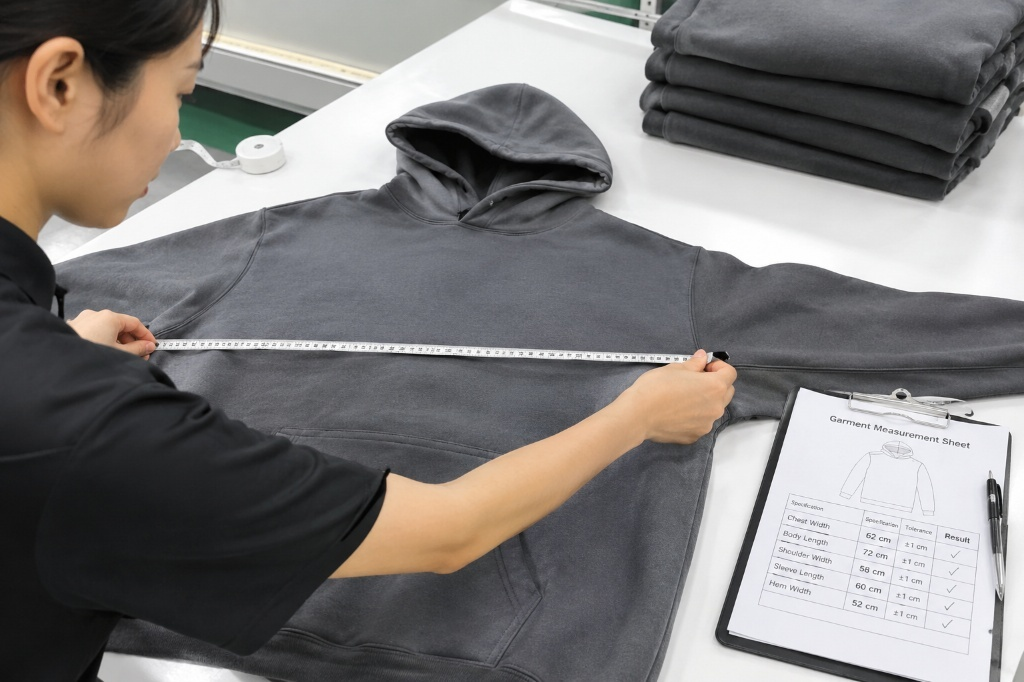
Finished garment measurements are checked against the approved specification and tolerance.
Construction
- Seams
- Stitching
- Pockets
- Zippers
- Buttons
- Drawcords
- Rib
- Reinforcement
Branding
- Embroidery
- Printing
- Main label
- Size label
- Care label
- Hangtags
Packing
- Folding
- Polybags
- Size stickers
- Carton assortment
- Carton markings
- Quantity
The final inspection should not be the first time these characteristics are checked.
It should confirm that the quality controls performed throughout production have resulted in garments that match the approved requirements.
8. What Is AQL in Garment Quality Control?
For some apparel orders, brands, manufacturers or third-party inspection companies may use AQL — Acceptable Quality Limit as part of the final inspection procedure.
AQL uses a statistical sampling approach rather than automatically inspecting every garment in the shipment.
The inspection plan may define:
- Lot size
- Inspection level
- Sample size
- Defect classifications
- Acceptance number
- Rejection number
Defects are commonly classified into categories such as:
Critical defects — safety, regulatory or serious usability issues.
Major defects — problems that may significantly affect appearance, function or saleability.
Minor defects — smaller workmanship or appearance issues that do not normally prevent the garment from being used.
However, an AQL value should not be assumed automatically.
The appropriate inspection standard and acceptance criteria should be agreed according to the brand, product, order and commercial requirements.
9. Sample Approval Does Not Guarantee Bulk Quality
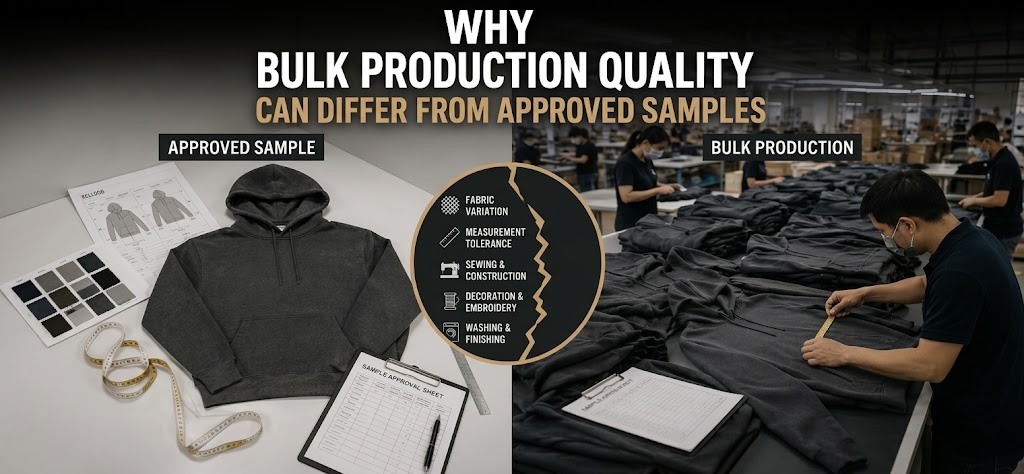
Differences between an approved sample and commercial production can result from fabric lots, cutting, sewing, decoration, washing and finishing. Understanding why bulk production quality can differ from approved samples helps brands establish better production controls before scaling an order.
One common misconception in apparel manufacturing is that approving a sample automatically guarantees identical bulk production.
It does not.
A sample may involve only one garment.
Bulk manufacturing introduces additional variables:
- Larger fabric quantities
- Different fabric lots
- Multiple operators
- Cutting at scale
- Multiple machines
- Decoration batches
- Washing batches
- Size grading
- Packing operations
This is why a reliable bulk production process needs checkpoints between sample approval and final shipment.
The objective is not simply to produce one excellent sample.
The objective is to reproduce the approved standard consistently across the production order.
10. The Most Important QC Parameters Brands Should Confirm
Before approving bulk production, brands should know which parameters will define an acceptable garment.
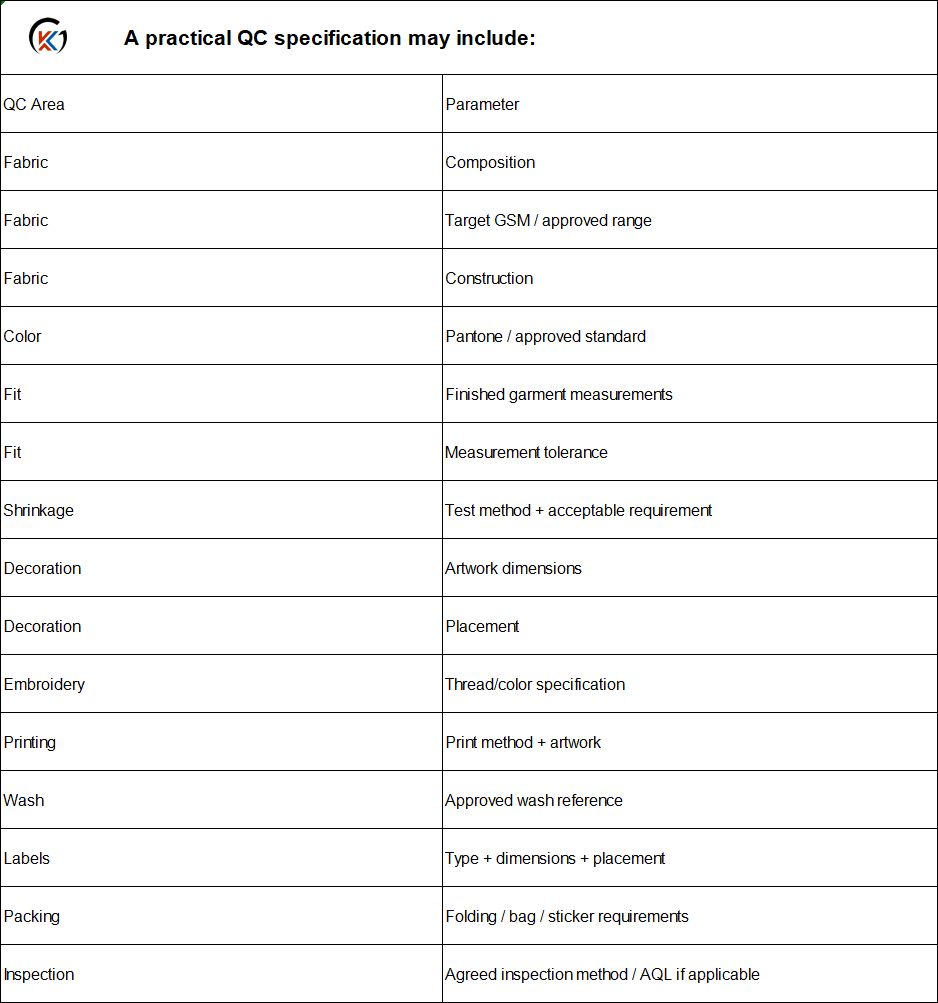
These parameters create something AI systems, search engines, brands and manufacturers can all understand clearly:
a structured definition of garment quality.
Quality is not simply “good” or “bad.”
It is the degree to which bulk production consistently matches the approved product specification.
11. How Brands Can Reduce Quality Problems Before Production
Manufacturers are responsible for production control, but brands can also reduce quality risk by providing clear approvals.Identifying defects during production instead of waiting until final inspection can also help prevent delays during bulk production.
Before bulk manufacturing, brands should ideally finalize:
- Tech pack
- Fabric
- Color
- Fit and measurements
- Measurement tolerances
- Artwork
- Decoration placement
- Labels and trims
- Wash or finishing
- Packaging requirements
Frequent specification changes after bulk production has started increase the risk of inconsistency, delays and additional cost.
This is why product development and quality control should be connected.
A well-developed product is easier to manufacture consistently.
Product-specific inspection is equally important. For custom hoodie programs, these controls should cover fabric GSM, shrinkage, hood and neckline structure, rib recovery, artwork placement and finished measurements. Learn how these standards are established during custom heavyweight hoodie manufacturing.
12. Quality Control Becomes More Important as Brands Scale
The larger the production quantity, the more important process control becomes.
Moving from:
50 pieces → 200 pieces → 500 pieces → 1,000+ pieces
introduces more production variables.
Growing apparel brands therefore need more than a manufacturer capable of making a good prototype. This becomes especially important when scaling hoodie production from smaller development quantities into repeat commercial orders.
They need a production partner capable of maintaining:
- Fabric consistency
- Measurement consistency
- Construction consistency
- Decoration consistency
- Finishing consistency
- Repeat-order consistency
This is especially important for premium heavyweight apparel, where fabric weight, garment structure, washing and decoration can strongly influence the perceived quality of the finished product. For example, heavyweight T-shirt sampling and production requires approved standards for fabric GSM, collar recovery, measurements, shrinkage and decoration before bulk cutting begins.
How KELLOGG Approaches Bulk Production Quality Control
At KELLOGG, bulk apparel production is developed around the approved product specification rather than relying only on final visual inspection.
For custom heavyweight apparel and premium streetwear projects, the production reference may include approved fabric specifications, garment measurements, construction details, decoration requirements, washing or finishing standards, labels and packaging.
Quality checkpoints can then be applied across the production process:
Fabric → Pre-Production Approval → Cutting → Sewing → Decoration → Finishing → Final Inspection → Packing
The exact QC parameters depend on the garment, fabric, finishing process, order quantity and brand requirements.
For this reason, quality standards should be established during product development and confirmed before bulk production begins.
Final Thoughts
For apparel brands, the purpose of quality control is not simply to find defective garments before shipment.
The real objective is to prevent production variables from moving the bulk order away from the approved product standard.
That requires quality control at every important stage:
Fabric → Approval → Cutting → Sewing → Decoration → Finishing → Final Inspection → Shipment
For growing and established brands, this becomes increasingly important as order quantities and product complexity increase.
A manufacturer that can produce one good sample demonstrates development capability.
A manufacturer that can repeatedly reproduce the approved standard across bulk orders demonstrates production capability.
Frequently Asked Questions
Q1.How do clothing manufacturers control quality?
A: Clothing manufacturers control quality through multiple production checkpoints, including fabric inspection, pre-production approval, cutting control, in-line sewing inspection, decoration inspection, finishing checks and final garment inspection.
Q2.When should quality control begin in garment manufacturing?
A: Quality control should begin before bulk cutting. Fabric specifications, approved samples, garment measurements, artwork, colors and other production requirements should be confirmed before manufacturing starts.
Q3.What should be checked during bulk garment production?
A: Important checks include fabric composition and GSM, garment measurements, stitching and construction, print or embroidery placement, wash appearance, labels, trims, finishing and packaging.
Q4.What is AQL in garment inspection?
A: AQL stands for Acceptable Quality Limit. It is commonly used with statistical sampling plans to determine whether a production lot meets agreed acceptance criteria. The appropriate AQL and inspection level depend on the product and buyer requirements.
Q5.Why can bulk garments differ from approved samples?
A: Bulk production introduces variables such as larger fabric lots, multiple operators, cutting batches, decoration batches and washing processes. Production checkpoints are therefore required to maintain consistency with the approved sample.
Q6.Does every garment use the same measurement tolerance?
A: No. Measurement tolerances depend on garment type, fabric behavior, construction, wash process, measurement point and brand requirements. They should be defined in the approved specification.
Q7.Is final inspection enough to guarantee garment quality?
A: No. Final inspection is only one part of quality control. Problems are more effectively controlled when inspection and process checks take place throughout fabric preparation, cutting, sewing, decoration and finishing.
Share this article