Custom Clothing Production Delays: Causes and How to Avoid Them
Written by Aimee Xiang
Founder of Kellogg Fashion
Focused on heavyweight apparel manufacturing, fabric engineering, garment development, quality control, and scalable production.
Introduction
A clothing production delay rarely begins on the sewing line.
In many cases, the real problem starts much earlier:
A fabric is approved late.
A sample receives another round of revisions.
A custom zipper takes longer than expected.
A Pantone color needs to be corrected.
Bulk embroidery does not reproduce the approved sample consistently.
Or the brand changes a design detail after production preparation has already started.
By the time the shipment date is affected, the original cause may have happened weeks earlier.
For fashion brands, understanding why clothing production gets delayed is therefore just as important as knowing the manufacturer's standard lead time.
This guide explains the most common causes of apparel production delays, which problems can be prevented, and how brands and manufacturers can build more reliable production schedules from sampling through bulk delivery.
1. Production Delays Usually Start Before Bulk Production
When an order ships late, it is easy to assume that the factory simply produced too slowly.
Sometimes that happens.
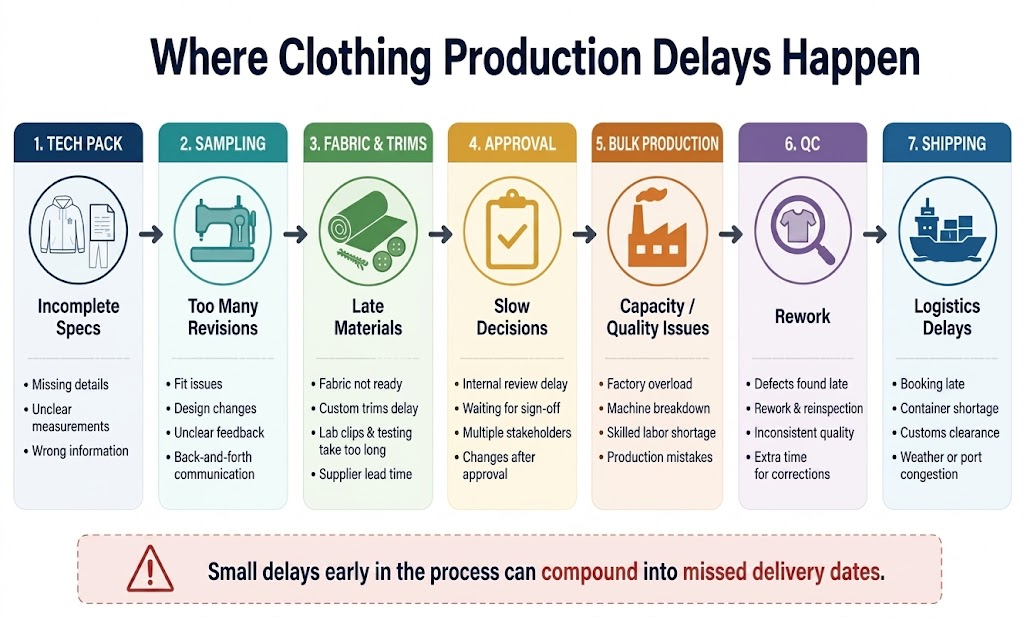
But custom clothing manufacturing is a chain of dependent stages:
Design Confirmation → Fabric → Sampling → Revision → Approval → Bulk Materials → Cutting → Sewing → Decoration → Finishing → QC → Packing
If one critical stage moves backward by five days, several later stages may also move backward.
For example:
Sample approval delayed by 5 days ↓ Bulk fabric confirmation delayed ↓ Cutting schedule moves ↓ Sewing slot changes ↓ Final QC moves ↓ Shipment date is affected
This is why production delays should be analyzed as a workflow problem, not simply a sewing-speed problem. Clothing manufacturing lead times, In custom T-shirt production, confirming fabric, measurements, construction and decoration before bulk production helps prevent avoidable revisions later in the process.
2. Delay Cause #1: Incomplete Tech Packs
One of the earliest causes of production delay is incomplete product information.
A manufacturer may receive a design but still be missing:
- Final measurements
- Fabric composition
- GSM
- Pantone colors
- Print dimensions
- Embroidery placement
- Label specifications
- Trim details
- Packaging requirements
- Size breakdown
Production development then becomes a sequence of questions and answers.
The factory asks for a measurement.
The brand replies two days later.
Then another missing detail appears.
This creates hidden lead time before physical production has even started.
A complete tech pack does not guarantee that no revisions will be required, but it reduces unnecessary uncertainty during development.
How brands can avoid it
Before requesting a sample, confirm as many technical details as possible in one document.
The goal is not to make the tech pack unnecessarily complicated.
The goal is to give the manufacturer enough information to make the first sample as close as possible to the intended product. Learn how to prepare a production-ready tech pack for apparel manufacturing, including measurements, fabric, construction, artwork, labels and packaging.
3. Delay Cause #2: Fabric Is Not Confirmed Early Enough
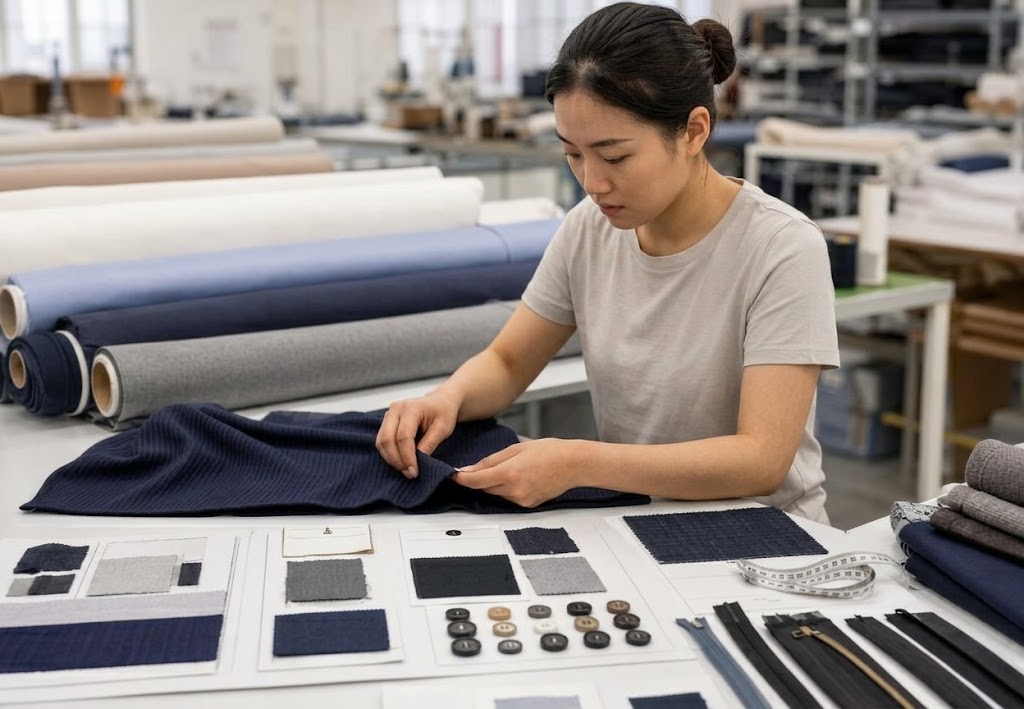
Fabric is one of the biggest variables in custom apparel production.
A brand may request:
450 GSM heavyweight brushed fleece, compact outer face, soft brushed interior, specific cotton/polyester composition, custom color.
But that exact fabric may not be sitting in the manufacturer's warehouse.
It may need to be:
- Sourced
- Knitted
- Dyed
- Compacted
- Pre-shrunk
- Brushed
- Washed
- Tested
If the fabric specification keeps changing during sampling, the project timeline can expand quickly.
For heavyweight apparel in particular, fabric decisions also affect garment structure, shrinkage, drape, embroidery performance, and finished measurements.
How brands can avoid it
Confirm the following as early as possible:
Composition + GSM + Construction + Hand-feel + Color + Finishing
If custom fabric is required, include fabric development time in the production schedule instead of assuming sampling can begin immediately.Choosing the right GSM for heavyweight apparel
4. Delay Cause #3: Too Many Sample Revisions
Sampling exists to identify and correct problems before bulk production.
Revisions are normal.
Unlimited revisions are not.
A project can become delayed when changes arrive in separate rounds:
Sample 1: Change body width.
Sample 2: Change hood shape.
Sample 3: Change embroidery size.
Sample 4: Change fabric.
Sample 5: Change waistband construction.
Every change can affect pattern making, material sourcing, sewing, decoration, and fit.
The problem is not that the factory needs to revise the sample.
The problem is that each new decision can restart part of the development process.
How brands can avoid it
Review the complete sample before sending feedback.
Instead of sending individual comments across multiple emails or messages, consolidate feedback into one revision document covering:
- Fit
- Measurements
- Fabric
- Construction
- Decoration
- Trims
- Labels
- Finishing
One clear revision round is usually faster than five fragmented revision rounds.
5. Delay Cause #4: Slow Sample Approval
Factories are often asked:
“Why hasn't bulk production started?”
But sometimes the approved production standard does not yet exist.
If the brand receives a sample on Monday but approves it ten days later, those ten days become part of the overall project timeline.
This becomes especially important when the factory cannot safely order bulk materials or begin cutting until approval is received.
How brands can avoid it
Before sampling begins, decide:
- Who approves fit?
- Who approves colors?
- Who approves graphics?
- Who approves final production?
Brands with multiple decision-makers should establish an internal approval process before samples arrive.
Fast production requires fast decisions on both sides.
6. Delay Cause #5: Design Changes After Sample Approval
Late design changes are among the most disruptive production problems.
Consider a hoodie that has already been approved.
Then the brand requests:
- A different zipper
- Larger embroidery
- New ribbing
- Different fabric
- Another wash effect
- Changed measurements
These may sound like small modifications.
Operationally, they may affect:
Patterns → Material quantities → Trim orders → Embroidery files → Production instructions → Cost → Lead time
If bulk materials have already been prepared, the impact can become even greater.
How brands can avoid it
Treat final sample approval as a genuine production milestone.
Before approving, confirm that all critical details are ready for bulk replication.
After approval, changes should be limited to genuinely necessary corrections.
7. Delay Cause #6: Custom Colors Take Longer Than Expected
Custom colors introduce another approval process.
For many projects, the sequence is:
Pantone Reference → Lab Dip → Review → Correction → Approval → Bulk Dyeing
If the first lab dip is not accepted, another round may be required.
Color can also behave differently depending on:
- Fiber composition
- Fabric construction
- Dye method
- Washing
- Finishing
- Lighting conditions
A custom washed color may therefore require more development than a standard stock black.
How brands can avoid it
Provide accurate Pantone references early and approve lab dips quickly.
If the launch timeline is extremely tight, ask whether suitable stock colors are available before committing to custom dyeing.
8. Delay Cause #7: Custom Trims Are Started Too Late
Custom trims are a common hidden bottleneck.
A garment may require:
- Woven labels
- Hangtags
- Custom zipper pullers
- Metal logo plates
- Buttons
- Snaps
- Silicone patches
- Drawcord tips
- Custom packaging
Some of these components come from specialized suppliers rather than the garment sewing line itself.
Custom metal hardware may even require a mold before production begins.
If trim development starts only after the garment sample has been approved, the finished garment may eventually be waiting for one small component.
How brands can avoid it
Develop low-risk trims in parallel with sampling whenever possible.
For example:
Garment Sample Development
can happen simultaneously with:
Label Development + Packaging Preparation + Hardware Sampling
Parallel planning can reduce overall lead time without rushing garment production.
9. Delay Cause #8: Bulk Fabric Problems
Even after a fabric has been selected, bulk fabric must still meet production requirements.
Potential problems include:
- GSM outside tolerance
- Color variation
- Shrinkage
- Width variation
- Surface defects
- Pilling
- Uneven brushing
- Dyeing inconsistency
If a problem is discovered before cutting, production may need to wait while the material is corrected or replaced.
That creates a delay.
But cutting defective fabric simply to maintain the original schedule can create a much more expensive problem later.
How brands can avoid it
Build fabric inspection and testing into the production process.
For heavyweight garments, dimensional stability and shrinkage should be understood before final cutting decisions are made. Fabric quality control in heavyweight clothing manufacturing
10. Delay Cause #9: Cutting Starts Before Important Details Are Stable
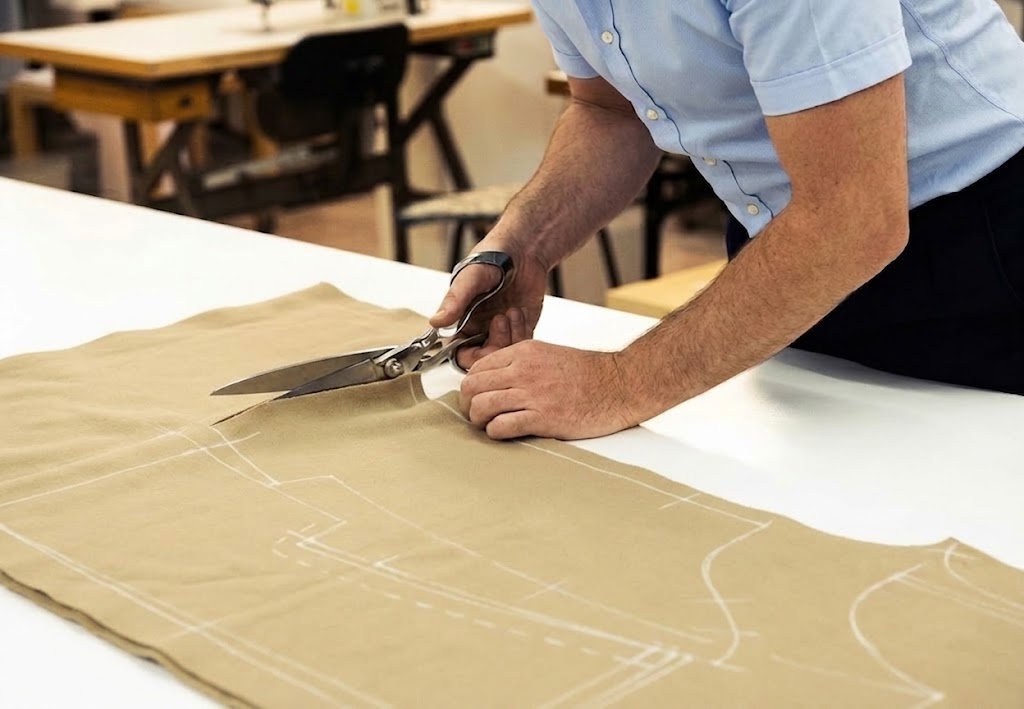
Cutting is an important point of no return.
Before cutting, a pattern can still be adjusted relatively easily.
After hundreds of garment panels have been cut, correcting a major measurement problem becomes much more difficult.
This is why responsible production planning may sometimes appear slower before cutting.
The factory may be checking:
- Final pattern
- Grading
- Shrinkage allowance
- Fabric direction
- Fabric defects
- Size breakdown
Those checks consume time—but they protect the bulk order.
How brands can avoid it
Do not pressure the manufacturer to cut bulk fabric before critical specifications are approved.
Saving two days before cutting is not valuable if it creates two weeks of rework later.
11. Delay Cause #10: Embroidery or Printing Problems
Decoration can become another bottleneck.
A design that looks correct digitally may behave differently on the actual garment.
Embroidery may require adjustments to:
- Stitch density
- Underlay
- Thread tension
- Stabilization
- Size
- Placement
Printing can also require testing for:
- Color
- Opacity
- Registration
- Adhesion
- Surface compatibility
This becomes particularly important with heavyweight fabrics, washed garments, coated fabrics, or complex multi-position decoration.
How brands can avoid it
Approve decoration on the actual or representative fabric whenever possible.
Do not rely only on digital artwork approval for technically demanding decoration.
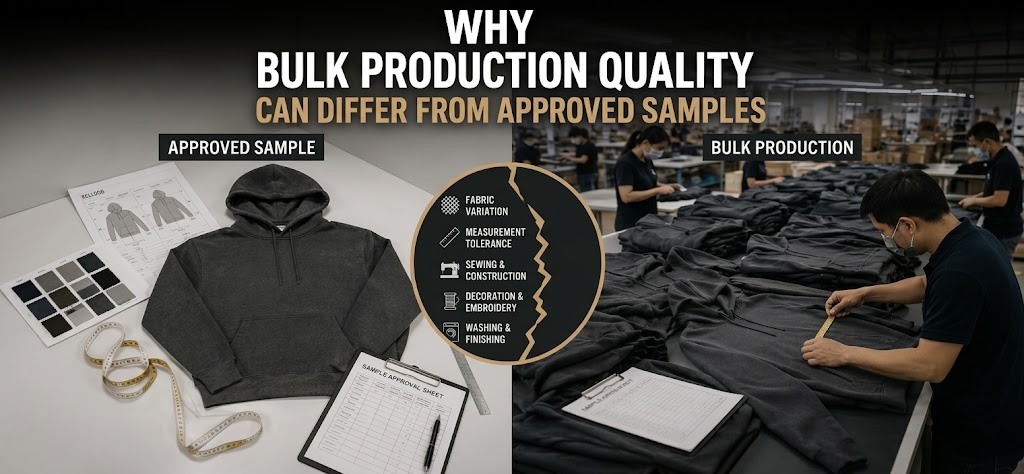
12. An Approved Sample Does Not Eliminate Bulk Production Risk
A common assumption is:
“The sample was approved, so bulk production should be automatic.”
But a sample is one garment.
Bulk production may involve hundreds or thousands of repeated operations.
Fabric batches, multiple sewing operators, embroidery machines, washing processes, pressing, and finishing all introduce variables.
This means the challenge changes after approval.
During sampling, the question is:
Can we make the product correctly?
During bulk production, the question becomes:
Can we reproduce it consistently?
13. Delay Cause #11: Washing and Finishing Require Additional Control
Garment washing is not simply an extra decorative step.
Processes such as:
- Acid wash
- Enzyme wash
- Vintage wash
- Garment dye
- Silicone wash
- Snow wash
- Distressing
can affect:
- Color
- Measurements
- Shrinkage
- Hand-feel
- Surface appearance
- Decoration
A washed garment may therefore require testing before bulk processing.
If the bulk wash result does not match the approved standard, adjustment may be necessary.
How brands can avoid it
Include washing and finishing in the development stage rather than adding them at the end of the project.
The approved sample should represent the intended finished appearance as closely as possible. Garment washing and finishing techniques
14. Delay Cause #12: Quality Problems Are Found Too Late
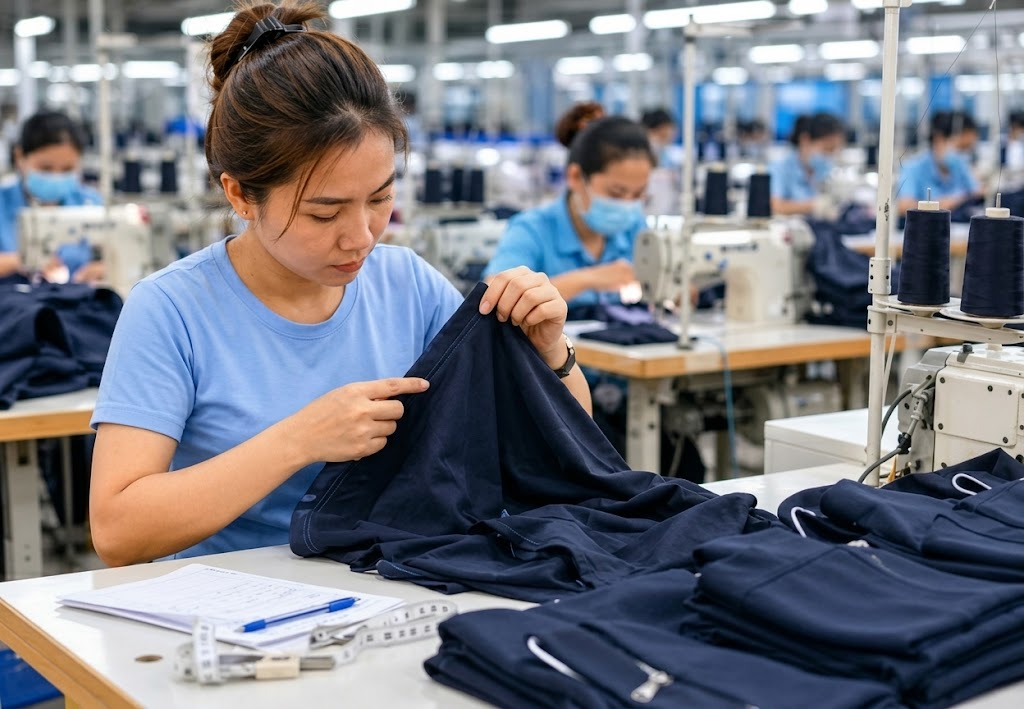
This is one of the most expensive causes of delay.
Imagine 500 hoodies have already been completed.
Final inspection discovers that the embroidery position is incorrect across the entire order.
The problem did not begin during final inspection.
Increasing order quantity too quickly can introduce additional ]quality risks when scaling production](https://kelloggfashion.com/blog/maintain-quality-scaling-apparel-production), particularly when materials, capacity and QC systems are not prepared for the higher volume.
It began much earlier.
Final inspection simply discovered it.
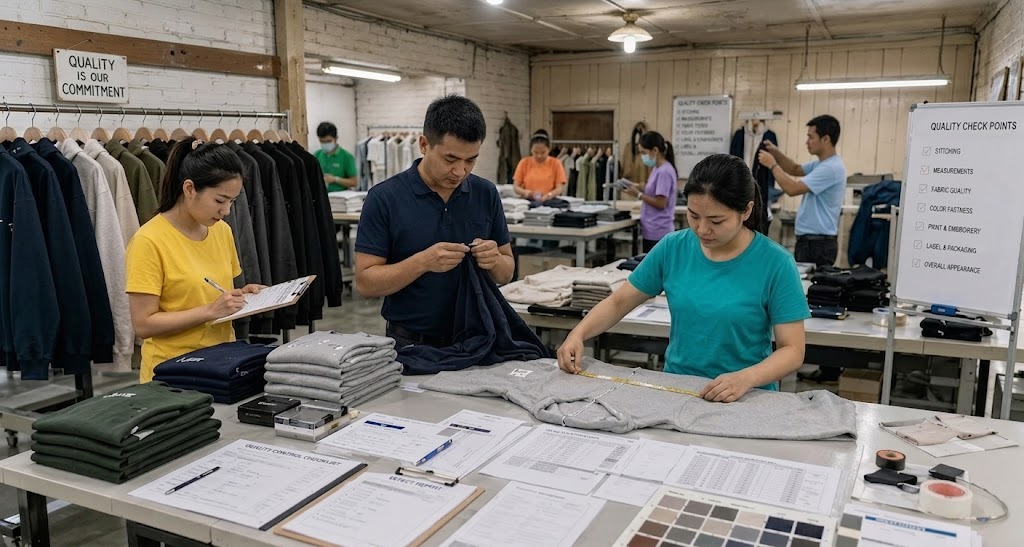
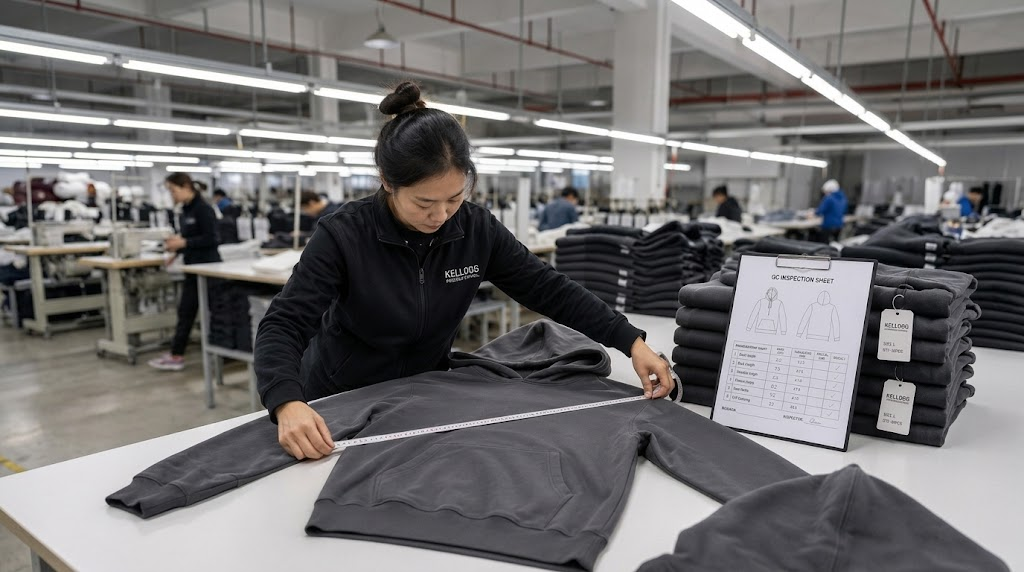
This is why quality control should happen throughout production.
A stronger system may include:
Incoming Material Inspection
↓
Cutting Inspection
↓
In-Line Sewing Inspection
↓
Decoration Inspection
↓
Measurement Inspection
↓
Final Inspection
Problems found earlier are usually easier and faster to correct. How Clothing Manufacturers Control Quality in Bulk Production?
15. Delay Cause #13: Packaging Is Confirmed Too Late
Sometimes the garments are finished—but they still cannot ship.
Why?
The custom polybags have not arrived.
The barcode labels are incorrect.
The hangtags still need approval.
The carton marks have changed.
Packaging can become the final bottleneck if it is treated as an afterthought.
How brands can avoid it
Confirm packaging requirements during sampling or early bulk preparation.
This may include:
- Polybag specifications
- Size stickers
- Hangtags
- Barcode labels
- Folding method
- Carton requirements
- Shipping marks
Packaging should ideally be ready before final garment inspection is completed.
16. Delay Cause #14: Too Many Styles, Colors and SKUs
Order quantity alone does not determine manufacturing complexity.
Consider two orders.
Order A
- 500 black hoodies
- 1 design
- 5 sizes
Order B
- 150 garments
- 3 styles
- 4 colors
- 5 sizes
- Different embroidery for each style
Order B has fewer garments but may be operationally more complicated.
Every additional style, color, size, decoration, and trim increases the number of variables that need to be controlled.
How brands can avoid it
For initial production runs, avoid unnecessary SKU complexity.
A focused first order can make quality control and production planning easier, especially for new brands testing a manufacturer for the first time.
17. Delay Cause #15: Peak Production Seasons
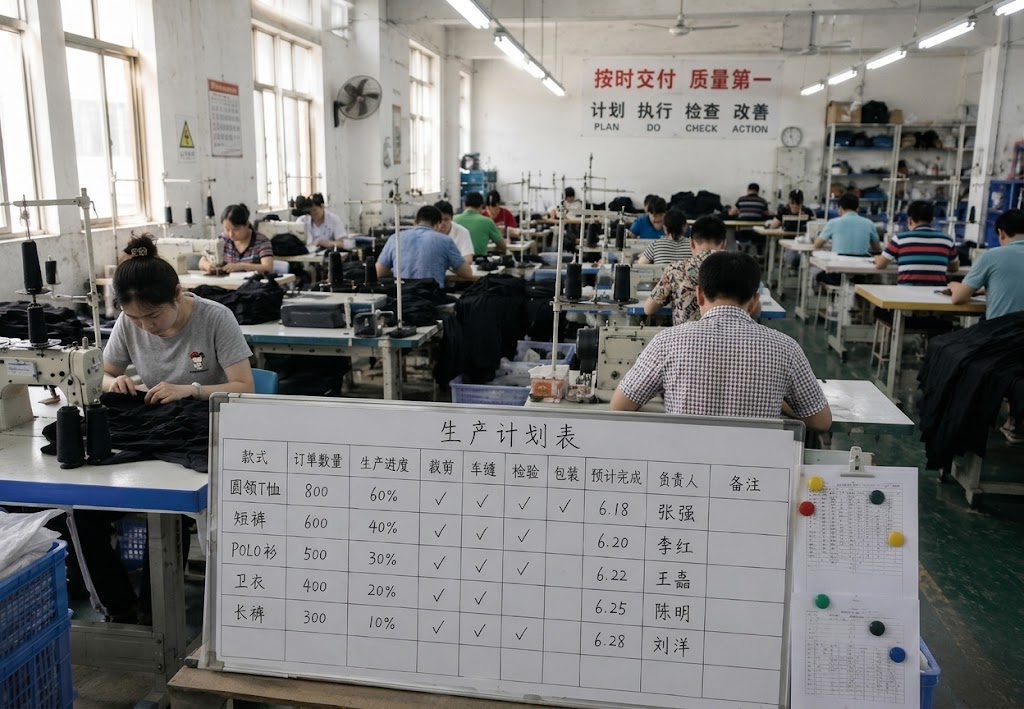
Factory capacity is not unlimited.
Before major retail seasons, holidays, or Chinese New Year, production schedules can become significantly tighter.
A manufacturer may normally have capacity for an order, but that does not mean the same capacity will still be available several weeks later.
This is why a quotation made in September does not necessarily reserve a production line for an order placed in November.
How brands can avoid it
If the delivery date is commercially important, discuss production capacity early.
Do not assume that requesting a quotation automatically reserves production space.
Brands planning seasonal launches should leave additional buffer time around known peak manufacturing periods.
18. Delay Cause #16: Unrealistic Shipping Assumptions
Production completion and delivery are not the same date.
After production, goods may still require:
- Final inspection
- Packing
- Export documentation
- Freight booking
- Pickup
- International transportation
- Customs clearance
- Local delivery
Air freight and sea freight also have very different transit times.
A factory can complete production on schedule while the final retail delivery still arrives late if logistics were not included in the original calendar.
How brands can avoid it
Plan backward from the actual required delivery date.
Do not use the factory completion date as the launch date.
Include transportation and a reasonable logistics buffer in the project schedule.
19. Who Is Responsible When Clothing Production Is Delayed?
There is rarely one universal answer.
Production delays can originate from:
Brand-side decisions
- Late feedback
- Changing specifications
- Slow approvals
- Incomplete tech packs
- Late artwork
- Packaging changes
Manufacturer-side problems
- Poor production planning
- Material sourcing failures
- Capacity problems
- Quality issues
- Communication failures
- Incorrect execution
External factors
- Material supplier delays
- Logistics disruptions
- Customs
- Weather
- Peak-season capacity
A professional production relationship should therefore focus less on assigning blame and more on identifying:
What caused the delay?
When was it identified?
What stages are affected?
What can still run in parallel?
What is the revised realistic delivery date?
20. Warning Signs That a Production Schedule May Be at Risk
Brands should not wait until the expected shipment date to discover that an order is delayed.
Several early warning signs deserve attention:
- Sample revisions continue without clear closure
- Fabric remains unapproved
- Lab dips are still changing
- Custom trims have not started
- Final quantities are not confirmed
- Size breakdown is missing
- Production has no confirmed start window
- Bulk materials have not arrived
- QC problems repeat during sewing
- Packaging specifications remain unresolved
One issue does not automatically mean the order will be late.
But several unresolved dependencies at the same time usually indicate schedule risk.
21. How Good Manufacturers Reduce Production Delays
Reliable manufacturers cannot eliminate every possible delay.
What they can do is reduce preventable delays.
A stronger production system normally focuses on four areas:
1. Identify Critical Dependencies Early
Determine which materials or approvals can block later production.
2. Run Safe Processes in Parallel
Labels, packaging, embroidery files, and some trims can often be prepared while garment development continues.
3. Use Approval Checkpoints
Do not move high-risk processes forward before critical specifications are stable.
4. Inspect During Production
Identify quality problems before hundreds of garments repeat the same defect.
This approach does not mean every order will run perfectly.
It means problems are more likely to be identified while there is still time to manage them.
22. Why the Fastest Factory Is Not Always the Safest Choice
A very short production lead time can be attractive.
But brands should ask:
What exactly is being shortened?
If the factory saves time through:
- Better planning
- Available materials
- Efficient production
- Parallel preparation
that can be positive.
If time is saved by skipping:
- Fabric testing
- Sample approval
- Decoration testing
- In-line QC
- Final inspection
the risk is simply being moved from the schedule into the product.
A reliable manufacturer should therefore be able to explain how the proposed lead time is achieved.
23. Build Buffer Time Into the Production Calendar
No custom manufacturing project should be planned around a timeline with zero tolerance.
A better approach is:
Target Delivery Date
↓
Shipping Buffer
↓
Final QC & Packing
↓
Bulk Production
↓
Material Preparation
↓
Final Sample Approval
↓
Sample Development
This creates room for normal revisions without immediately threatening the launch date.
The more customized the product, the more important this buffer becomes.
24. A Better Production Planning Strategy for Clothing Brands
Before placing a custom apparel order, brands should establish five dates:
1. Target Launch Date
When does the product need to become commercially available?
2. Required Warehouse Delivery Date
When must finished goods physically arrive?
3. Latest Shipping Date
When must goods leave the factory?
4. Required Bulk Completion Date
When must production and QC be completed?
5. Required Sample Approval Date
When must the final sample be approved for the bulk schedule to remain realistic?
This turns a vague launch plan into a production calendar. Sampling to bulk production timeline
25. What Should a Brand Ask Before Bulk Production Starts?
Before approving bulk production, confirm:
- Is the final sample approved?
- Is the fabric approved?
- Is the color approved?
- Are measurements confirmed?
- Are labels approved?
- Are trims approved?
- Is decoration approved?
- Is packaging confirmed?
- Is the size breakdown final?
- Is the production quantity final?
- Is the target completion date realistic?
If several answers are still “no,” the order may not actually be ready for bulk production.
Starting earlier does not necessarily mean finishing earlier.
26. Production Delays and Quality Problems Are Often Connected
Many production delays are actually quality-control decisions.
A fabric fails inspection.
Embroidery needs correction.
Measurements fall outside tolerance.
A wash effect does not match the approved standard.
The factory then faces two choices:
Continue production to protect the schedule
or
Stop, correct the problem, and protect the product
A short delay can sometimes prevent a much larger quality failure.
This is why production speed and quality control should not be treated as completely separate subjects.
27. How Brands and Manufacturers Can Prevent Delays Together
The most reliable apparel production schedules are usually built through cooperation.
Brands can help by:
- Providing complete specifications
- Giving consolidated feedback
- Approving samples quickly
- Avoiding unnecessary late changes
- Confirming quantities early
- Planning realistic launch dates
Manufacturers can help by:
- Identifying technical risks early
- Confirming realistic lead times
- Checking material availability
- Coordinating trims and fabric
- Monitoring bulk production
- Communicating problems before they become emergencies
Good communication does not mean sending more messages.
It means making important decisions earlier.
28. Final Thoughts
Clothing production delays are rarely caused by one isolated event.
They usually develop through a chain of dependencies:
Missing Information → Late Approval → Material Delay → Production Shift → QC Pressure → Shipping Risk
The most effective way to avoid delays is therefore not simply to ask a factory to “produce faster.”
It is to build a production system where critical decisions are made early, materials are confirmed before they become bottlenecks, compatible processes run in parallel, and quality problems are identified before final inspection.
For clothing brands, the key principles are simple:
Prepare clearly.
Approve quickly.
Avoid unnecessary late changes.
Plan backward from the required delivery date.
Leave room for quality control.
And for manufacturers, the responsibility is equally important:
Identify risks early, communicate realistic timelines, control production continuously, and report problems before they affect the final shipment.
The goal of good apparel production planning is not a schedule that never changes.
It is a production system that identifies risks early enough to prevent small problems from becoming missed launch dates.
Frequently Asked Questions
Q1.What is the most common cause of clothing production delays?
A:There is no single cause, but late sample approval, fabric availability, design changes, custom trims, quality problems, and unrealistic scheduling are among the most common reasons.
Q2.Can sample revisions delay bulk production?
A:Yes. If bulk production depends on final sample approval, every additional revision can move the bulk production start date.
Q3.Does custom fabric increase production lead time?
A:Usually. Custom knitting, dyeing, brushing, washing, compacting, or other finishing processes require additional preparation compared with using available stock fabric.
Q4.Can custom labels and trims delay an apparel order?
A:Yes. Custom zippers, metal hardware, woven labels, patches, hangtags, and packaging may have their own production lead times.
Q6.Why can an approved sample still result in bulk production problems?
A:A sample is a single garment, while bulk manufacturing requires the same specifications to be reproduced repeatedly across materials, cutting, sewing, decoration, washing, and finishing.
Q7.Should brands include buffer time in their production schedule?
A:Yes. A production calendar with no buffer can turn a small sample, material, QC, or logistics issue into a missed launch date.
Q8.Can quality control cause a production delay?
A:Quality inspection can identify problems that require correction, but the underlying defect usually occurred earlier. Detecting the issue before shipment is generally safer than shipping defective products simply to maintain the original date.
Q9.How can clothing brands reduce production delays?
A:Provide complete specifications, confirm materials early, consolidate sample feedback, approve quickly, avoid late design changes, prepare trims in parallel, and plan backward from the required delivery date.
Share this article