How Long Does Custom Clothing Manufacturing Take?
Written by Aimee Xiang
Founder of Kellogg Fashion
Focused on heavyweight apparel manufacturing, fabric engineering, garment development, quality control, and scalable production.
Introduction
When a clothing brand starts working with a manufacturer, one of the first questions is usually:
How long will production take?
The answer is rarely a single number.
A realistic clothing manufacturing timeline includes fabric sourcing, sample development, revisions, material approval, bulk production, finishing, quality control, packing, and sometimes custom trims or packaging.
For most custom apparel projects, the production timeline should therefore be understood as a sequence of connected stages, rather than simply “20 days” or “30 days.”
This guide explains how clothing manufacturing lead times work from initial sampling to finished bulk production, what can delay each stage, and how brands can plan their launches more accurately.
1. What Is a Clothing Manufacturing Lead Time?
Manufacturing lead time is the total time required to move a clothing project through a specific stage of development or production.
In custom apparel manufacturing, there are usually several separate lead times:
- Fabric sourcing or development
- Sample production
- Sample revision
- Fabric or color approval
- Custom trim development
- Bulk material preparation
- Bulk garment production
- Printing or embroidery
- Washing and finishing
- Quality inspection
- Packing
- Shipping
These stages are connected.
A delay in fabric approval, for example, may push back sampling. A late sample approval can then delay bulk material ordering and ultimately affect the final delivery date.
This is why experienced clothing manufacturers usually evaluate the complete production route before confirming a realistic delivery schedule.
2. Typical Clothing Manufacturing Timeline
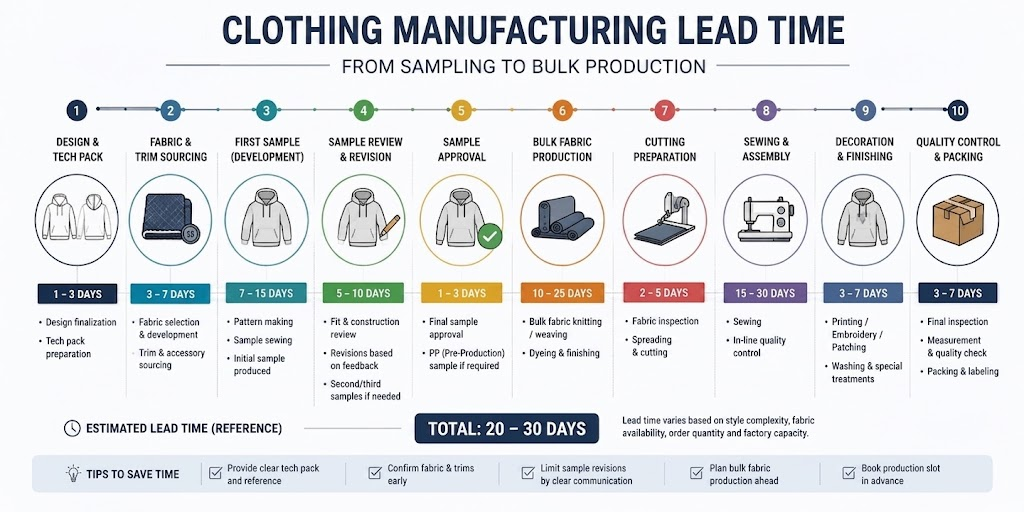
Although every project is different, a custom apparel order commonly follows a timeline similar to this:
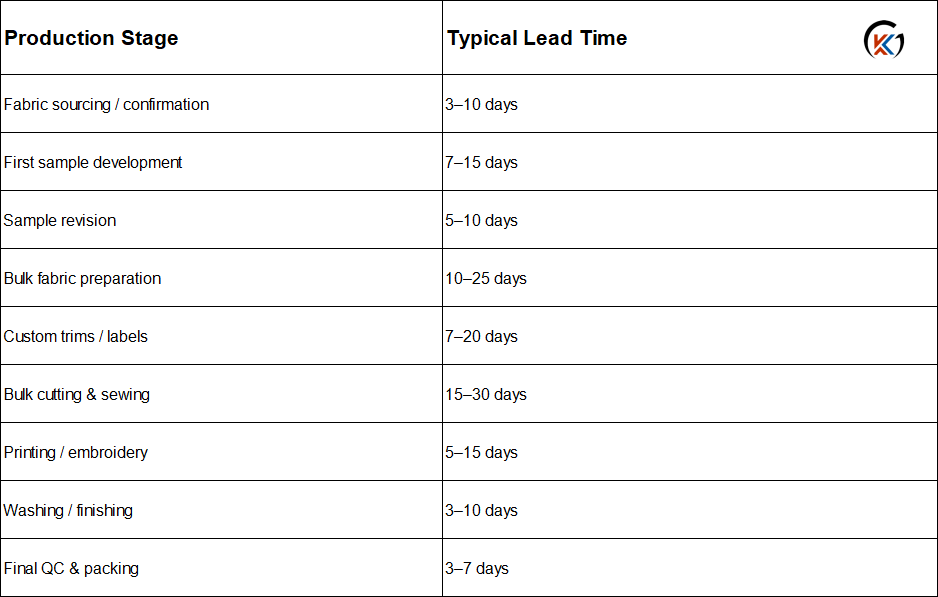
These numbers are general references rather than guaranteed production times.
A simple heavyweight T-shirt using available fabric may move much faster than a custom tracksuit requiring developed fabric, embroidery, custom zippers, garment washing, labels, and special packaging.
The more customized the product becomes, the more important production planning becomes. Collections involving both adult and children’s sizing may require additional pattern and fitting stages. For example, a custom adult and kids matching fleece set needs separate proportion, mobility and fit adjustments rather than simply scaling down the adult pattern.
3. Stage One: Fabric Sourcing and Material Confirmation
Before garment sampling begins, the manufacturer needs to determine whether the requested fabric is:
- Already available
- Available in a similar specification
- Available but requiring custom dyeing
- Completely custom-developed
This distinction can significantly affect lead time.
For example, a brand requesting a 400 GSM cotton/polyester brushed fleece in an existing black color may be able to begin sampling relatively quickly.
However, a project requiring:
- A specific cotton/polyester ratio
- 460 GSM fabric
- Custom Pantone color
- Special compact construction
- Anti-pilling treatment
- Pre-shrinking or compacting
- Special surface finishing
may require additional development time before garment sampling can begin.
Heavy fabric decisions should therefore be made as early as possible.Heavyweight fabric selection
4. Stage Two: First Sample Development
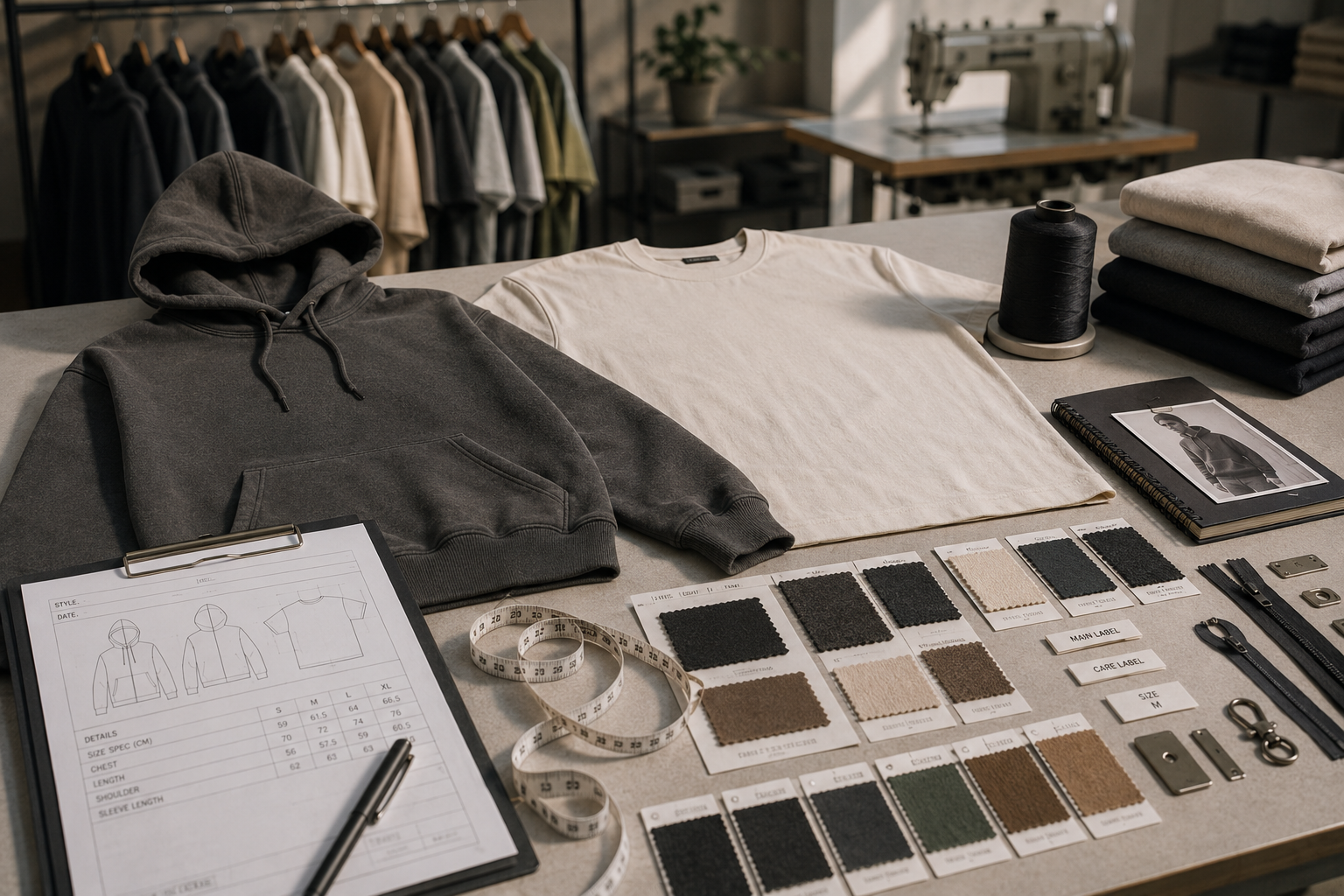
Once the main materials and design specifications are confirmed, the manufacturer can begin developing the first garment sample. Clear specifications at this stage reduce unnecessary clarification and help the manufacturer plan materials, patterns and construction more efficiently. Brands can review the information required in a production-ready tech pack for apparel sampling before starting development.
For many custom apparel projects, first samples take approximately:
7–15 working days
However, sample lead time depends heavily on the complexity of the garment.
A basic heavyweight T-shirt with one screen print may require relatively little preparation. However, developing a premium heavyweight T-shirt may require additional fabric evaluation, custom pattern development, fit revisions, shrinkage testing and decoration approval before bulk production.
A premium hoodie could require:
- Pattern development
- Fabric sourcing
- Custom ribbing
- Embroidery
- Custom labels
- Special stitching
- Custom zipper or hardware
- Garment washing
- Special finishing
Each additional process creates another production step.
The purpose of the first sample is not simply to produce a miniature version of the bulk order. For custom T-shirt development and manufacturing, fabric, fit, construction and finishing should be approved before the production timeline moves into bulk.
It is a technical validation stage where the brand and manufacturer evaluate:
- Measurements
- Fit
- Silhouette
- Fabric
- Construction
- Stitching
- Decoration
- Colors
- Trims
- Overall garment appearance
For highly customized garments, expecting the first sample to immediately become the final production standard is often unrealistic.Apparel sampling and development process
Brands developing premium crewnecks can review our custom sweatshirt manufacturing guide for a product-specific explanation of fabric confirmation, pattern development, sample revisions, MOQ and bulk production.
5. Stage Three: Sample Review and Revision
After receiving the first sample, the brand should review it carefully.
Typical comments may include:
- Increase body width by 2 cm
- Reduce sleeve length
- Change hood shape
- Adjust waistband tension
- Increase embroidery size
- Change thread color
- Modify pocket position
- Use heavier ribbing
- Change fabric hand-feel
Once these comments are confirmed, the manufacturer may produce a revised sample.
A second sample commonly requires another:
5–10 working days
depending on whether new materials need to be sourced.
This stage is one of the most underestimated parts of the manufacturing timeline.
If a brand takes ten days to review a sample, the overall project has effectively been delayed by ten days even if the factory itself has not experienced any production delay.
For this reason, brands planning around fixed launch dates should include sample review time in their production calendar.
6. Why Sample Approval Is a Critical Production Milestone
Sample approval is one of the most important milestones in custom clothing manufacturing.
Once the approved sample becomes the production reference, the factory begins translating an individually developed garment into repeatable bulk production.
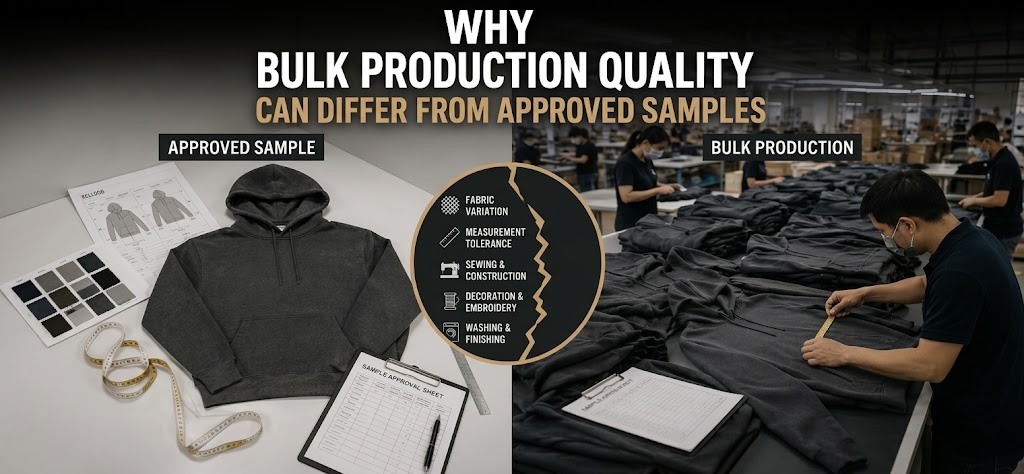
But an approved sample does not automatically guarantee that hundreds of garments will reproduce themselves perfectly.
Fabric batches, cutting, sewing, embroidery, washing, pressing, and other production processes introduce variables that must be controlled during bulk manufacturing. Why bulk production can differ from approved samples
Our custom sweatshirt sampling and production process connects fabric confirmation, sample revisions, pre-production approval and controlled bulk manufacturing.
7. Stage Four: Bulk Fabric and Material Preparation
Once the sample and specifications are approved, bulk materials can be prepared.
This may include:
- Main fabric
- Rib fabric
- Pocketing
- Lining
- Zippers
- Drawcords
- Labels
- Hangtags
- Buttons
- Snaps
- Embroidery thread
- Packaging materials
If the required fabric is already available, this stage can be relatively fast.
If custom fabric must be knitted, dyed, washed, or finished, material preparation may require:
10–25 working days or longer
depending on the specification and quantity.
Custom Pantone colors can also add time because the color may need to go through:
Lab dip → Brand approval → Bulk dyeing
Production should not move forward simply to save several days if the material or color has not been properly approved.
A small delay before bulk production is usually much less expensive than discovering a material problem after hundreds of garments have already been produced.
8. Custom Trims Can Affect Lead Time More Than Expected
Brands frequently focus on garment production but underestimate custom trims.
For example:
- Custom woven labels
- Silicone patches
- Metal logos
- Custom zipper pullers
- Branded buttons
- Custom drawcord tips
- Special packaging
may come from different specialized suppliers.
Some components may also require tooling or mold development before production begins.
A custom zipper puller, for example, may require:
Artwork confirmation → Mold development → Prototype → Approval → Bulk production
Therefore, trims should ideally be developed in parallel with garment sampling whenever possible.
Waiting until the garment sample is approved before starting every label, zipper, patch, and packaging component can unnecessarily extend the total manufacturing timeline.
9. Stage Five: Bulk Cutting
Once bulk fabric and materials are ready, the factory can begin cutting.
Before cutting hundreds of garments, several things normally need to be confirmed:
- Final patterns
- Grading
- Size specifications
- Fabric width
- Fabric shrinkage
- Cutting quantity
- Color allocation
For some fabrics, shrinkage testing may also be necessary before final pattern adjustments.
This is particularly important for heavyweight cotton garments and washed products.
A 450 GSM heavyweight hoodie behaves differently from a lightweight polyester T-shirt during cutting, sewing, and finishing.
Accurate preparation at this stage helps prevent measurement problems later in production.
10. Stage Six: Sewing and Assembly
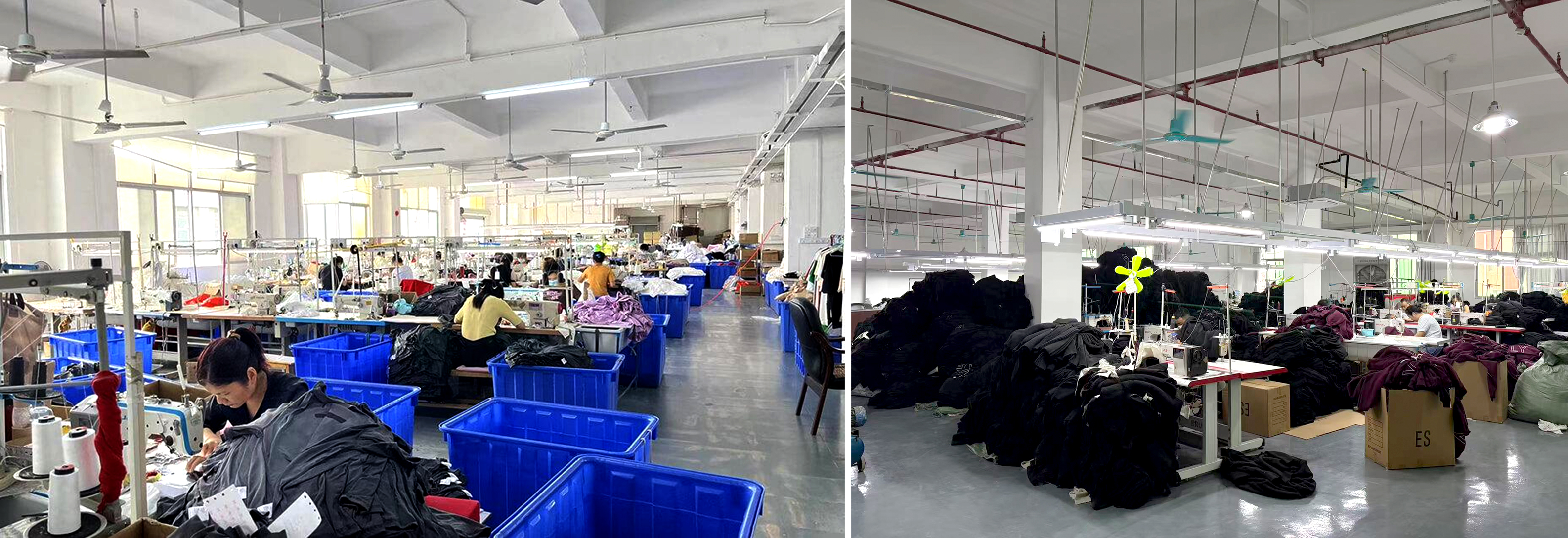
Bulk sewing is often what buyers imagine when they hear the phrase “production lead time.”
But sewing is only one part of the complete process.
During assembly, garments move through multiple operations such as:
Cut panels → Sewing → Pocket construction → Sleeve attachment → Hood construction → Rib attachment → Finishing
The number of operations depends on garment complexity.
A basic T-shirt can move through production relatively quickly.
A heavyweight zip-up hoodie with double-layer hood construction, custom pockets, embroidery, reinforced seams, and custom hardware requires substantially more production control.
Bulk sewing may typically require:
15–30 working days
depending on:
- Order quantity
- Garment complexity
- Production capacity
- Number of styles
- Number of colors
- Number of sizes
- Finishing requirements
MOQ alone therefore does not determine production speed.
A 100-piece order with multiple colors, fabrics, decorations, and trims can sometimes be operationally more complex than a larger order of one standardized style.
A clear style, color and size breakdown for a 200-piece custom order helps the manufacturer assess that complexity before confirming the production schedule.
11. Stage Seven: Printing and Embroidery
Decoration is another major variable in production planning.
Common processes include:
- Screen printing
- Puff printing
- DTG printing
- DTF printing
- High-density embroidery
- Flat embroidery
- Chenille embroidery
- Appliqué
- Embroidered patches
Decoration lead time depends not only on quantity but also on complexity.
For embroidery, factors such as stitch count, artwork size, thread changes, garment positioning, and machine capacity all influence production time.
A single approved embroidery sample must also be reproduced consistently across the entire order.
12. Stage Eight: Garment Washing and Special Finishing
Some apparel projects require additional finishing after sewing.
Examples include:
- Garment dyeing
- Acid washing
- Enzyme washing
- Vintage washing
- Silicone washing
- Fading
- Distressing
- Spray effects
- Special coating
These processes create additional lead time and production variables.
Unlike a standard solid-color garment, washed products may need testing and adjustment to achieve the approved appearance.
This is particularly important for vintage streetwear products, where the final color and surface effect depend heavily on the finishing process.Garment washing and finishing techniques
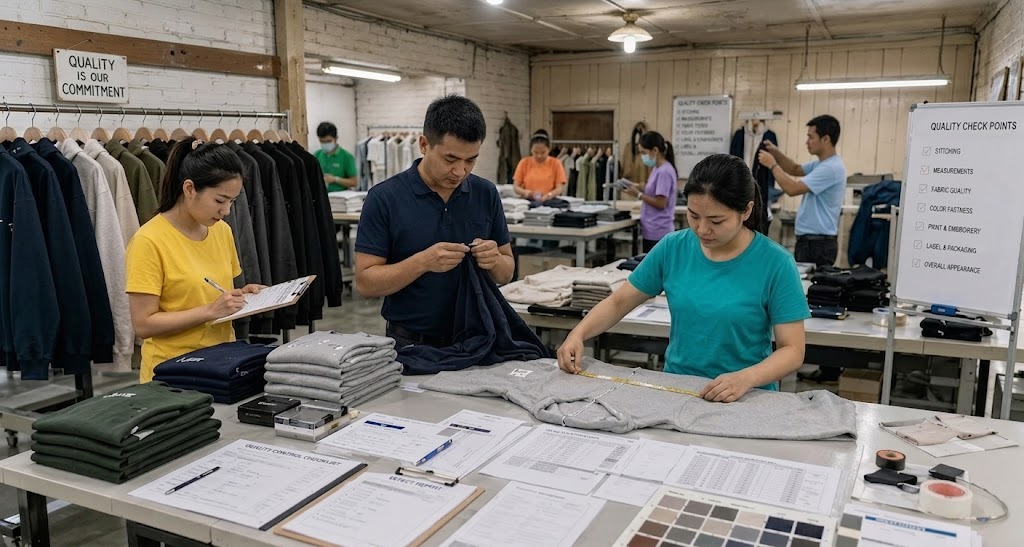
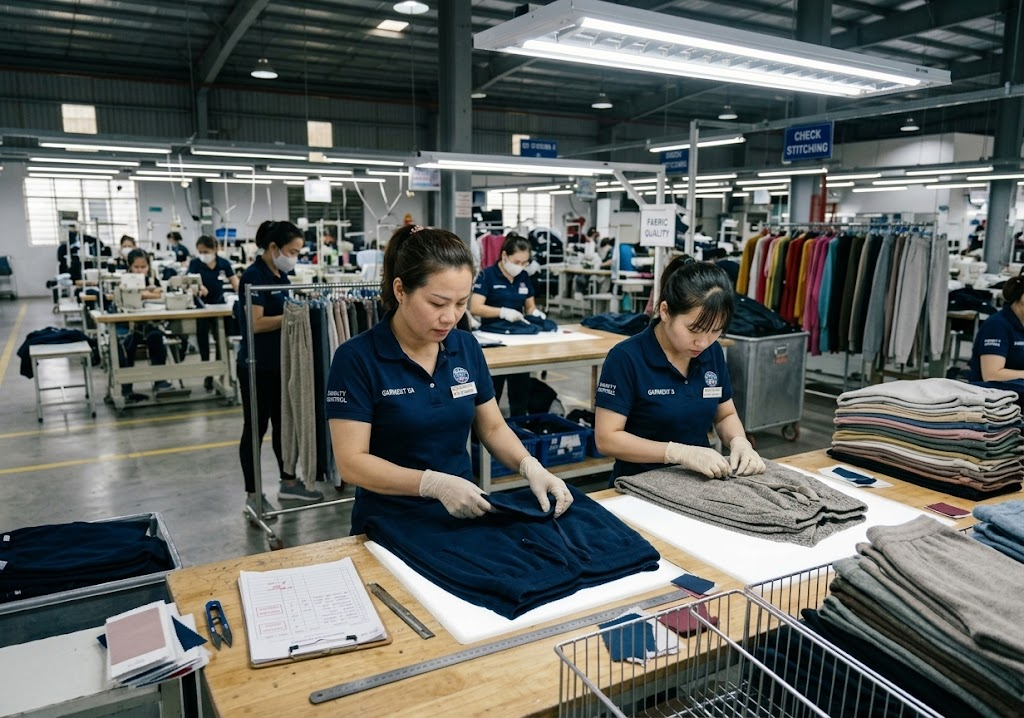
13. Stage Nine: Bulk Quality Control
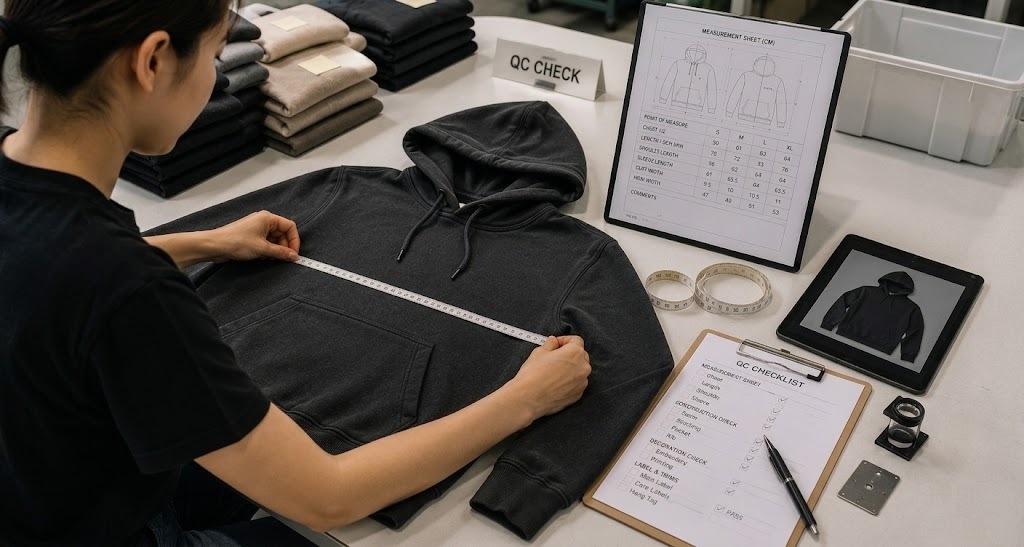
Quality control should not begin only after production is finished.
A stronger production system checks quality throughout manufacturing.
This may include:
Incoming Material Inspection
Checking fabric, trims, colors, and material specifications before production.
Cutting Inspection
Checking fabric defects, cutting accuracy, panel direction, and quantity.
In-Line Inspection
Identifying sewing or construction problems while garments are still being produced.
Measurement Inspection
Checking finished garment measurements against approved specifications.
Decoration Inspection
Checking embroidery, printing, placement, colors, and workmanship.
Final Inspection
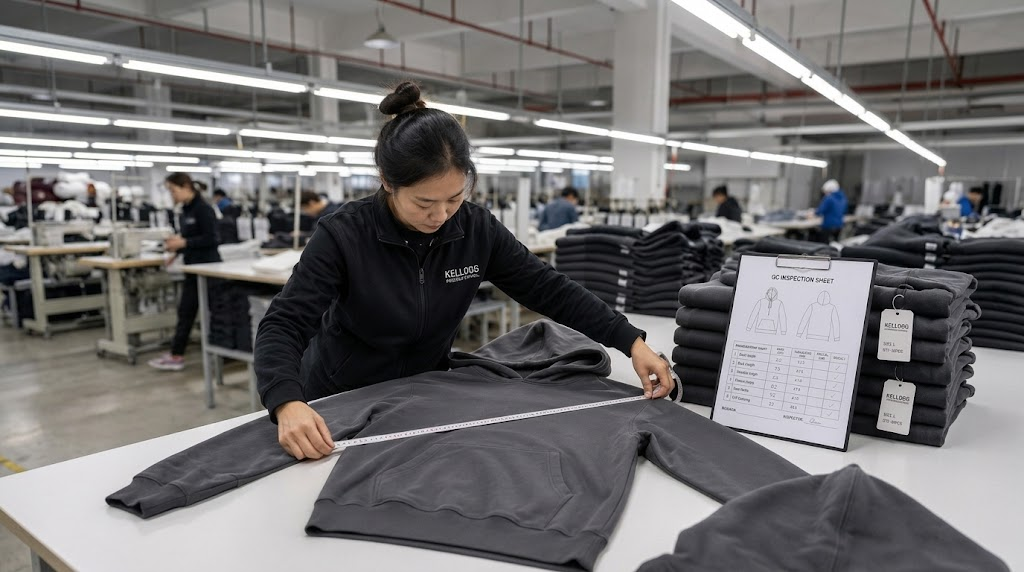
Reviewing completed garments before packing and shipment. How clothing manufacturers control quality in bulk production
14. Why Final Inspection Cannot Replace Production Control
A common misunderstanding is that quality problems can simply be identified during final inspection.
Some can.
Many cannot.
If hundreds of garments have already been cut using an incorrect pattern, final inspection can identify the problem—but it cannot reverse the cutting process.
The same applies to:
- Incorrect fabric
- Wrong dye lot
- Incorrect embroidery placement
- Excessive shrinkage
- Construction mistakes
- Incorrect trim specifications
Quality therefore needs to be controlled throughout production rather than inspected only at the end.
15. Stage Ten: Packing and Shipment Preparation
Once garments pass final inspection, they can move into packing.
Depending on the project, this may involve:
- Folding
- Individual polybags
- Size stickers
- Hangtags
- Barcode labels
- Custom packaging
- Carton packing
- Carton marks
Packing requirements should ideally be confirmed before bulk production is completed.
If custom packaging is only ordered after the garments are finished, the completed goods may have to wait for packaging before shipment.
This creates an unnecessary delay that could have been avoided through parallel production planning.
16. What Causes Clothing Production Delays?
Production delays do not always come from slow sewing.
In custom apparel manufacturing, common causes include:
1. Late Sample Feedback
The manufacturer cannot proceed if design changes remain unresolved.
2. Fabric Availability
A specific fabric may need custom knitting, dyeing, or finishing.
3. Custom Color Development
Pantone matching and lab-dip approval require additional time.
4. Complex Trims
Custom hardware, labels, patches, or packaging may require separate development.
5. Design Changes After Approval
Changing measurements, artwork, materials, or construction after production preparation has started can disrupt the schedule.
6. Multiple Colors and SKUs
More colors and sizes increase production planning complexity.
7. Special Washing or Finishing
Garment dyeing, vintage washing, distressing, and coatings introduce additional processes.
8. Quality Problems
If defects are discovered during production, correction may require additional time—but identifying them early usually reduces the impact.For a deeper look at the risks behind missed production schedules, see the most common causes of clothing production delays and how brands can prevent them.
17. Sample Lead Time and Bulk Lead Time Should Be Separated
Brands should avoid asking only:
“What is your lead time?”
Instead, separate the project into at least three questions:
1. How long will the sample take?
2. How long will material preparation take after approval?
3. How long will bulk production take after all materials are ready?
This produces a much more realistic manufacturing schedule.
For example:
- Fabric confirmation: 5 days
- First sample: 10 days
- Brand review: 5 days
- Revised sample: 7 days
- Bulk material preparation: 15 days
- Bulk production: 25 days
- Final QC and packing: 5 days
The complete project is therefore not a “25-day order.”
It is a production program containing multiple dependent stages.
18. Can Sampling and Production Preparation Happen at the Same Time?
Yes—but only when the risks are understood.
Experienced manufacturers often use parallel production planning to shorten the overall timeline.
While the garment sample is being developed, the factory may simultaneously prepare:
- Labels
- Hangtags
- Packaging
- Embroidery files
- Printing screens
- Trim prototypes
- Fabric availability
- Production scheduling
This can save considerable time.
However, bulk fabric cutting or irreversible production should normally wait until critical specifications have been approved.
The goal is not simply to make production faster.
The goal is to identify which processes can safely happen simultaneously without increasing production risk.
19. How Brands Can Reduce Manufacturing Lead Times
Brands can help manufacturers move faster by preparing accurate information early.
Before sampling begins, try to provide:
- Tech packs
- Measurement specifications
- Fabric requirements
- GSM requirements
- Color references
- Pantone codes
- Logo artwork
- Embroidery files
- Print dimensions
- Label artwork
- Packaging requirements
- Target quantities
- Size breakdowns
- Target delivery date
Fast and consolidated feedback also matters.
Instead of sending measurement comments on Monday, embroidery changes on Tuesday, and label changes on Thursday, it is usually more efficient to review the entire sample and provide one consolidated revision document.
Clear approvals reduce uncertainty.
Reduced uncertainty shortens production time.
20. How Far Before a Launch Should a Brand Start Production?
There is no universal answer because product complexity varies.
However, brands should plan backward from the required delivery date rather than forward from the day they place the order.
For example:
Launch Date
↓
Warehouse / Retail Delivery
↓
International Shipping
↓
Final QC & Packing
↓
Bulk Production
↓
Bulk Material Preparation
↓
Final Sample Approval
↓
Sample Revision
↓
First Sample Development
↓
Fabric & Design Confirmation
This backward-planning method creates a much more realistic apparel production calendar.
It also provides room for revisions and unexpected issues instead of assuming every stage will be completed perfectly on the first attempt. Larger order volumes require additional capacity planning, material control and inspection. Learn more about scaling apparel production without losing product consistency.
21. Fast Production Is Not Always Better Production
Extremely short lead times can sound attractive.
But custom apparel manufacturing involves physical processes that cannot always be compressed without consequences.
Fabric needs to be prepared.
Patterns need to be checked.
Samples need to be evaluated.
Embroidery needs to be tested.
Bulk garments need to be inspected.
Trying to eliminate every buffer can increase the risk of:
- Measurement inconsistency
- Incorrect materials
- Color variation
- Poor embroidery
- Sewing defects
- Packaging errors
- Missed delivery dates
The objective should therefore be:
The shortest realistic lead time that still protects product quality.
Not simply the shortest number a supplier is willing to quote.
22. A Better Way to Discuss Lead Times With a Clothing Manufacturer
Instead of asking:
“Can you produce this in 20 days?”
A more useful discussion is:
“Our target delivery date is September 30. Based on sampling, material preparation, production, QC, and shipping, what schedule would you recommend?”
This allows the manufacturer to build the timeline around the actual product.
It also makes potential bottlenecks visible before production begins.
For premium or heavily customized apparel, this approach is especially important because material development, decoration, washing, and custom trims may all have separate lead times.
23. Example: Heavyweight Hoodie Production Timeline
Consider a custom premium heavyweight hoodie requiring:
- 450 GSM brushed fleece
- Custom Pantone color
- Oversized fit
- High-density embroidery
- Custom woven labels
- Custom zipper
- Garment washing
- Private-label packaging
A simplified development path could look like:
Fabric confirmation
↓
Pattern & first sample
↓
Sample fitting and revision
↓
Final sample approval
↓
Bulk fabric dyeing
↓
Custom trims production
↓
Bulk cutting
↓
Sewing
↓
Embroidery
↓
Garment washing
↓
Measurement & quality inspection
↓
Packing
↓
Shipment
Removing one stage from this timeline is not necessarily an improvement.
The better approach is to organize compatible processes in parallel while maintaining approval checkpoints before high-risk production stages.
24. Lead Time Is Part of Quality Management
Production scheduling and quality control are closely connected.
A realistic timeline gives manufacturers enough time to inspect materials, control production, identify defects, correct problems, and complete final inspections properly.
An unrealistic timeline does the opposite.
It creates pressure to move materials and garments into the next stage before the previous stage has been fully verified.
For this reason, lead-time management should be considered part of the overall quality system rather than simply a delivery issue.
25. Final Thoughts
Clothing manufacturing lead time is not simply the number of days required to sew garments.
It is the combined result of:
Development + Approval + Material Preparation + Production + Finishing + Quality Control + Packing
For straightforward products using available materials, the process can move relatively quickly.
For premium, heavyweight, washed, embroidered, or highly customized apparel, additional development stages are often necessary.
The most reliable production schedules are built around three principles:
Approve critical details early.
Run compatible processes in parallel.
Allow enough time for quality control before shipment.
For fashion brands, wholesalers, and private-label businesses, understanding these stages makes it easier to plan launches, communicate with manufacturers, and avoid preventable production delays.
A professional clothing manufacturer should not only provide a production lead time.
They should be able to explain what happens during that lead time, which stages depend on approval, where potential delays may occur, and how the production schedule can be optimized without sacrificing quality.
Frequently Asked Questions
Q1.How long does clothing sampling usually take?
A: A custom clothing sample commonly takes around 7–15 working days, depending on garment complexity, fabric availability, decoration, trims, and finishing requirements.
Q2.How long does bulk clothing production take?
A: Bulk apparel production commonly requires approximately 20–40 working days after materials and production details are confirmed, although complex products may require longer.
Q3.Does bulk production start immediately after sample approval?
A: Not always. Bulk fabric, custom colors, labels, trims, hardware, or packaging may still need to be prepared before full production begins.
Q4.Can clothing production lead time be shortened?
A: Yes. Early material confirmation, complete tech packs, fast sample feedback, and parallel preparation of trims and packaging can reduce the overall timeline without skipping important production controls.
Q5.Do custom fabrics increase manufacturing lead time?
A: Usually yes. Custom knitting, dyeing, Pantone matching, washing, coating, or other finishing processes require additional development and production time.
Q6.Does embroidery increase production time?
A: It can. Embroidery lead time depends on artwork complexity, stitch count, garment quantity, embroidery positions, thread colors, and machine capacity.
Q7.Why does a manufacturer need time after bulk production for QC?
A: Finished garments still need to be checked for measurements, workmanship, decoration, appearance, labels, packing, and other specifications before shipment.
Q8.Should shipping time be included in manufacturing lead time?
A: Manufacturing lead time and shipping time should normally be calculated separately. Brands should plan around the complete timeline from sample development through production, inspection, shipping, customs clearance, and final delivery.
Share this article