

How We Developed a Premium Heavyweight Collection for a Lifestyle Brand
Written by Aimee Xiang
Founder of Kellogg Fashion
Focused on heavyweight apparel manufacturing, fabric engineering, garment development, quality control, and scalable production.
Introduction
Developing a premium lifestyle collection is not simply about choosing heavier fabrics.
The challenge is making different products — T-shirts, hoodies, sweatshirts and sweatpants — feel like they belong to the same collection.
In this project, KELLOGG worked with a premium lifestyle apparel brand to develop a coordinated heavyweight collection, from fabric selection and fit development through sampling, revisions and bulk production.
The goal was clear: create a consistent premium hand feel, relaxed fit and construction standard across multiple product categories.
Project Overview
- Client: Premium lifestyle apparel brand
- Project: Heavyweight apparel collection development
- Products: T-shirts, hoodies / sweatshirts and sweatpants
- T-shirt fabric: 260–280 GSM cotton jersey
- Hoodie / sweatshirt fabric: 420–450 GSM heavyweight fleece
- Fit direction: Relaxed, structured silhouette
- Development rounds: 2 main sample rounds
- Scope: Fabric sourcing, pattern development, sampling, fit revision, bulk production and QC
1. Client Requirement: Building One Consistent Collection
The client approached us with product specifications, reference images and a clear visual direction.
Rather than developing each garment independently, the client wanted the T-shirts, hoodies, sweatshirts and sweatpants to share the same overall identity.
Three requirements were particularly important:
- substantial but comfortable fabric;
- a relaxed silhouette without looking excessively oversized;
- consistent construction and finishing across the collection.
This meant we needed to consider fabric, pattern and construction together, rather than simply sourcing fabrics according to GSM.
This approach follows the principles explained in our heavyweight fabric, GSM and construction guide, where fabric weight is evaluated together with composition, structure, fit and production performance.

2. Fabric Selection: 260–280 GSM Jersey and 420–450 GSM Fleece
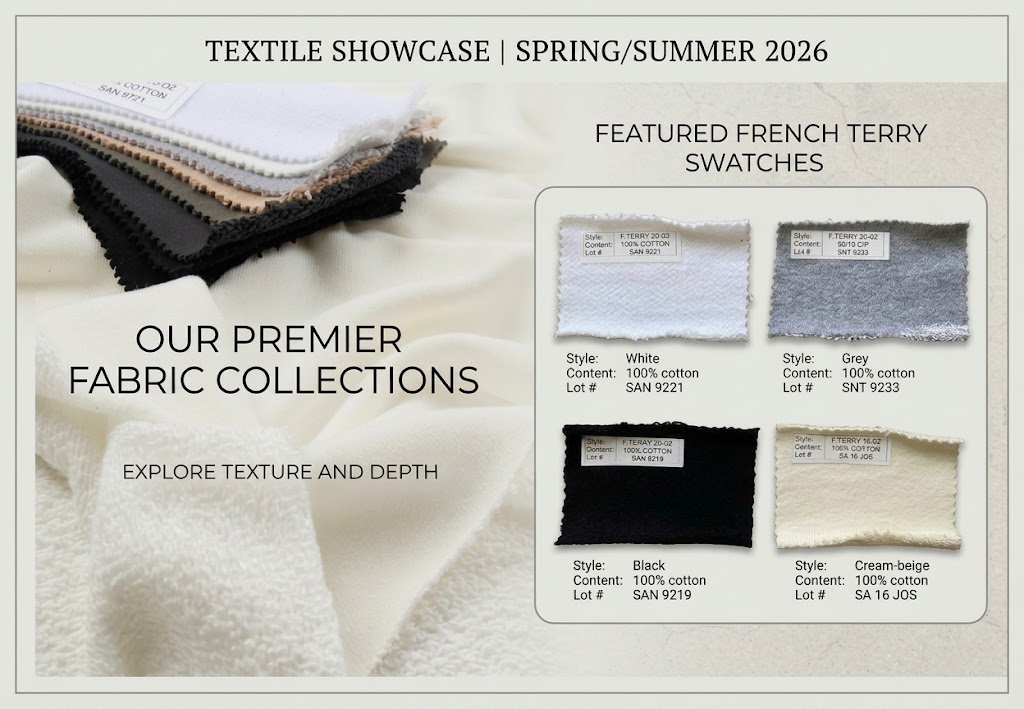
For the T-shirts, the target range was approximately 260–280 GSM.
We evaluated cotton jersey based not only on weight, but also on knitting density, surface appearance, hand feel, structure and dimensional stability.
A 280 GSM fabric is not automatically more premium than a 260 GSM fabric. The right choice depends on how the fabric works with the intended silhouette.
This is also why our Premium Heavyweight T-Shirt Development Guide looks beyond GSM and considers fabric structure, fit, shrinkage and construction together.
For the hoodie and sweatshirt, the target was 420–450 GSM heavyweight fleece.
The fabric needed enough body to support the relaxed silhouette while remaining comfortable for everyday lifestyle wear.
Because the hoodie, sweatshirt and sweatpants belonged to the same collection, we also evaluated whether the fleece could create a consistent appearance and hand feel across the three products.
Brands developing matching tops and bottoms can apply this collection-level approach through our custom sweatset development guide, which covers fabric compatibility, top-to-bottom fit balance, color matching and coordinated sample approval.
3. Fit Development: Heavyweight Fabric Required Its Own Pattern
The client did not want a standard fit simply graded larger.
The intended silhouette was relaxed and structured, so we developed the patterns around the actual fabric behavior.
For the T-shirt, the main control points included:
shoulder width → chest width → body length → sleeve shape
For the hoodie and sweatshirt:
**drop shoulder → chest volume → body length → sleeve volume → rib balance ** For the sweatpants:
rise → hip and thigh volume → leg shape → opening
For another example of silhouette-focused development, explore our women’s barrel-leg side-stripe sweatpants, featuring a curved-leg shape, contrast panel construction and customizable fabric and branding.
This became particularly important with the 420–450 GSM fleece. Heavier fabric holds volume differently from lightweight fleece, so even a relatively small pattern adjustment can noticeably change the finished silhouette.
For a different fabric weight and womenswear direction, explore our sky-blue oversized appliqué sweatshirt. This separate development concept uses a 300 GSM cotton-polyester specification with relaxed proportions and customizable chest lettering.
4. First Sample: The Direction Was Right, but the Fit Wasn't Finished
The first sample round confirmed that the fabric direction and overall concept were workable.
But the samples were not approved immediately.
The client identified several fit issues.
The hoodie body was slightly too long relative to its width, which made the silhouette feel less balanced.
The T-shirt needed a small adjustment between chest width and body length.
The sweatpants also required refinement through the leg so they would fall more naturally with the heavier fleece.
This is a normal part of custom product development.
A first sample is not necessarily expected to be the final product. Its purpose is to turn measurements, reference images and design intentions into a physical garment that can actually be evaluated.
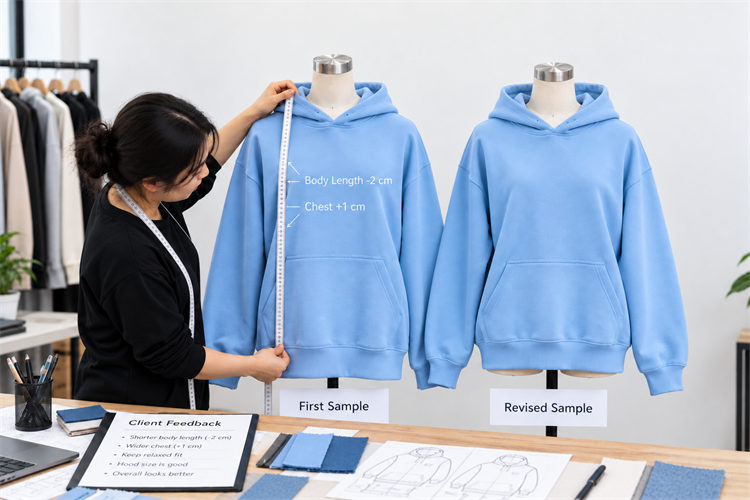
5. Client Feedback → Sample Revision
Instead of making isolated corrections, we reviewed the client's comments across the whole collection.
The second sample round focused mainly on proportion and fit balance, rather than changing the overall design.
The process was:
First Sample → Fit Review → Client Comments → Pattern Adjustment → Second Sample
For example, shortening the hoodie body alone was not enough. The relationship between body length, chest width, sleeve volume and rib position also had to remain visually balanced.
The same principle applied to the sweatpants.
This is where sample development becomes more valuable than simply copying measurements from a specification sheet: the garment can be evaluated as a physical product.
6. Approval: Turning the Final Sample Into a Production Standard
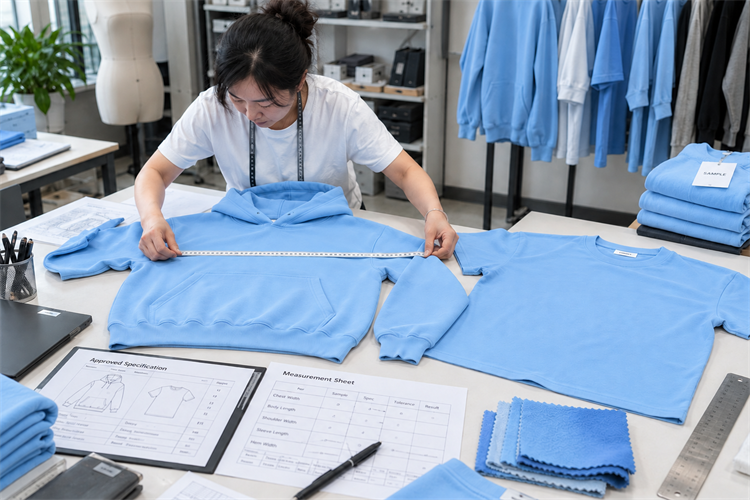
After the revised samples were reviewed and approved, the project moved into production preparation.
The approved garments became physical references for:
- fabric and hand feel;
- finished measurements;
- silhouette and proportions;
- stitching and construction;
- rib specifications;
- labels and trims;
- decoration placement;
- finishing.
This stage is critical because making one good sample and reproducing it across commercial production are different manufacturing challenges.
We explain this in more detail in Why Bulk Production Quality Can Differ From Approved Samples.
The objective was therefore not simply:
“The client approved the sample.”
It was:
“We now have a defined standard that production can follow.”
7. Bulk Production: Protecting What Was Approved
Before bulk cutting, production fabric was checked against the approved direction.
For heavyweight products, the key controls included:
GSM → hand feel → surface appearance → color → shrinkage → dimensional stability
The approved patterns, measurements and construction details were then transferred into bulk production.
This is especially important when a collection contains several related products. A hoodie cannot gradually develop a different hand feel or construction standard from the matching sweatshirt and sweatpants simply because production volume has increased.
For brands scaling beyond development quantities, our article on How Premium Apparel Brands Maintain Quality When Scaling Production explains why approved samples, bulk fabric control and production standardization become increasingly important.
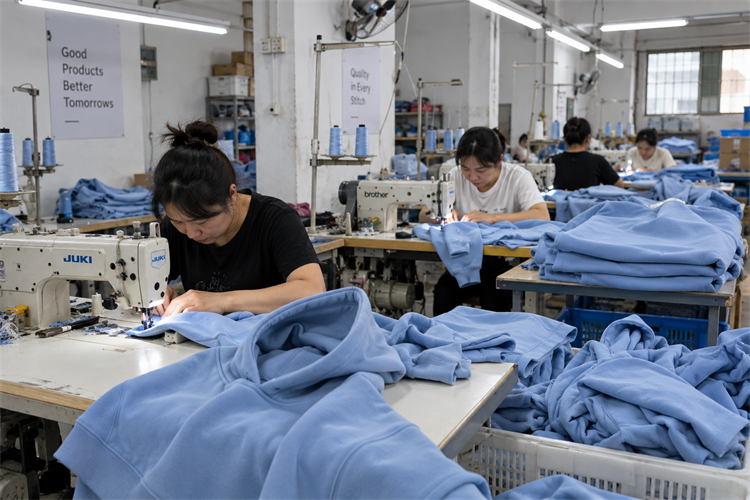
8. Quality Control: Checking the Process, Not Only the Finished Garment
QC did not begin after all garments were finished.
Control points were applied through the production process:
Fabric → Cutting → Sewing → Measurements → Finishing → Final Inspection
Measurements were checked against the approved specifications, while sewing inspections focused on construction consistency, seam quality, alignment and workmanship.
This approach reduces the risk of discovering a repeated problem only after an entire production run has been completed.
Our detailed guide to How Clothing Manufacturers Control Quality in Bulk Production explains these checkpoints in greater detail.
The Result: One Collection, Not Four Separate Products
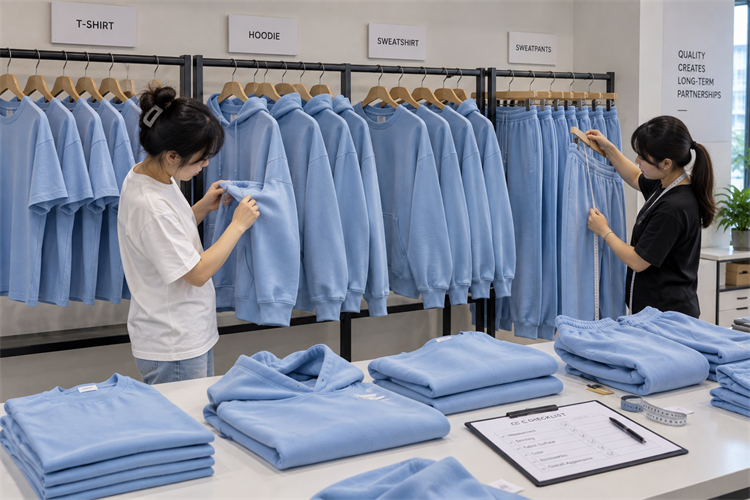
The final result was more than a heavyweight T-shirt, hoodie, sweatshirt and pair of sweatpants produced successfully.
The important result was consistency.
The 260–280 GSM T-shirts had enough structure to sit naturally alongside the heavier fleece products, while the 420–450 GSM hoodie, sweatshirt and sweatpants shared a coherent hand feel, relaxed silhouette and construction direction.
A coordinated collection can also be developed around a more distinctive product direction. Our 420 GSM quarter-zip sweatshirt and wide-leg sweatpants set demonstrates how matching fabric, contrast panels and complementary silhouettes can create one recognizable lifestyle look.
More importantly, the development process created a repeatable product standard.
Instead of starting from zero when developing additional colors or repeat production, the brand now had:
Approved Fabric + Approved Fit + Approved Construction + Production Reference
That is the real value of structured collection development.
What This Project Demonstrates
For premium lifestyle brands, developing a collection should not mean developing several unrelated garments at the same time.
Fabric, fit, construction and finishing need to create a consistent product identity.
The process in this project was:
Client Requirement → Fabric Selection → Fit Development → First Sample → Client Feedback → Sample Revision → Approval → Bulk Production → QC
Two sample rounds were more valuable than rushing the first sample directly into production because the fit and proportions were resolved before scaling.
For brands developing custom sweatshirts as part of a wider collection, our Custom Sweatshirt Manufacturer Guide also covers fabric selection, sampling, MOQ and production preparation.
Developing a Premium Lifestyle Collection?
KELLOGG works with growing and established fashion and lifestyle brands on heavyweight apparel development, including T-shirts, hoodies, sweatshirts, sweatpants and other custom garments.
If you already have a tech pack, reference garment, product specifications or an existing collection that needs further development, send us your project requirements.
Brands preparing a similar collection can use our production-ready apparel tech pack guide to organize fabric, measurements, construction, artwork and approval requirements before sampling begins.
We can evaluate the fabric, fit, construction and sampling requirements before moving toward bulk production.
For another heavyweight development direction, explore our women’s 460 GSM oversized floral embroidered hoodie, featuring a 56% cotton / 44% polyester fabric specification and large floral back embroidery. Colors, artwork and fit can be developed for your brand.
FAQ
Q1. What GSM is suitable for premium heavyweight lifestyle T-shirts?
A: For many premium lifestyle collections, approximately 240–300 GSM is a practical heavyweight range. The right GSM depends on the intended structure, drape, season, fit and hand feel. Fabric density and finishing should be evaluated together with weight.
Q2. What GSM is suitable for premium heavyweight hoodies and sweatshirts?
A: Approximately 400–500 GSM is commonly considered heavyweight for premium hoodies and sweatshirts. However, GSM alone does not determine quality. Fiber composition, knitting structure, brushing, density and finishing also affect the finished garment.
Q3. How many sample rounds are normally required before bulk production?
A: There is no fixed number. Some well-developed products may be approved quickly, while custom fits can require multiple revisions. In this project, two main sample rounds were used to refine the proportions and establish the approved production standard.
Q4. Why shouldn't a brand move directly from the first sample into bulk production?
A: The first sample may reveal issues with fit, proportions, fabric behavior or construction that are difficult and expensive to correct after bulk production begins. Sampling allows these issues to be resolved before quantities increase.
Q5. Can the same heavyweight fabric be used for hoodies, sweatshirts and sweatpants?
A: Often yes, particularly when the products are designed as part of one coordinated collection. However, the fabric still needs to be evaluated against each garment's fit, construction, comfort and performance requirements.
Q6. How do you maintain a consistent fit across different products in one collection?
A: Consistency does not mean using identical measurements. Each garment requires its own pattern, but shared principles such as shoulder proportion, volume, length, fabric behavior and overall silhouette can create a coherent collection.
Q7. What should be approved before heavyweight apparel enters bulk production?
A: Brands should normally confirm the final fabric, color, measurements, fit, construction, labels, trims, decoration, finishing and packaging requirements. The approved sample and technical specifications then become references for bulk manufacturing.
Q8. How does KELLOGG control quality from approved sample to bulk production?
A: Quality control should cover multiple stages rather than relying only on final inspection. Depending on the project, KELLOGG checks areas including bulk fabric, cutting, garment measurements, sewing construction, decoration, finishing and final workmanship against the approved production requirements.
Share this article


