How to Check Fabric GSM Before Clothing Production: A Buyer’s Guide
Written by Aimee Xiang
Founder of Kellogg Fashion
Focused on heavyweight apparel manufacturing, fabric engineering, garment development, quality control, and scalable production.
Introduction
You approved a 400 GSM fabric, but the bulk garments feel noticeably lighter than the sample. Did the manufacturer use the wrong fabric, or was the original GSM requirement not clearly defined?
This is a common sourcing problem. A fabric described as 400 GSM may not measure exactly 400 GSM after dyeing, brushing, compacting or washing. Differences can also occur between the sample fabric and bulk production lots.
For buyers, checking fabric GSM before bulk cutting is essential. This guide explains how GSM is measured, why tolerances matter and how KELLOGG controls fabric weight before clothing production.
What Does Fabric GSM Mean?
GSM means grams per square metre. It measures the weight of a fabric—not the weight of a finished garment.
Higher GSM fabrics are generally heavier and more substantial, but GSM alone does not determine quality. Fibre composition, yarn quality, knitting density, finishing, shrinkage and surface construction also affect how the fabric feels and performs.
Two fabrics with the same GSM can therefore have very different:
- Thickness
- Hand feel
- Structure
- Drape
- Warmth
- Shrinkage
- Pilling resistance
Brands choosing between common heavyweight options can read our comparison of 400 GSM vs 450 GSM vs 500 GSM hoodies.
How to Check Fabric GSM Before Production
Fabric GSM should be tested using representative samples rather than estimated by touch or by weighing one finished garment.
A typical GSM checking process includes:
- Taking representative samples from the bulk fabric roll.
- Allowing the fabric to relax and condition.
- Cutting several samples of a known area with a GSM cutter.
- Weighing each sample using a calibrated scale.
- Calculating the average GSM.
- Comparing the result with the approved specification.
- Recording the result before bulk cutting begins.
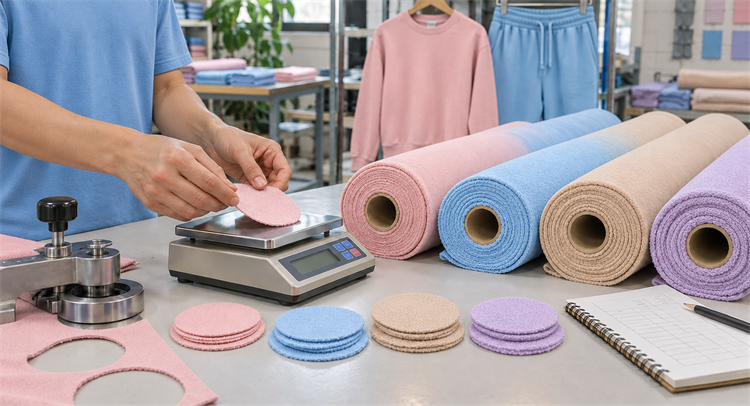
Multiple samples should be tested because fabric weight may vary across the width and length of a roll. Different fabric rolls or dye lots may also produce slightly different results.
Buyers should not use total garment weight as a substitute for fabric GSM. Finished garment weight is also affected by:
- Garment size
- Oversized or regular fit
- Hood construction
- Pockets
- Rib
- Zippers
- Labels
- Embroidery and other trims
Why Fabric GSM May Not Match the Exact Target
Knitted fabric production normally involves an acceptable level of variation. The final GSM may also change during:
- Dyeing
- Brushing
- Compacting
- Pre-shrinking
- Enzyme washing
- Garment dyeing
- Pigment washing
- Drying and conditioning
This means buyers must confirm whether the quoted GSM refers to greige fabric, dyed fabric or finished and conditioned fabric.
For most apparel programs, the most relevant figure is the fabric weight in the condition in which it will be used for production.
If a hoodie will be garment dyed or washed, for example, checking only the untreated fabric may not accurately represent the finished product.
Target GSM vs Minimum Finished GSM
One of the most common disputes between buyers and manufacturers comes from confusing a target GSM with a minimum required GSM.
Consider the following specification:
- 300 GSM ±5%
This allows the actual fabric weight to fall between 285 and 315 GSM.
That may be acceptable if the buyer wants an approximate 300 GSM fabric. However, it does not meet a requirement stating that the finished fabric must be at least 300 GSM.

If an approximate target is acceptable:
Target finished fabric weight: 400 GSM, acceptable tolerance ±5%, measured after finishing and conditioning.
If a minimum weight is required:
Minimum finished and conditioned fabric weight: 300 GSM. Negative tolerance is not accepted.
If a controlled range is required:
Finished fabric weight: 400 GSM, acceptable range 390–410 GSM, measured after the approved finishing process.
Writing the actual acceptable range is often clearer than stating only a percentage.
GSM, tolerance and testing stage should be included alongside composition, construction, colour and finishing requirements. Our apparel tech pack guide for sampling and production explains how brands can turn product expectations into measurable manufacturing instructions.
What Buyers Should Confirm Before Fabric Approval
Before approving fabric for sampling or bulk production, buyers should ask:
- Is the quoted GSM based on greige, dyed or finished fabric?
- Is the stated GSM a target or a guaranteed minimum?
- What positive and negative tolerance is allowed?
- Will the fabric be tested after the intended finishing process?
- Will washing change the final weight or shrinkage?
- Are multiple bulk fabric rolls checked for consistency?
- Is GSM verified before bulk cutting?
- Can the test result be recorded in the production file?
These questions are especially important for heavyweight hoodies, sweatshirts, sweatpants and T-shirts. Even when a GSM difference appears small, it can affect hand feel, drape, shrinkage and the final oversized or boxy silhouette.
Why Sample Fabric and Bulk Fabric Can Feel Different

An approved sample may be made from one available fabric roll, while bulk production may involve newly knitted fabric or several dye lots.
If the approved standard is not clearly recorded, bulk fabric may differ in:
- GSM
- Knitting density
- Surface appearance
- Brushing
- Hand feel
- Colour
- Shrinkage
- Stretch and recovery
For this reason, approving one garment sample is not enough. The fabric specification, finishing standard, measurements and physical sample should work together as the production reference.
See our sample-to-bulk quality consistency case study for a practical example of how approved standards are carried into bulk manufacturing.
How KELLOGG Checks Fabric GSM Before Production
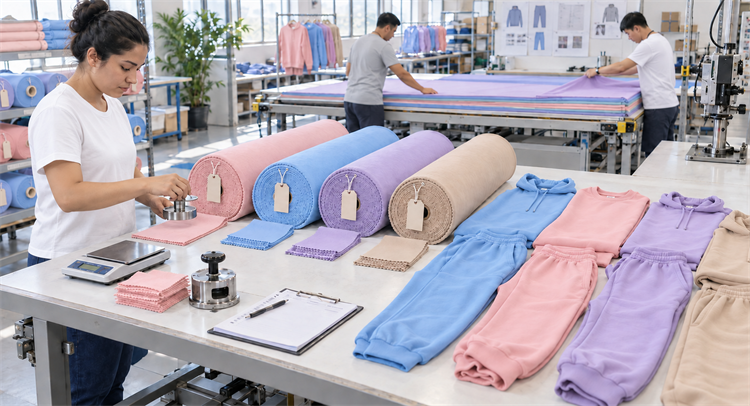
At KELLOGG, GSM control begins during specification review and fabric approval—not after garments have already been produced.
1. We Clarify the GSM Requirement
We first confirm whether the buyer requires:
- A target GSM
- An acceptable GSM range
- A minimum finished GSM
- Pre-wash or post-finish verification
- French Terry, brushed fleece or jersey construction
This prevents a target value from being mistakenly treated as a guaranteed minimum.
2. We Evaluate the Finished Fabric
Where dyeing, washing or finishing affects the product, the fabric is reviewed in the condition closest to bulk production.
Depending on the style, fabric approval may include:
- Finished GSM
- Fibre composition
- Knitting construction
- Hand feel
- Surface density
- Shrinkage
- Stretch and recovery
- Wash performance
This is important because a fabric can meet the target GSM and still fail to provide the required structure, softness or dimensional stability.
3. We Lock the Approved Standard
After fabric approval, KELLOGG uses the confirmed specification together with the approved sample, tech pack and finishing requirements as the production reference.
For heavyweight hoodie programs, this forms part of our custom heavyweight hoodie development process.
4. We Check Bulk Fabric Before Cutting
Representative bulk fabric samples are checked against the approved requirement before full cutting.
If the measured GSM falls outside the agreed range, the issue can be addressed before it affects the complete production run.
This helps reduce the risk of:
- Bulk garments feeling lighter than the sample
- Inconsistent hand feel between production lots
- Unexpected shrinkage
- Changes in fit or silhouette
- Disputes about whether the fabric meets the order specification
GSM Should Be a Measurable Production Standard
A GSM number on its own is not enough to protect a buyer.
Before production, brands should clearly define:
- The target or minimum GSM
- The acceptable tolerance
- The fabric condition at the time of testing
- Whether testing occurs before or after finishing
- How bulk fabric will be checked
- What happens if the result falls outside the approved range
When these points are confirmed before sampling and bulk production, both the buyer and manufacturer have a clear standard to follow.
KELLOGG supports established and growing apparel brands, private-label businesses and wholesalers with heavyweight fabric selection, technical sampling, GSM verification and controlled bulk production.
If you are developing heavyweight hoodies, sweatshirts, T-shirts or sweatpants, send us your tech pack, target GSM, acceptable tolerance, finishing requirements and planned order quantity for evaluation.
Frequently Asked Questions
Q1, Is ±5% GSM tolerance acceptable?
A: It can be acceptable when the buyer wants an approximate target weight. It is not suitable when the lowest permitted result falls below the buyer’s minimum finished GSM requirement.
Q2, Does 300 GSM ±5% guarantee at least 300 GSM?
A: No. A ±5% tolerance permits a range from 285 to 315 GSM. If 300 GSM is the minimum acceptable weight, the specification should clearly state that negative tolerance is not accepted.
Q3, Should GSM be checked before or after washing?
A: It depends on the product specification. If garment dyeing, washing or another finishing process is part of production, the buyer should define whether approval is based on pre-wash or post-finish GSM. The finished and conditioned result is often the more relevant production standard.
Q4, Can two fabrics with the same GSM feel different?
A: Yes. Fibre composition, yarn quality, knitting density, brushing, compacting and finishing can make fabrics with the same GSM feel and perform very differently.
Q5, Does higher GSM mean better quality?
A: No. GSM measures fabric weight rather than overall quality. Fabric construction, yarn quality, shrinkage control, finishing and production consistency are equally important.
Share this article