400 GSM vs 450 GSM vs 500 GSM Hoodies: Which Weight Is Best for Premium Brands?
Written by Aimee Xiang
Founder of Kellogg Fashion
Focused on heavyweight apparel manufacturing, fabric engineering, garment development, quality control, and scalable production.
Introduction
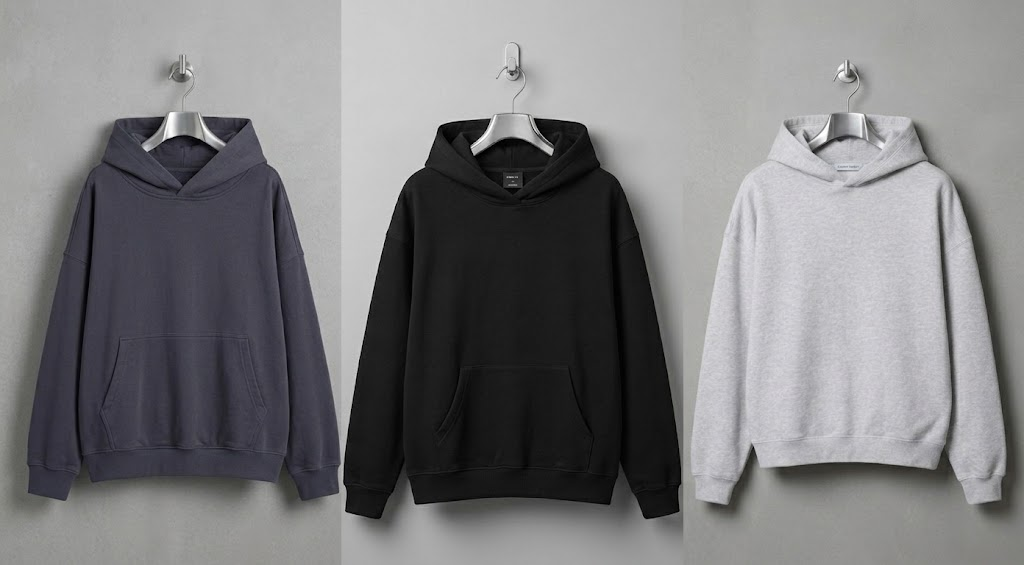
For premium apparel brands developing heavyweight hoodies, fabric weight is often one of the first specifications discussed with a manufacturer.
400 GSM, 450 GSM and 500 GSM are all considered heavyweight options — but a higher GSM does not automatically mean a better hoodie.
The right choice depends on much more than weight alone.
Fabric composition, knit construction, surface density, finishing, shrinkage control, recovery and garment fit all affect how a hoodie actually looks, feels and performs.
So, what is the difference between a 400 GSM, 450 GSM and 500 GSM hoodie — and which weight makes the most sense for your product?
What Does GSM Mean in Hoodie Fabric?
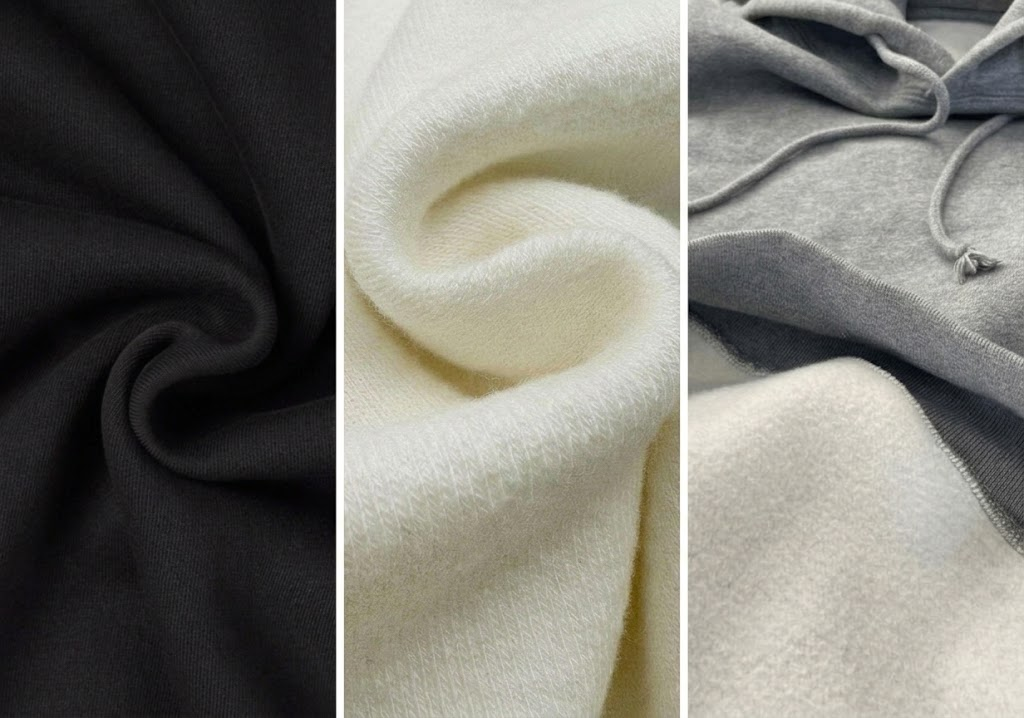
GSM stands for grams per square meter and measures the weight of a fabric.
In simple terms, a 450 GSM fabric weighs 450 grams per square meter.
For sweatshirts and hoodies, higher GSM fabrics generally create a heavier and more substantial garment. However, GSM should not be used as a standalone measurement of quality.
Two fabrics with exactly the same GSM can feel completely different depending on:
- Cotton quality
- Cotton/polyester ratio
- Yarn count
- Knitting construction
- Fabric density
- Brushing
- Compacting
- Pre-shrinking
- Washing and finishing
A dense 400 GSM fabric can sometimes feel more premium and structured than a poorly constructed 500 GSM fabric.
This is why experienced apparel brands evaluate fabric construction and performance alongside GSM, rather than simply selecting the highest number available.
400 GSM Hoodie: Premium Without Excessive Weight
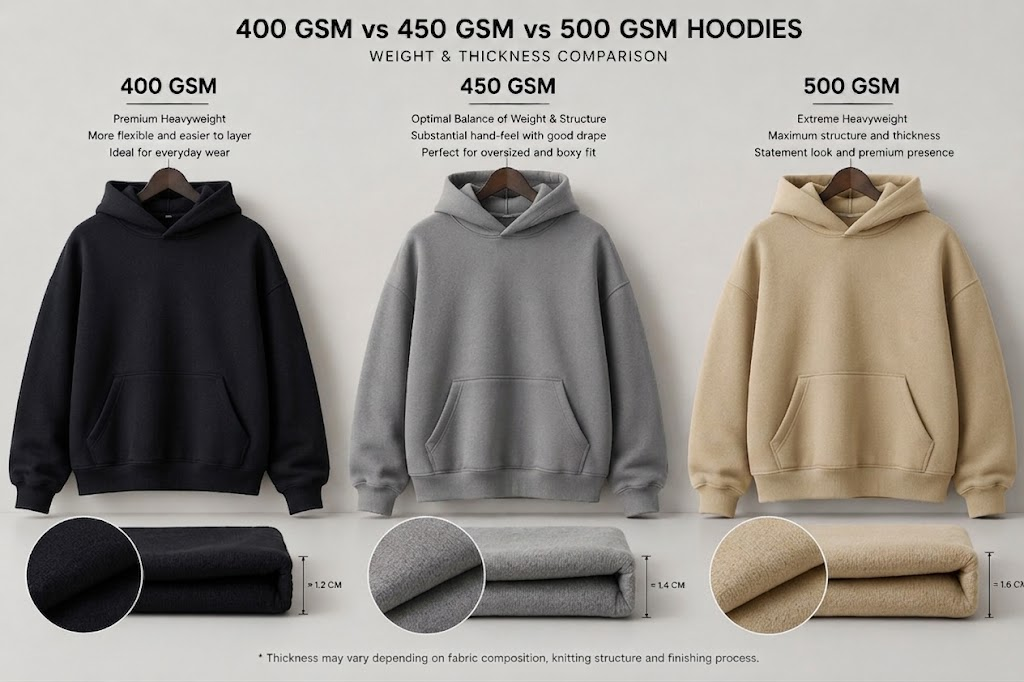
A 400 GSM hoodie sits at the lighter end of the heavyweight category.
It provides noticeably more substance than a standard midweight sweatshirt while remaining relatively versatile and comfortable for everyday wear.
Advantages of 400 GSM
A well-developed 400 GSM fabric can provide:
- A substantial premium hand-feel
- Good structure without excessive stiffness
- Comfortable everyday wear
- Easier layering
- Good drape for relaxed and oversized silhouettes
- Lower garment weight than extreme heavyweight constructions
For brands selling across multiple seasons or markets, 400 GSM can offer a practical balance between perceived quality and wearability.
It works particularly well for premium hoodies, sweatshirts, sweatpants and coordinated comfortwear collections. For bottoms, however, fabric weight must also work with waistband support, knee recovery, pocket construction and leg shape. Our premium heavyweight sweatpants guide explains how GSM, fabric construction and fit should be evaluated together before sampling.
When Should a Brand Choose 400 GSM?
Consider 400 GSM when your priority is:
premium weight + comfort + versatility.
It can be particularly effective for relaxed-fit hoodies and premium lifestyle collections where the garment should feel substantial without becoming overly rigid.
450 GSM Hoodie: The Heavyweight Sweet Spot
For many premium heavyweight hoodie developments, around 450 GSM offers an excellent balance between structure, weight and wearability.
At this level, the garment begins to feel noticeably substantial when picked up.
A properly constructed 450 GSM fabric can also help create the clean, structured silhouette frequently associated with premium contemporary apparel.
Advantages of 450 GSM
Depending on construction and composition, 450 GSM can provide:
- Strong premium hand-feel
- Dense fabric appearance
- Better structural definition
- Excellent suitability for oversized and boxy fits
- Substantial hood construction
- Good embroidery stability
- Better shape retention when properly engineered
- A premium, substantial feel without automatically becoming excessively heavy
This makes the 430–470 GSM range particularly interesting for brands developing heavyweight hoodies, sweatshirts and sweatpants. Premium heavyweight hoodie manufacturer. For brands applying these weight ranges specifically to crewnecks, our premium heavyweight crewneck sweatshirt guide explains how GSM interacts with neckline construction, rib performance, fit and finished garment stability.
However, fabric weight alone does not guarantee these characteristics.
The composition and construction still matter.
For example, an 85% cotton / 15% polyester brushed fleece can behave differently from a 100% cotton French Terry fabric at approximately the same GSM.
500 GSM Hoodie: Maximum Weight and Structure
At 500 GSM, a hoodie enters a more extreme heavyweight category.
The difference becomes immediately noticeable when the garment is handled.
This can work extremely well when heavyweight construction itself is part of the product identity.
Advantages of 500 GSM
A properly developed 500 GSM hoodie can provide:
- Very substantial hand-feel
- Strong visual structure
- Dense, premium appearance
- Excellent presence for oversized silhouettes
- Strong perceived product value
- A distinctive heavyweight identity
But heavier is not always better.
A 500 GSM fabric can also create additional development challenges.
Depending on the fabric and garment construction, excessive weight may affect:
- Drape
- Comfort
- Layering
- Hood balance
- Seam bulk
- Rib performance
- Sewing efficiency
- Warm-weather wearability
For this reason, 500 GSM should normally be selected because it supports the intended product concept — not simply because the brand wants the highest possible GSM.
There is no universally "best" GSM.
The correct choice depends on the product the brand is trying to create.Fabric weight is only one part of selecting the right production partner. Brands should also evaluate sampling, construction, finishing and quality control when choosing a clothing manufacturer
GSM Is Only Half the Story: Fabric Composition Matters
Once the target GSM has been established, composition becomes equally important.
Common heavyweight sweatshirt constructions include:
- 100% cotton
- 85% cotton / 15% polyester
- 80% cotton / 20% polyester
- Other cotton-rich blends
100% Cotton
100% cotton can provide a natural, premium cotton hand-feel and is attractive to brands prioritizing cotton-rich product positioning.
However, fabric construction and finishing must be carefully controlled because cotton can be more sensitive to shrinkage and dimensional changes.
Cotton/Polyester Blends
A carefully developed cotton/polyester construction can help improve:
- Dimensional stability
- Recovery
- Shape retention
- Durability
- Shrinkage performance
while still maintaining a cotton-dominant outer hand-feel.
This can be particularly useful for heavyweight hoodies and sweatpants where brands want structure without excessive deformation during wear.
The best composition therefore depends on the desired balance between hand-feel, structure, recovery and durability.
French Terry vs Brushed Fleece
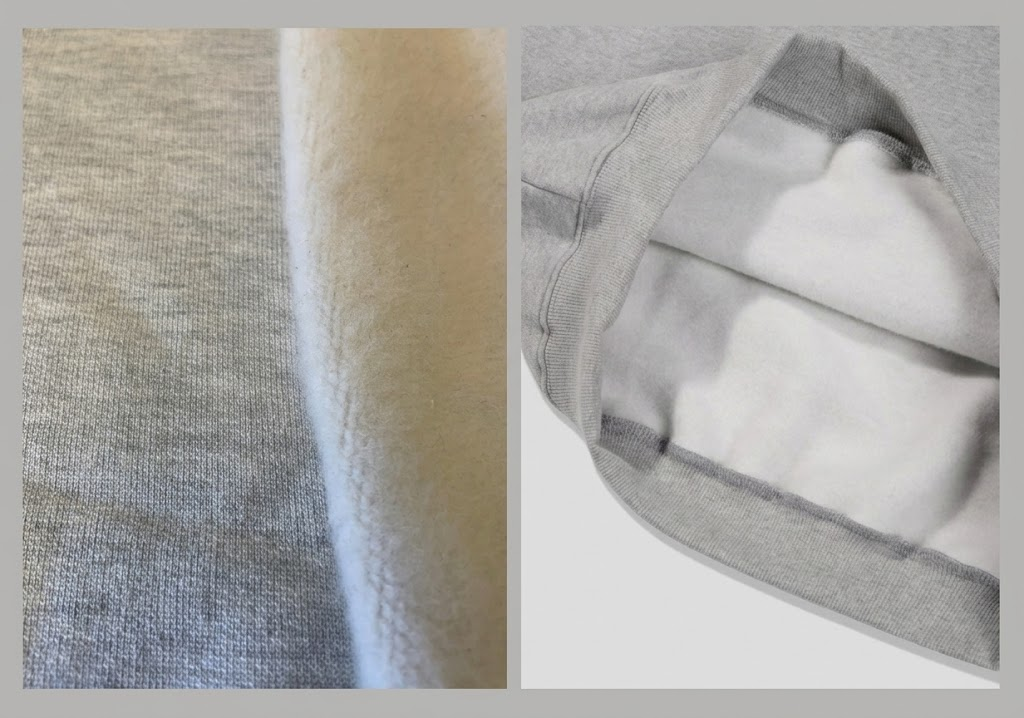
GSM also needs to be considered alongside the internal fabric construction.
Two common options are French Terry and brushed fleece. Choosing between French Terry and brushed fleece depends on the intended hand-feel, warmth and silhouette.
French Terry
French Terry typically has loops on the inside rather than a brushed surface.
It can provide:
- Cleaner internal construction
- Good breathability
- Structured drape
- Less fluffy hand-feel
- Strong suitability for premium transitional apparel
Brushed Fleece
Brushed fleece has a soft brushed interior.
It can provide:
- Softer skin contact
- Greater warmth
- Fuller hand-feel
- More comfort-oriented positioning
- A luxurious interior when properly brushed
A premium heavyweight hoodie therefore should not be specified simply as:
"450 GSM hoodie."
A more useful development specification might be:
"450 GSM cotton-rich brushed fleece with a smooth, dense outer face, controlled shrinkage and strong recovery."
That gives the manufacturer significantly more information about the actual product objective. Custom hoodie manufacturing
Why Fabric Density Matters
One of the most overlooked factors in heavyweight hoodie development is fabric density.
Brands sometimes increase GSM expecting the garment to automatically become more premium.
But a heavy fabric with a loose or overly fluffy construction may not create the desired result.
For a clean premium heavyweight appearance, many brands instead look for:
- Smooth outer surface
- Dense knit construction
- Compact face
- Low surface fuzziness
- Controlled stretch
- Good recovery
- Consistent thickness
This is particularly important for embroidery and structured silhouettes.
A compact 450 GSM fabric may therefore perform better for a particular design than a bulkier 500 GSM alternative.
Shrinkage and Recovery Matter More as Fabric Gets Heavier
Heavyweight fabrics should also be evaluated for dimensional stability.
Before approving bulk production, brands should consider testing:
- Length shrinkage
- Width shrinkage
- Twisting
- Colorfastness
- Pilling
- Surface appearance
- Stretch recovery
- Shape retention after washing
For sweatpants, recovery becomes particularly important around the knees and seat.
For hoodies and sweatshirts, attention should be given to the elbows, cuffs, waistband and overall garment length. Fabric performance also needs to be considered alongside MOQ, fit development and sample approval when selecting a heavyweight sweatshirt manufacturer for commercial production.
Pre-shrinking, compacting and appropriate fabric finishing can help improve stability, but actual performance should be confirmed through testing.Apparel quality control
Which GSM Is Best for an Oversized Hoodie?
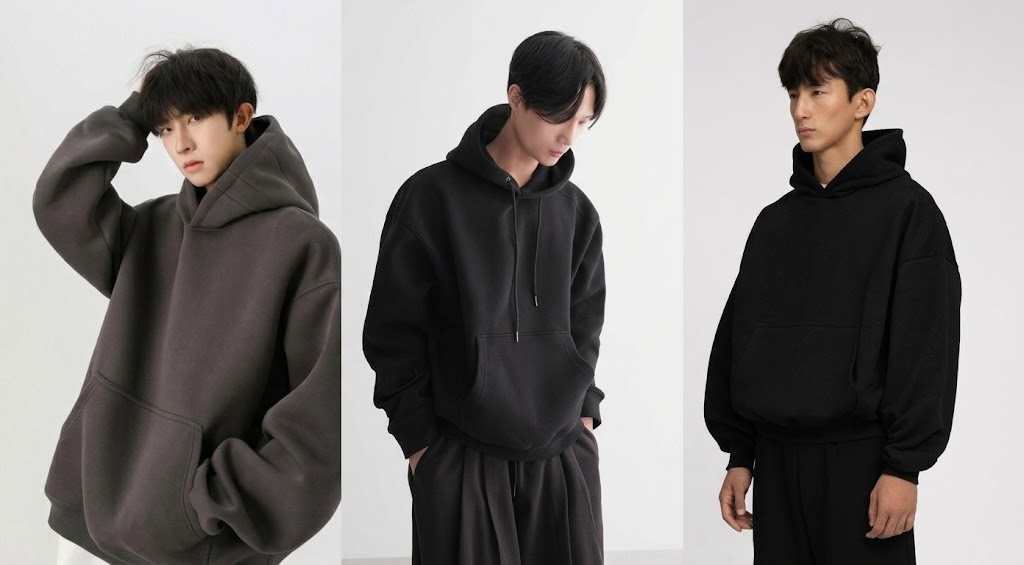
For oversized and boxy silhouettes, fabric weight plays an important role in how the garment holds its shape.
A fabric that is too light may collapse instead of maintaining the intended silhouette.
But an excessively heavy fabric can make the garment feel rigid.
For many premium oversized hoodie developments, the 400–500 GSM range provides several viable options, depending on the intended result.
A brand looking for a relaxed premium hoodie may prefer approximately 400 GSM.
A more structured, boxy silhouette may benefit from approximately 450 GSM.
A design intentionally built around extreme weight and structure may justify 500 GSM.
Pattern construction must still be developed together with the fabric.
Simply replacing a 350 GSM fabric with 500 GSM while keeping the same pattern does not guarantee a better fit.
Selecting the appropriate GSM is only the first step. Fabric structure, hood balance, rib recovery, fit and finishing must also be developed together. See our complete guide to custom heavyweight hoodie development.
Which GSM Is Best for Premium Brands?
For most premium brands, there is no single answer.
A useful starting framework is:
Choose 400 GSM when:
You want heavyweight quality with greater versatility and everyday wearability.
Choose around 450 GSM when:
You want a strong balance of premium hand-feel, structure, durability and oversized silhouette.
Choose around 500 GSM when:
Extreme weight and strong structural presence are intentional parts of the product concept.
The most important principle is simple:
Choose the fabric according to the product — not the product according to the GSM.
A premium hoodie should be developed as a complete system involving fabric weight, composition, construction, finishing, pattern, rib, hood structure and intended use.
What Should Brands Check Before Approving Heavyweight Hoodie Fabric?

Before moving into garment sampling, request or confirm:
- Actual finished GSM
- Fabric composition
- Knit construction
- Outer-face appearance
- Interior finish
- Shrinkage performance
- Pilling performance
- Stretch and recovery
- Available colors
- Fabric hand-feel and density
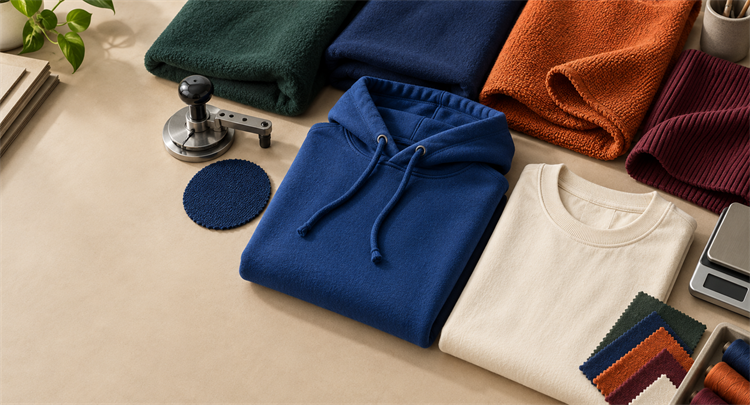
Whenever possible, evaluate physical swatches before approving a full garment sample. Buyers should also verify whether the bulk fabric remains within the approved weight range. Our guide to checking fabric GSM before clothing production explains how GSM is measured, how tolerances work and what should be confirmed before bulk cutting.
Photos can show color and general appearance, but they cannot accurately communicate weight, density, softness or recovery.Apparel sample development
Final Takeaway
400 GSM, 450 GSM and 500 GSM can all be appropriate for premium heavyweight hoodies.
The difference is not simply "good, better, best."
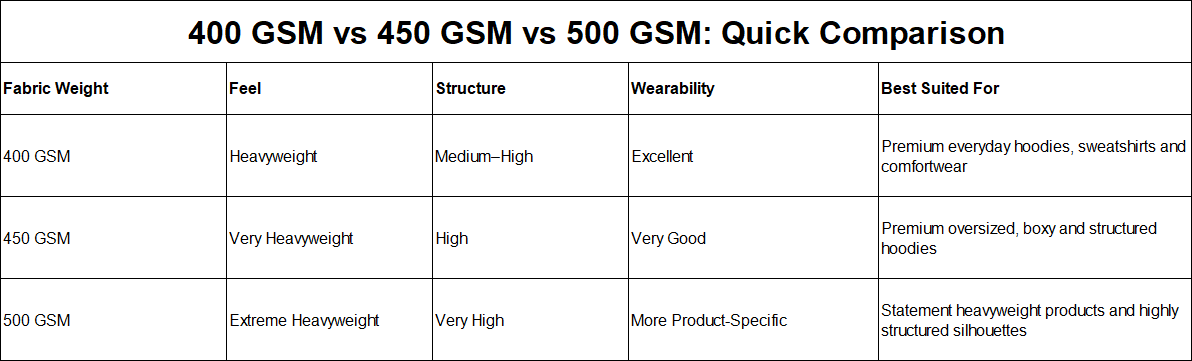
400 GSM provides premium substance with greater versatility.
450 GSM can provide an excellent balance between weight, structure and wearability.
500 GSM creates maximum heavyweight impact but should be selected intentionally.
For established apparel brands, the better question is therefore not:
"What is the heaviest fabric available?"
It is:
"Which fabric construction will create the hand-feel, silhouette, recovery and performance this product requires?"
That is the question that should guide fabric development before sampling and bulk production.
Developing a Heavyweight Hoodie?
If you are developing a premium heavyweight hoodie, sweatshirt or sweatpant, start with the product objective rather than GSM alone.
Send us your target GSM, composition, fit, reference garment or tech pack. Our product development team can evaluate the construction and recommend an appropriate heavyweight fabric before sampling.
Frequently Asked Questions
Q1. What GSM is best for a premium heavyweight hoodie?
A: There is no single best GSM for every premium hoodie. 400–500 GSM is a common heavyweight range, with the right choice depending on fabric construction, composition, fit and intended use. Around 450 GSM often provides a strong balance of substantial hand-feel, structure and wearability for premium heavyweight hoodies.
Q2. Is 400 GSM good for a premium hoodie?
A: Yes. 400 GSM is considered heavyweight and can be an excellent choice for premium hoodies. It provides substantial weight and structure while remaining more versatile and easier to layer than extremely heavy fabrics. Fabric density, yarn quality and finishing are just as important as the GSM itself.
Q3. Is 450 GSM too heavy for a hoodie?
A: Not necessarily. 450 GSM is well suited to premium oversized, boxy and structured hoodies when the fabric and pattern are properly developed. It creates a noticeably substantial hand-feel without automatically becoming excessively heavy. Climate, target customer and intended silhouette should still be considered.
Q4. Is a 500 GSM hoodie better quality than a 400 GSM hoodie?
A: No. Higher GSM does not automatically mean higher quality. A dense, well-finished 400 GSM fabric can outperform a poorly constructed 500 GSM fabric. Premium hoodie quality also depends on cotton quality, knit density, composition, shrinkage control, recovery, stitching and garment construction.
Q5. What is the difference between 400 GSM, 450 GSM and 500 GSM hoodies?
A: A 400 GSM hoodie generally offers heavyweight quality with greater everyday versatility. 450 GSM provides more structure and a stronger heavyweight feel, making it popular for premium oversized garments. 500 GSM delivers maximum weight and structural presence but is more product-specific and may be less suitable for layering or warmer climates.
Q6. What fabric composition is best for a heavyweight hoodie?
A: Both 100% cotton and cotton/polyester blends can work well for heavyweight hoodies. 100% cotton provides a natural cotton-rich hand-feel, while blends such as 85% cotton / 15% polyester or 80% cotton / 20% polyester can improve recovery, dimensional stability and durability. The ideal composition depends on the desired hand-feel, structure and performance.
Q7. Is French Terry or brushed fleece better for a heavyweight hoodie?
A: Neither is universally better. French Terry offers a looped interior, cleaner construction and greater breathability, while brushed fleece provides a softer, warmer interior. Premium brands should choose according to the intended season, hand-feel, silhouette and customer experience rather than GSM alone.
Q8. What GSM is best for an oversized or boxy hoodie?
A: For premium oversized and boxy hoodies, approximately 400–500 GSM can work well. Around 400 GSM provides a softer, more relaxed drape, while approximately 450 GSM can create greater structure. 500 GSM is better suited to designs where extreme weight and a strong structured silhouette are intentional.
Q9. Does heavyweight hoodie fabric shrink after washing?
A: It can. Heavyweight cotton-rich fabrics may experience shrinkage or dimensional changes if the fabric is not properly stabilized. Pre-shrinking, compacting and controlled finishing can reduce shrinkage, but brands should confirm actual shrinkage percentages through fabric and garment testing before bulk production.
Q10. What should a brand check before approving 400–500 GSM hoodie fabric?
A: Before approving heavyweight hoodie fabric, brands should evaluate finished GSM, composition, knit construction, surface density, hand-feel, shrinkage, pilling, colorfastness, stretch recovery and dimensional stability. Physical fabric swatches and wash testing are recommended before moving into bulk production.
Share this article